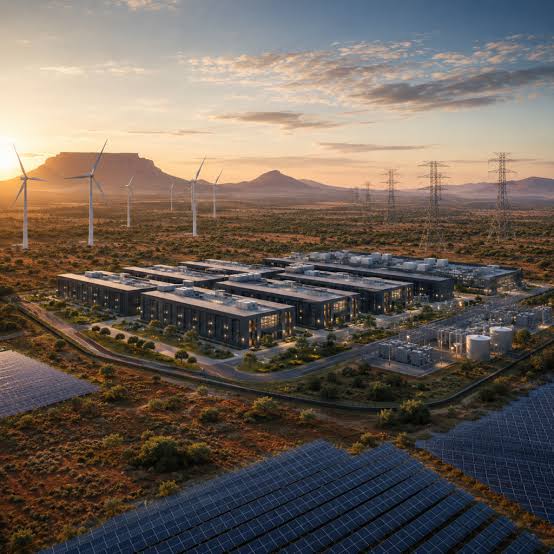
CAPE TOWN
South Africa has spent the past two years converting a long-standing advantage — dense subsea fiber connectivity and a mature financial sector — into a leadership position in Africa's emerging artificial intelligence and cloud infrastructure economy. In 2026, that shift has become concrete: hyperscale cloud providers are pouring hundreds of millions of dollars into Johannesburg and Cape Town data center capacity, Nvidia's first AI-ready facility on the continent has gone live outside Johannesburg, and the country's fintech sector continues to absorb the largest share of African tech investment. Together, these developments are repositioning South Africa from a regional financial hub into the physical and logical backbone of African artificial intelligence.

Hyperscalers Race to Build AI Capacity
The clearest signal of South Africa's new role is the scale of hyperscale cloud investment landing in the country in 2026. Microsoft has committed roughly $329 million to expand data center and AI infrastructure capacity domestically, on top of an earlier announced $300 million plan to expand cloud and AI infrastructure by 2027 — investment the company has paired with commitments to train South Africans in AI skills. Google has formally launched its Johannesburg cloud region, backed by close to $148 million in investment, giving South African businesses and developers local access to Google Cloud's AI and data services without routing latency-sensitive workloads through Europe. Amazon Web Services' commitment is larger still: a $1.7 billion investment in its Cape Town region, the company's most significant African infrastructure commitment to date.
Local data center operators are scaling in parallel. Teraco, owned by Digital Realty, has outlined plans to bring four new data centers online in South Africa between 2025 and 2026, representing a cumulative investment of approximately $877 million. And in a milestone for the continent's AI compute capacity, the first phase of Nvidia's South Africa AI-ready data center went live in June 2026, hosting roughly 3,000 Nvidia GPUs — the kind of dedicated AI compute cluster that, until recently, African developers and enterprises had to access exclusively through cloud regions based in Europe or the Middle East. Industry estimates put South Africa's overall data center market at $2.55 billion in 2025, projected to nearly double to $5.28 billion by 2031 at a compound annual growth rate of roughly 12.9%, with the country's installed data center power capacity expected to reach approximately 94 megawatts by 2031 — comfortably the largest in the region.
The Subsea Cable Foundation Making It Possible
None of this hyperscale build-out would be viable without the undersea cable capacity that has landed on South Africa's coastline over the past three years. The Meta-backed 2Africa cable, now connecting 33 countries across Africa, Europe and Asia and reaching more than 3 billion people, completed activation of its core infrastructure in November 2025; its gulf extension, 2Africa Pearls, is scheduled to go live later in 2026. In South Africa, Open Access Data Centres (OADC) operates the local landing infrastructure for 2Africa, with physical landing stations in the Western Cape (Yzerfontein and Duynefontein), the Eastern Cape (Gqeberha) and KwaZulu-Natal (Durban) — giving the country redundant entry points on three separate coastlines.
Running alongside 2Africa is Equiano, the Google-backed cable connecting Sesimbra, Portugal to Cape Town, with branching units extending to Lagos, Lomé, Swakopmund and Saint Helena. Equiano has been in commercial service since March 2023 and uses space-division multiplexing technology across twelve fiber pairs, delivering a design capacity of roughly 144 terabits per second — about twenty times the capacity of the cable systems it supersedes in the region. The combined effect of Equiano and 2Africa has been a structural repricing of African connectivity: wholesale international bandwidth prices in key landing markets including Cape Town, Lagos and Mombasa have fallen by an estimated 30% to 60% over the past decade, while round-trip latency to Europe and the Middle East has dropped by 20 to 40 milliseconds — a difference significant enough to matter for real-time fintech transactions, cloud application performance, and the kind of low-latency inference that AI-driven services increasingly require.
Fintech Remains the Largest Draw for Tech Capital
While AI infrastructure dominates headlines, fintech remains the most heavily capitalized segment of South African technology. According to the FinTech Association of South Africa's 2026 ecosystem summary, fintech attracted 37.2% of total South African tech funding in 2025 — by far the largest share of any vertical, reflecting both the maturity of the country's banking-adjacent startup base and continued investor confidence in payments infrastructure.
Tyme Group, parent of digital bank TymeBank, illustrates the scale these companies have reached: the group closed a $250 million Series D round led by Brazilian fintech giant Nubank in December 2024, lifting its valuation to roughly $1.5 billion, and has since expanded internationally, launching a merchant lending platform in Indonesia in mid-2025 alongside plans for a retail banking license there. Payments company Yoco, focused on small and medium merchants, reported more than 202,000 active customers in early 2026 and over $2 billion in annual transaction volume processed, while strengthening its merchant software stack through the acquisition of restaurant-focused operating platform Dyner.ai. Cape Town-based Stitch, an open banking and account-to-account payments infrastructure provider, raised $55 million in a Series B round in 2025 and used the proceeds in part to acquire payments processor Efficacy Payments and card-issuance specialist ExiPay, broadening its ability to offer end-to-end payment infrastructure rather than a single point solution.

Why Infrastructure and Fintech Are Converging
The simultaneous build-out of AI compute capacity, subsea bandwidth, and fintech infrastructure is not coincidental — each reinforces the others. Lower-latency, higher-capacity connectivity from Equiano and 2Africa makes it commercially viable for global cloud providers to locate AI and data infrastructure inside South Africa rather than serving the region remotely from Europe. That local infrastructure, in turn, lowers the cost and latency of running the real-time fraud detection, credit-scoring, and transaction-processing systems that companies like Yoco, TymeBank and Stitch depend on, strengthening the business case for continued fintech investment. And the resulting financial data flows — transaction volumes, merchant analytics, credit histories — are precisely the kind of dataset that makes locally hosted AI infrastructure commercially attractive to deploy against in the first place.
This convergence gives South Africa a structural advantage that is difficult for other African tech hubs to replicate quickly. Nigeria and Kenya have built deeper startup ecosystems by sheer volume of ventures and, in Nigeria's case, a larger domestic market; Egypt has positioned itself as a subsea cable transit hub of its own. But South Africa's combination of multiple redundant international cable landings, the continent's largest and most liquid capital markets, and now multi-billion-dollar hyperscale and AI compute investment from Microsoft, Google, Amazon and Nvidia gives it a distinct role: less the continent's most prolific startup factory, and more its physical and financial infrastructure backbone — the place where African data increasingly lives, is processed, and is monetized.
What to Watch Through the Rest of 2026
Several developments will determine how durable this position proves. The completion of 2Africa Pearls later in 2026 will add further redundancy and capacity exactly as AI workloads scale up demand for bandwidth. Continued build-out at Teraco's new facilities and the maturation of Nvidia's GPU cluster beyond its initial 3,000-unit phase will signal whether South Africa can scale AI compute capacity fast enough to meet regional demand rather than losing workloads back to cloud regions in Europe or the Gulf. And on the fintech side, whether Tyme Group's international expansion into Indonesia dilutes its South African focus, or whether new entrants emerge to challenge Yoco and Stitch in account-to-account payments, will shape whether the 37.2% funding share the sector commands in 2025 proves to be a peak or a floor. For now, the trajectory across all three domains — compute, connectivity and capital — points firmly in the same direction: South Africa consolidating its position as the continent's most important digital infrastructure hub.
Published By | Tech Wiz