Written By | Torch Media Africa
Six Billion Miles From Home, NASA's Ghost Ship Just Woke Up
LAUREL, MARYLAND
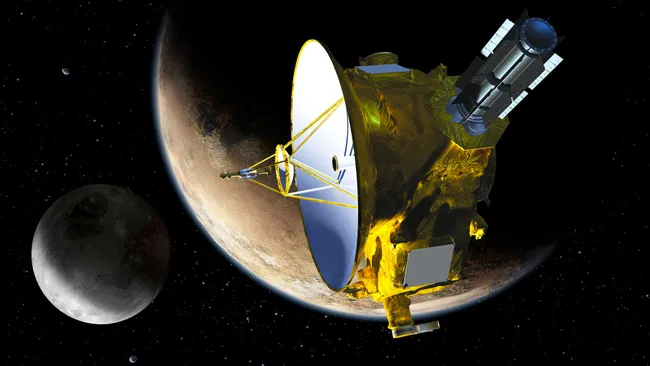
For 321 days, nobody on Earth heard a word from it. No status pings, no science data, nothing but a faint automated whisper every seven days confirming the machine was still alive. Then, in late June, flight controllers at the Johns Hopkins Applied Physics Laboratory got the signal they'd been waiting almost a year for: New Horizons, the piano-sized spacecraft that gave humanity its first close-up look at Pluto, had woken itself up right on schedule, nearly 5.9 billion miles from home, and was in "good health."
The signal took nearly nine hours to arrive — eight hours and 52 minutes, to be exact — traveling at the speed of light from a NASA Deep Space Network dish in Madrid to mission control in Maryland. That lag alone tells you how far this thing has traveled: New Horizons is now roughly 64 astronomical units from the sun — 64 times farther from our star than Earth is. It left Cape Canaveral on January 19, 2006, back when Pluto was still officially a planet and the iPhone was a year from being announced.
The Longest Nap in the Mission's History
At 321 days, this was the longest sleep New Horizons has ever taken, edging out previous rest periods NASA has used throughout the mission to conserve fuel, reduce wear on systems, and cut down on ground-team labor. The spacecraft slipped into hibernation on August 7, 2025, after a stretch of active data collection, and stayed down through fall, winter, and spring, waking only for brief automated self-checks.
The probe is now about 9.5 billion kilometers from Earth. Even during the long silence, New Horizons wasn't entirely dormant. Three onboard instruments kept working around the clock, quietly logging the charged-particle environment of the sun's outer heliosphere and the dust density of the Kuiper Belt. "Even when our spacecraft sleeps, round-the-clock science data collection never stops," said Alan Stern, the mission's principal investigator.
From Pluto's Heart to the Edge of Nowhere
On July 14, 2015, New Horizons swept past Pluto at roughly five billion kilometers from Earth, becoming the first spacecraft ever to visit the dwarf planet up close. What it found stunned planetary scientists: not a dead, frozen rock, but a world with towering water-ice mountains, sweeping nitrogen glaciers, wind-blown dunes, and hints of an underground ocean.
After Pluto, mission planners steered it toward an even more distant target: Arrokoth, a strange, reddish, snowman-shaped object in the Kuiper Belt that New Horizons flew past on New Year's Day 2019. It remains the most distant object ever explored up close.
Now NASA has approved extending the mission again, this time with an even bigger goal: riding New Horizons all the way out of the Kuiper Belt itself, an exit expected around 2028 or 2029. After that, the spacecraft will push toward the heliopause — the invisible boundary where the sun's solar wind finally loses its fight against interstellar pressure. Researchers estimate that boundary sits around 130 astronomical units out, which New Horizons could reach sometime in the 2040s.
What Happens Next
In roughly three weeks, the spacecraft's Alice ultraviolet spectrograph will point itself at surrounding space to study hydrogen distribution in the sun's outer heliosphere — essentially mapping the invisible edge of our solar bubble from the inside. Meanwhile, its other instruments will continue gathering readings that no other spacecraft in history has been positioned to collect.
Ground teams are also running a full battery of system checkouts on a 20-year-old machine that hasn't seen a mechanic since it left Florida. Everything so far points to a spacecraft in remarkably good shape, cruising along at over 30,000 miles per hour with no plans to slow down.
Why Scientists Are Watching So Closely
There is no other spacecraft anywhere near New Horizons' current position, and there won't be another one out there for the foreseeable future. That makes every measurement it takes irreplaceable. Voyager 1 and 2 are farther out and have crossed into interstellar space, but they carry 1970s-era instruments that can't match New Horizons' newer sensors. New Horizons is humanity's freshest set of eyes at the true outer edge of where the sun still holds sway.
That's precisely why the mission keeps getting extended. Every additional year is a year of data from a region that took humanity 50 years to reach with a working spacecraft, and that we may not return to again for decades.
What This Means for You
You're probably not adjusting your retirement plan around a spacecraft near Pluto, and that's fair. But the New Horizons wake-up is a reminder of how much space exploration runs on patience measured in decades, not news cycles. The team that built this probe in the early 2000s knew that some of its most valuable science wouldn't arrive until the 2020s, 2030s, or even 2040s.
It's also one of the best-value missions NASA has ever flown. New Horizons cost roughly $780 million across its development and initial mission — a fraction of many single-purpose satellites — and two decades later it's still returning first-of-their-kind data from a region nobody else can reach.
The Bottom Line
Nearly six billion miles out, moving faster than a bullet through the emptiest, coldest neighborhood in our solar system, a NASA spacecraft built when the Xbox 360 was cutting-edge just proved it still has plenty of life left. For the next several years, as it pushes toward the boundary between our sun's domain and interstellar space, New Horizons will keep sending back a signal, letting a small team in Maryland know that humanity's farthest-flung working explorer is still watching, still listening, and still very much awake.
Sources: NASA, Johns Hopkins Applied Physics Laboratory, Space.com, SciTechDaily, Universe Today



