Written By | Torch Media Africa
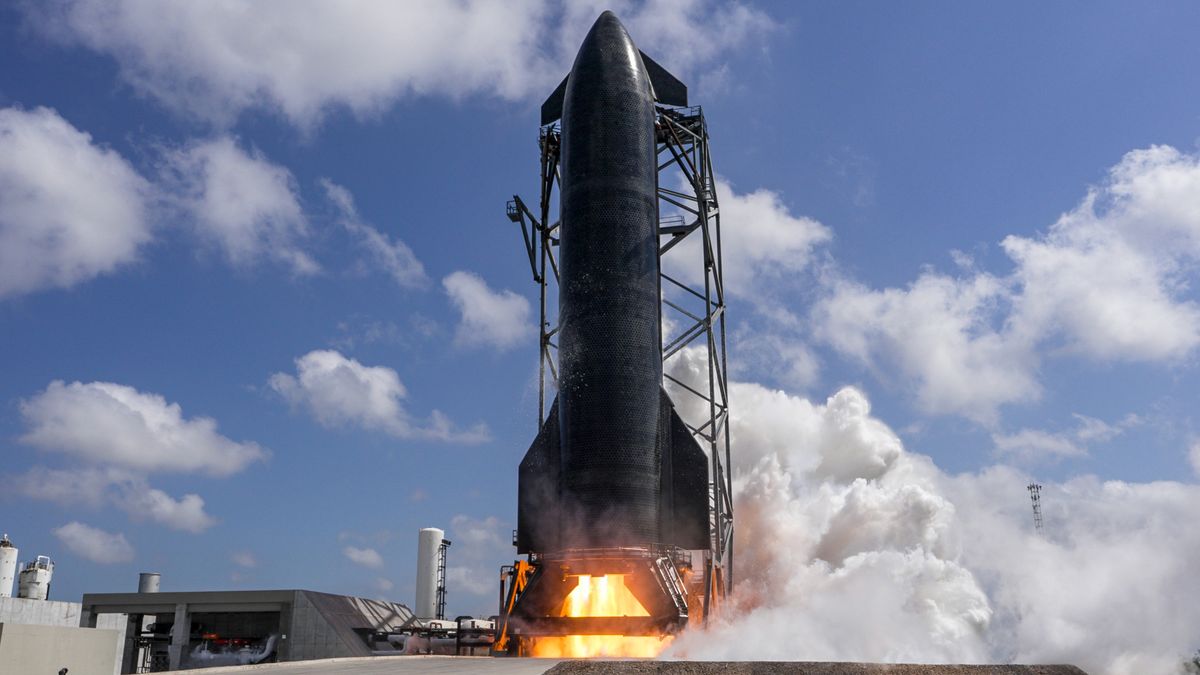
After two straight fireballs over the Gulf, Elon Musk's Starship gets one more shot tonight — and this time it's not just about survival, it's about proving the giant rocket can actually do its job
STARBASE, TEXAS
Tonight, at 6:45 p.m. Eastern, the tallest, most powerful rocket ever built will thunder off a launch pad on the southern tip of Texas, and for the first time in its short, explosive history, it will actually be carrying something the world needs.
Twenty next-generation Starlink satellites — each one too big to fit inside any other rocket SpaceX owns — are strapped inside the payload bay of Starship, waiting for the 90-minute launch window to open. If Flight 13 goes to plan, those satellites will unfurl solar wings the width of a school bus, fire up laser links capable of talking to ground stations on the other side of the planet, and become the backbone of the next generation of global internet. If it doesn't go to plan, it will be the third high-profile Starship failure in under a year — and the fireball will be visible from space. This is the flight SpaceX cannot afford to botch.
A Rocket With A Losing Streak
To understand why tonight matters so much, you have to understand what's happened the last two times this monster left the ground.
Flight 12, launched in the spring, ended in a cascade of failures that reads like a checklist of everything that can go wrong with rocketry. According to the official mishap report accepted by the Federal Aviation Administration on July 13 — just three days before tonight's launch — "heat effects on propulsion system components during the ascent and erroneous engine alarm system settings" caused the loss of the enormous Super Heavy booster. In plain English: the booster got too hot in the wrong places, and a faulty alarm system either shut down engines that were fine or failed to catch ones that weren't.
The failure cascaded fast. At the moment of stage separation, slight differences in how the ship's engines started up threw the booster's flip maneuver off by roughly 90 degrees — nowhere close to where it needed to be pointed for its return trip home. Five of the Raptor engines needed for the boostback burn, the maneuver that turns the booster around and sends it back toward a splashdown point, simply refused to light. The burn that did happen ended early. By the time Super Heavy tried to relight engines for its final landing burn, it was already in trouble. It hit the Gulf of America in an uncontrolled, hard splashdown instead of the gentle, engines-throttled landing SpaceX has been chasing for years.
The upper stage — the actual Starship spacecraft — didn't fare much better. It suffered its own Raptor engine failure during ascent and had to abort a planned in-space engine relight, a test that's considered critical for any future mission that needs the ship to fire its engines again after coasting through the vacuum of space, the exact maneuver that would be required for, say, a trip to the Moon or Mars.
The FAA grounded the program while SpaceX conducted a company-led investigation — standard practice after a "mishap," which is the sanitized aerospace term for what looked, on video, like an extremely expensive rocket falling apart over open water. That investigation wrapped up July 13, the FAA accepted the findings, and SpaceX confirmed it had made "vehicle hardware and software configuration updates" to stop the same failures from happening twice. Which brings us to tonight.
What's Actually Riding On Top
Flight 13 is the second launch of Starship's "Version 3" configuration, the newest and most capable iteration of the vehicle, and it's engineered to mirror Flight 12's flight profile almost exactly — with the fixes baked in. SpaceX has introduced a modified startup sequence for the ship's engines and hardware updates to the Super Heavy booster specifically targeting the orientation anomaly and ignition issues that doomed the last attempt, along with revised engine alarm and abort logic.
But the headline difference between tonight and every previous Starship flight is what's inside the nose.
For the first time, Starship will deploy 20 functioning Starlink V3 satellites — SpaceX's next-generation broadband spacecraft, and physically the reason this entire rocket program exists in its current form. These satellites are simply too large to fit inside the payload fairing of a Falcon 9, SpaceX's smaller and vastly more reliable workhorse rocket. Only Starship's cavernous payload bay can carry them. Each V3 satellite is built around deployable solar arrays, onboard cameras, and — most importantly — high-capacity laser inter-satellite links designed to hand off data between satellites in orbit rather than routing everything through ground stations. Once deployed tonight, the satellites will attempt to extend their solar arrays and antennas and try to establish contact with ground stations in South Africa before linking into the broader Starlink constellation via those lasers.
If that works, it's a proof point that Starship isn't just a very large, very loud science experiment — it's a functioning delivery vehicle for the piece of hardware that is, by revenue, the most important thing SpaceX makes.
The mission profile is otherwise a repeat of Flight 12's ambitions. About two and a half minutes after liftoff, the Super Heavy booster will separate from the upper stage and attempt its boostback burn, aiming for a controlled splashdown at an offshore landing point in the Gulf — the same maneuver that fell apart last time. Once free of the booster, the Starship upper stage's job is threefold: deploy the 20 satellites, attempt a relight of a single Raptor engine while coasting through space, and execute a controlled entry, descent, and splashdown, this time targeting the Indian Ocean.
That in-space engine relight might sound like a minor technical checkbox, but it's arguably the most consequential test on tonight's list. Any Starship mission that goes beyond Earth orbit — a lunar landing for NASA's Artemis program, a Mars cargo run, an on-orbit refueling rendezvous — requires the ship to reliably fire its engines after an extended coast in the vacuum of space. Flight 12 never got to attempt it. Tonight, SpaceX gets another shot.
Why NASA, Not Just SpaceX, Is Watching
Starship isn't just Elon Musk's personal moonshot anymore — it's contractually tied to NASA's Artemis program as the vehicle that will actually put astronauts on the lunar surface for Artemis III. NASA has already begun assembling segments of the Space Launch System's solid rocket boosters for that mission, tentatively targeted as early as next year, which means the clock on Starship's reliability is no longer just a SpaceX problem. Every delay, every hard splashdown, every mishap investigation pushes against a deadline the space agency has already started building hardware for.
SpaceX's ambitions for the rocket go well beyond a single Moon landing. The company has talked for years about ramping Starship's launch cadence from a handful of flights annually to, eventually, something approaching one per hour — a scale that would be necessary to build the orbital propellant depots required for any serious push toward Mars. That vision remains, for now, a long way off. But every successful satellite deployment, every clean booster catch, every completed in-space relight is a building block toward it. Every failure is a reason for skeptics — and there are plenty in the space industry — to argue the whole architecture is overbuilt and undercooked.
The View From The Industry
Space analysts tracking the program have been blunt about what's at stake. The FAA's decision to close the Flight 12 mishap investigation just three days before this launch is itself notable — it's an unusually fast turnaround for an agency that grounded the vehicle for months after an earlier 2025 failure. That speed suggests both that the identified failure modes were well understood and fixable, and that there's institutional pressure — from NASA's Artemis timeline, from SpaceX's Starlink revenue needs, from sheer competitive pressure as China and other players race forward with their own heavy-lift programs — to keep Starship flying rather than sitting on the ground under review.
Industry watchers have also flagged that tonight's flight profile is deliberately conservative in one sense: SpaceX chose to repeat Flight 12's basic architecture almost exactly, rather than push new envelope-expanding maneuvers, because the priority right now is proving reliability, not chasing new milestones. A clean flight tonight — even an imperfect one that nails the satellite deployment and struggles elsewhere — would be treated across the industry as a meaningful data point that Version 3 Starship is stabilizing.
What This Means For You
If you've never thought about a rocket launch in Texas affecting your life, tonight might change that. If you use Starlink for internet — whether you're a rural homeowner outside the reach of cable, a boat or RV owner needing connectivity on the move, or simply someone whose cell carrier increasingly leans on satellite backup for dead zones — the satellites launching tonight are part of the infrastructure upgrade that determines whether that service gets faster, more resilient, and cheaper, or stays stuck at its current capacity. The laser inter-satellite links being tested tonight are specifically designed to reduce reliance on ground stations, which is the difference between "your internet slows down over the ocean or in remote areas" and "it doesn't."
More broadly, if you care about NASA returning astronauts to the Moon on any kind of realistic timeline, tonight's flight is a leading indicator. Artemis III depends on a working Starship lunar lander. Every Starship test flight, good or bad, either keeps that timeline plausible or pushes it further into the fog.
The Bottom Line
Two failures. One FAA investigation closed just days ago. Twenty satellites that represent SpaceX's actual business riding in the nose cone for the first time. And a countdown clock ticking toward 6:45 p.m. Eastern tonight at Starbase, Texas.
Whether Flight 13 becomes the flight that proves Starship is finally growing up, or the third entry in an increasingly expensive highlight reel of Gulf-of-Mexico fireballs, the world will know within the hour of liftoff. Either way, watch the skies over South Texas tonight — history, or at least a very loud attempt at it, is scheduled for 6:45 p.m.
Sources: Space.com, SpaceNews, SpaceX, Spaceflight Now, TechTimes, Tesla Oracle, The Register, BigGo Finance, Technobezz, Starlust.



