Written By | Torch Media Africa
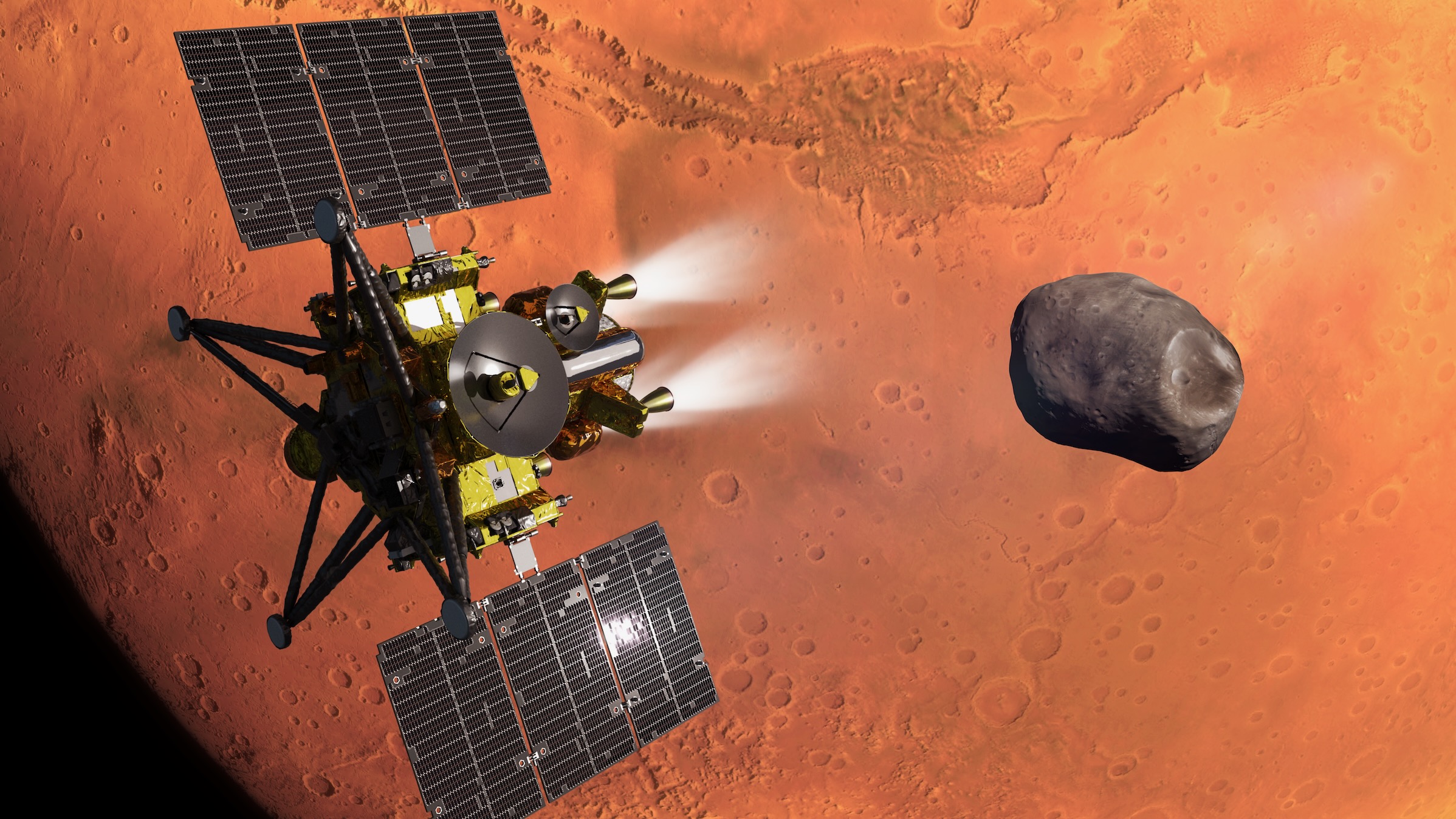
The MMX probe is on its way to Phobos with a rover, a $578 million price tag and a bold promise: bring home the first-ever samples from a moon other than our own
SCIENCE & TECH
Japan has just fired a starting gun on one of the most ambitious robotic missions of the decade. In the early hours of Tuesday, 20 October, local time, a H3 rocket thundered off the pad at the Tanegashima Space Center carrying the Martian Moons eXploration probe, known as MMX. Its target is a lumpy, crater-scarred little world called Phobos, and its mission is almost cheeky in its audacity: land on it, scoop up at least 10 grams of dirt, and carry that dirt all the way home to Earth.
If it works, it will be the first time humanity has returned samples from a moon other than our own. It will also be the first spacecraft ever to orbit Phobos, the first to collect material from its surface, and the first to come back to Earth from the Mars system. Not bad for a mission that, as of this week, is only a few days into a journey that will last roughly five years.
Liftoff: a flawless start
The Japan Aerospace Exploration Agency (JAXA) launched MMX at 04:41 Japan Standard Time on 20 October, which was the evening of 19 October in Europe and the United States. That date mix-up has caused some confusion in headlines, which is why you will see both dates in coverage. The European Space Agency confirms the 04:41 JST timing, equal to 20:41 British Summer Time on 19 October.
Reports describe a smooth ride. One source describes this as the tenth H3 rocket to lift off, JAXA's flagship launcher, and says the probe separated from the rocket successfully. No launch problems were reported. The spacecraft weighs roughly 4,200 kilograms with fuel, and is reported to cost around $578 million.
NASA astrophysicist Tom Statler, who serves as NASA's MMX program executive and program scientist, admitted the tension in the days leading up to the launch. "There's a lot of adrenaline," he said.
Why Phobos? The mystery of Mars's moons
Mars has two small moons, Phobos and Deimos, and nobody is quite sure where they came from. They look like potato-shaped rocks, and Phobos, at around 22 kilometres across, is the larger of the two. Scientists have two main theories, and MMX is designed to settle the argument.
The first theory says the moons are asteroids that wandered too close to Mars and were captured by its gravity. If that is true, their composition should differ from Mars itself. The second says they are leftover debris, thrown into orbit after a giant object smashed into the young Mars billions of years ago. In that case they would be made of material that records conditions on the early Red Planet, a kind of frozen time capsule.
Either answer is a prize. "It will help illuminate that early era," Statler said of the findings, when the inner planets may have acquired their water and organic compounds. In other words, a few grams of Phobos could tell us how rocky planets like Earth ended up habitable.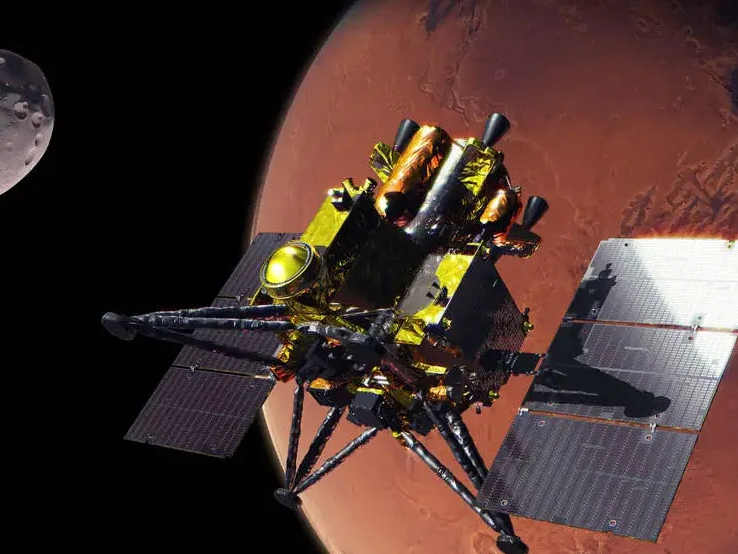
A very long road trip
MMX is not in a hurry. The timeline, drawn from JAXA, ESA and NASA material, runs as follows. Arrival at Mars is expected in August 2027. The spacecraft will then spend about three years investigating the Martian system from a quasi-satellite orbit near Phobos, with no landing planned on Deimos, although it will observe that moon too. Around the turn of 2028 to 2029, the mission will deploy its rover and attempt the sampling landing. The agencies' summaries differ slightly on the exact sampling date, with NASA citing December 2028 at the earliest and ESA's overview pointing to 2030, so expect the schedule to firm up as the mission progresses.
The probe leaves the Mars system in 2030, and the return capsule, around 60 centimetres across, is due to reach Earth in 2031, landing in the Australian desert before the samples are taken to Japan for opening, extraction and first cataloguing.
Meet the gadgets
This is a spacecraft packed with clever kit. Its three modules, covering propulsion, return and exploration, carry a total of 11 scientific instruments according to ESA's factsheet. Among them:
Then there are the samplers. Japan's own corer will drill roughly 2 centimetres down, to reach material less altered by space weathering. NASA contributes a pneumatic sampler, built by Honeybee Robotics, which uses bursts of high-pressure nitrogen to blast loose surface material into a container. It is mounted on a landing leg as a technology demonstration, and a backup in case the drill struggles.
Idefix: the little rover that could
The mission's breakout star is likely to be Idefix, a 25-kilogram rover developed jointly by France's CNES and Germany's DLR. Phobos's gravity is so feeble that Idefix will weigh the equivalent of a 15-gram object on Earth, roughly the weight of a few coins. Rolling around in that environment is unlike anything robots have done before.
The rover is scheduled to be dropped from about 40 metres above the surface and will explore for around three months, using a radiometer, a Raman spectrometer to identify minerals, and cameras. French Space Agency official Julien Baroukh has described Idefix as a "scout for safety." Its job is to test the ground, so the main spacecraft knows what it is landing on. Phobos is dusty, and no one has ever touched down on it, so the scouting matters.
A team effort
MMX is led by JAXA, but it is truly international. NASA, ESA, CNES and DLR are all partners, and NASA's Deep Space Network and ESA's Estrack ground stations will keep the line open as the probe travels. ESA contributed the deep-space communication equipment, a transponder and power amplifier. In a nice touch of fairness, NASA will receive about 15 percent of the returned material to curate at the Johnson Space Center's Astromaterials Lab in Houston, while JAXA and partners catalogue and share the rest with researchers worldwide.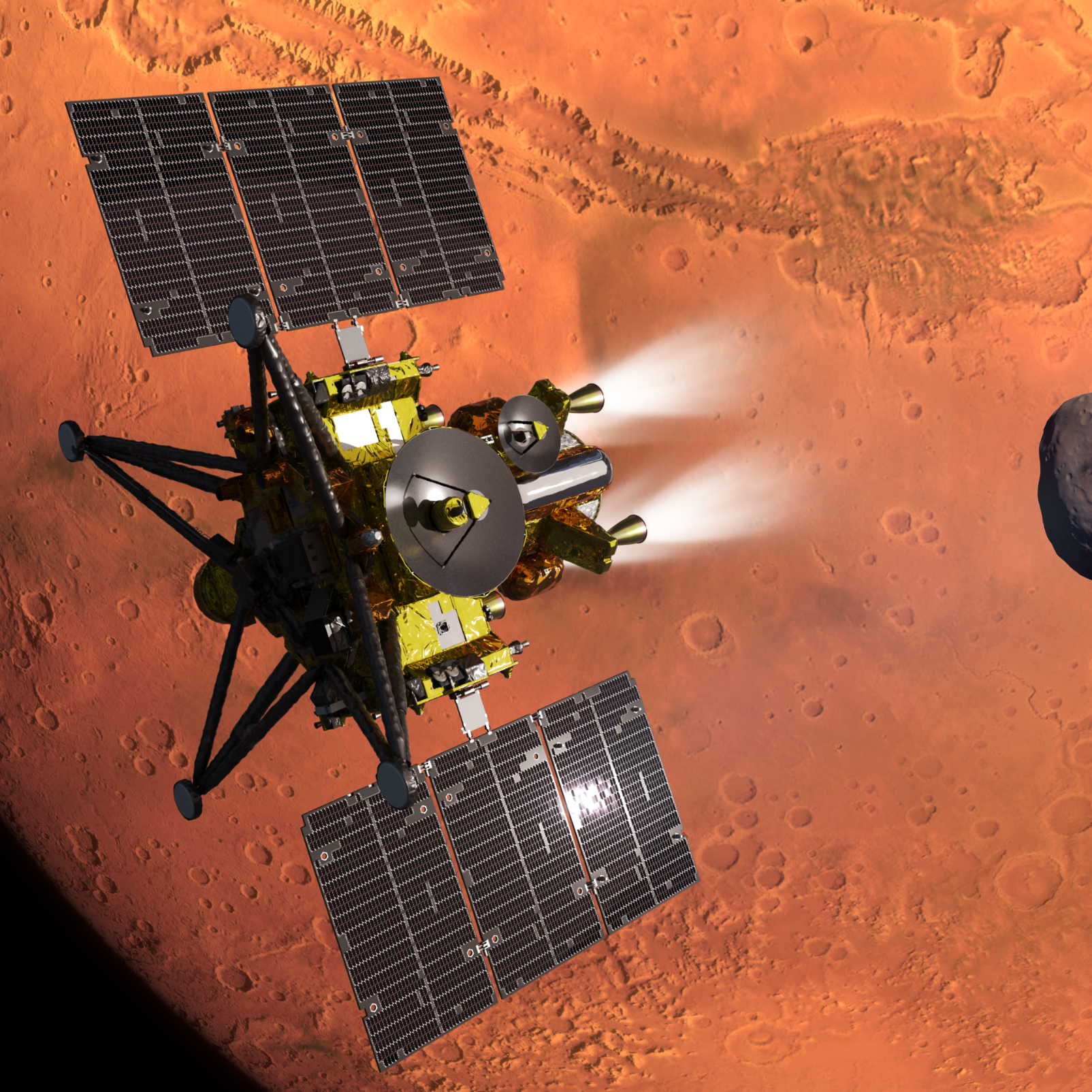
Expert perspective
Space scientists say the real value lies in the combination of orbit, rover and sample. Taking measurements from afar can only tell you so much; a physical sample can be studied in laboratories for decades, using techniques that haven't been invented yet. That is exactly what happened with samples from asteroids Ryugu and Bennu. In fact, NASA formally ended its OSIRIS-REx mission, which brought home Bennu material, on 30 September, just three weeks before MMX's launch. Researchers also announced this week that Bennu samples contain hidden cracks which explain why the asteroid loses heat so quickly, a reminder of how much a small pile of grit can teach.
There is also a deeper strategic angle. Phobos is considered a stepping stone for future crewed Mars exploration, a low-gravity outpost close to the planet. Learning what it is made of, how dusty it is and what resources are present could shape how humans eventually approach the Red Planet. MMX is being flown by a robot, but it is quietly scouting for people.
Risks: what could go wrong
Nothing about this is easy. Landing on a tiny moon with almost no gravity means that a bounce could send a spacecraft drifting away. The sampling window is short, the communications delay to Earth is large, and the dust environment is uncertain. Deep-space missions also suffer from the simple tyranny of time: a five-year journey gives equipment plenty of time to fail. Japan has a strong record here, having already returned samples from two asteroids with its Hayabusa missions, which gives MMX's team a hard-won head start. But no one on the project would claim success is guaranteed.
There is one more thing to watch for. Some pre-launch coverage mentioned a 2027 arrival, which matches the Mars arrival but not the landing. Do not mix the two up: the probe reaches Mars next summer, but the dramatic landing on Phobos is more than a year after that.
What this means for you
You will not be buying a Phobos souvenir any time soon, but the mission matters to ordinary people in a few ways. First, it speeds the day we understand how planets like ours get their water, a question that touches directly on whether life is common or rare in the universe. Second, the technology developed for low-gravity landing, sampling and robotic exploration tends to spill over into industry, from robotics to materials science. Third, it keeps Japan, and the wider international partnership behind it, at the front of a new space race where the prizes are knowledge and technological leadership rather than flags and footprints.
And finally, there is the sheer wonder of it. When the Super Hi-Vision cameras start sending back 8K pictures of Mars hanging over the horizon of Phobos, expect your social feeds to fill with some of the most spectacular space images ever taken.
Conclusion
For the next few years, MMX will be a quiet traveller, cruising through the dark toward a rendezvous with a moon most people have never given a thought. But the launch has set in motion a mission that could rewrite the story of Mars, answer a decades-old puzzle about where its moons came from, and put a few precious grams of another world on a laboratory bench in 2031. The adrenaline Statler talked about is only the start. The real excitement begins when a small robot, weighing next to nothing, rolls out onto the dusty surface of Phobos.



