Written By | Torch Media Africa
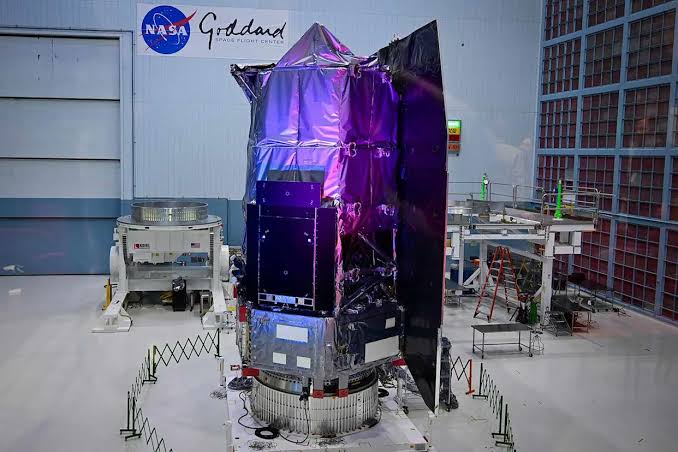
NASA's Nancy Grace Roman Space Telescope
CAPE CANAVERAL, FLA.
On Sunday, June 21, a 250-foot NASA barge called Pegasus nosed into Kennedy Space Center carrying its latest cargo: an 18,000-pound space telescope built to answer two of the biggest questions in physics. The Nancy Grace Roman Space Telescope has arrived at the Payload Hazardous Servicing Facility, where technicians will spend the summer running final checks before it launches atop a SpaceX Falcon Heavy. Liftoff is targeted for no earlier than August 30, 2026 — roughly eight months ahead of schedule, a near-unheard-of feat for a major NASA observatory.
THE CAMERA THAT SEES IN WIDESCREEN
Roman's primary instrument, the Wide Field Instrument, is a 300-megapixel detector array that can capture images covering an area of sky at least 100 times larger than Hubble's while maintaining similar crispness and infrared sensitivity. A single Roman exposure contains the detail of roughly 100 Hubble pictures stitched together. Over its first five years, Roman is expected to image more sky than Hubble has covered in its entire 30-year career — and do it 1,000 times faster.
That matters for Roman's two flagship science campaigns: hunting dark energy and hunting planets around other stars.
THE DARK ENERGY PROBLEM
Roughly 68% of the universe is made of dark energy — a mysterious force accelerating cosmic expansion. We can measure its effects, but we don't know what it actually is. To answer that, scientists need a massive census of galaxies across cosmic time — a job narrow-field instruments like Hubble and Webb can't do. Roman's High Latitude Wide Area Survey will chart hundreds of millions of galaxies, looking for fingerprints that reveal whether dark energy is a fixed constant or something stranger.
HUNTING FOR WORLDS LIKE OURS
Roman's microlensing survey will watch dense star fields for the telltale brightening that occurs when a foreground star — and any planets orbiting it — passes in front of a background star. This technique finds planets other methods miss: wide-orbit worlds, free-floating "rogue" planets, and planets around faint stars. Astronomers expect Roman to discover thousands of new exoplanets — potentially more than every other survey combined. It also carries a Coronagraph Instrument to directly image planets by blocking stellar glare, paving the way for future Earth-like planet hunters.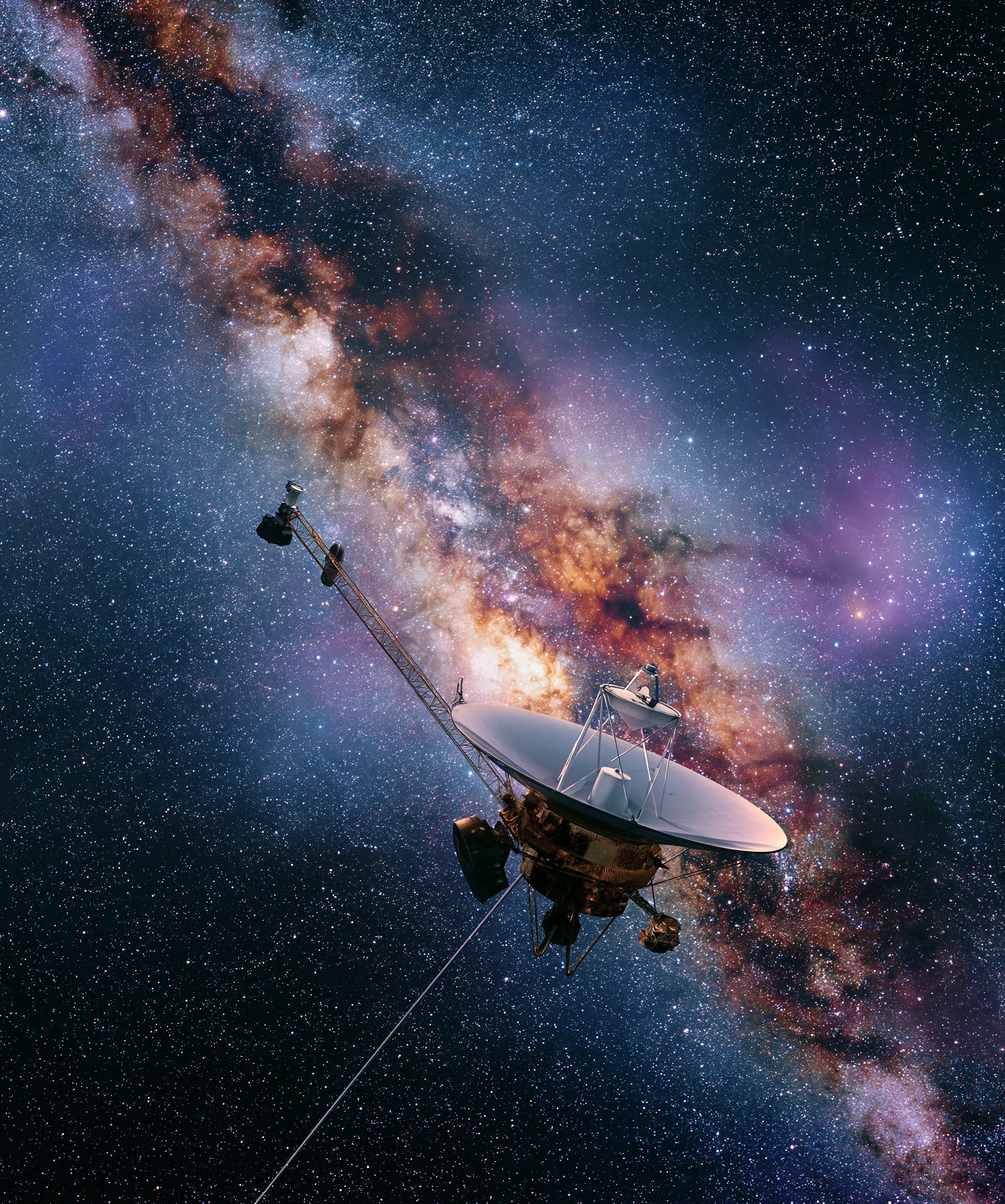
NASA's Voyager 1 on mission
WHY THIS TELESCOPE EXISTS
Roman traces to a 2010 decadal survey that identified a wide-field infrared survey telescope as astrophysics' top priority. Originally called WFIRST, it was renamed in 2020 to honor Nancy Grace Roman, NASA's first chief astronomer and driving force behind Hubble. Its 2.4-meter mirror — same size as Hubble's — came from declassified spy satellite hardware, saving enormous time and cost. Construction completed in November 2025, and the mission is both ahead of schedule and under its roughly $3.9 billion budget — vanishingly rare words for flagship telescopes.
Pegasus barge carrying the Nancy Grace Roman telescope inside at the Kennedy Space Center, followed by the transfer of the container
WHAT HAPPENS NEXT
At Kennedy, technicians will complete final testing, fuel the spacecraft, and encapsulate it for launch. Roman won't orbit Earth like Hubble — it will travel a million miles to Sun-Earth Lagrange Point 2, the same neighborhood as Webb, for stable infrared observations. Science operations will likely begin in early 2027.
WHAT THIS MEANS FOR YOU
You may never personally use Roman's data. But if it succeeds, the headlines over the next decade — about dark energy, about potentially habitable planets, about the architecture of the universe — will trace back to this week, to a barge quietly docking in Florida. Big science moves slowly, and then suddenly it's all anyone is talking about. Roman's launch window this August is when that clock starts ticking.
CONCLUSION
For now, Roman sits in a clean room in Florida, eighteen detectors and one enormous mirror waiting for their moment. In roughly ten weeks, a Falcon Heavy will light up the coast and send it a million miles from home. From there, it will spend years staring at vast stretches of sky and finding, hidden in the statistics of hundreds of millions of galaxies, answers about the fundamental fabric of reality. The barge has docked. The clock is running. The universe is about to get a much closer look.





