Written By | Torch Media Africa
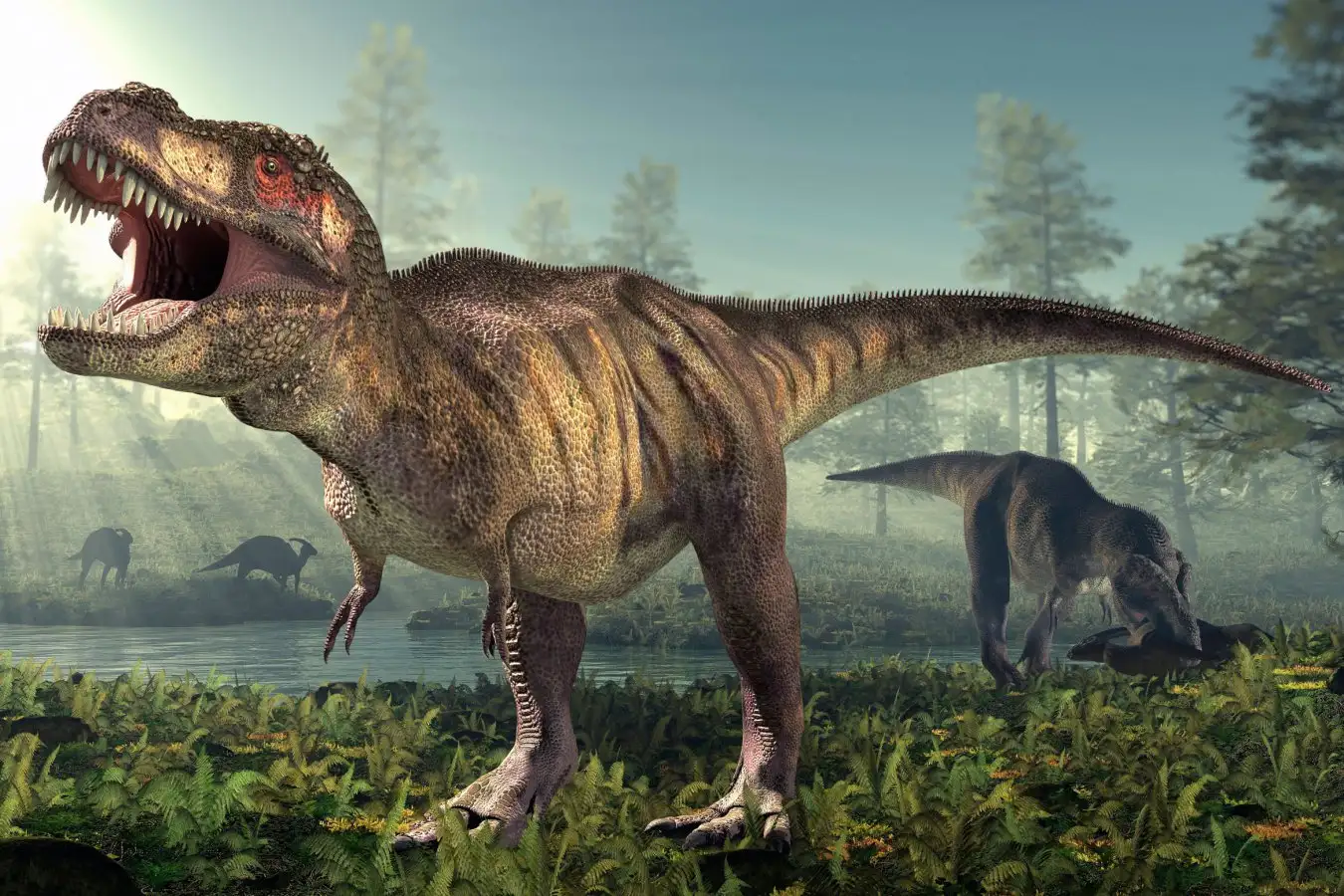
Hidden growth rings invisible to decades of scientists reveal that Tyrannosaurus rex spent four decades — not 25 years — clawing its way to apex-predator status
STILLWATER, Okla
For more than a century, Tyrannosaurus rex has occupied a strange dual role in the public imagination: the most studied dinosaur on Earth, and somehow still one of the most mysterious. Now a sweeping new analysis of 17 tyrannosaur fossils, published this week in the journal PeerJ, has rewritten one of the most basic facts paleontologists thought they knew about the King of the Dinosaurs — how long it took to grow up.
The old number, widely cited for years, was about 25 years to reach full adult size. The new number, built from the largest dataset of T. rex growth records ever assembled, is roughly 40 years — a full 15-year extension that fundamentally changes how scientists think about the animal's biology, behavior, and even its identity. And in a twist that has paleontology forums buzzing, the same dataset has reopened a bitter, long-running fight over whether some of the most iconic T. rex skeletons in museums today have been misclassified entirely.
"This is the largest data set ever assembled for Tyrannosaurus rex," said Holly Woodward, a professor of anatomy at Oklahoma State University's Center for Health Sciences who led the research. "Examining the growth rings preserved in the fossilized bones allowed us to reconstruct the animals' year-by-year growth histories." 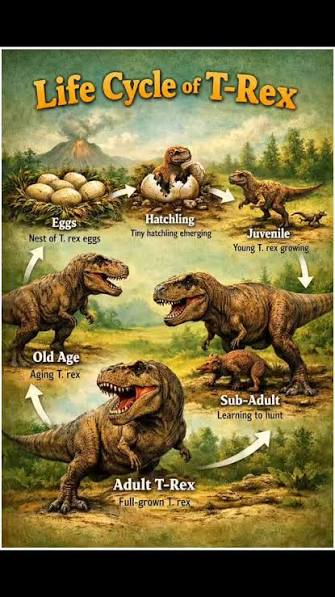
READING TREE RINGS IN A MONSTER'S LEG BONE
The method at the heart of this discovery sounds almost too simple to produce such a seismic result: tree rings, but for dinosaurs.
When paleontologists want to know how old a dinosaur was when it died and how fast it was growing, they slice into fossilized leg bones and examine the cross-section under a microscope. Bone, like wood, lays down growth marks over time — denser in slow-growth periods, more porous during rapid growth spurts — creating a record not unlike the rings inside a tree trunk. Count the rings, measure the spacing, and in theory you can reconstruct an animal's entire growth trajectory.
In practice, it's been far messier than that. Unlike a tree stump, which preserves a complete record from seedling to felling, a cross-section of a T. rex leg bone typically only preserves the final 10 to 20 years of that individual's life — the earliest growth rings get resorbed and destroyed as the bone's central marrow cavity expands over time. That means no single fossil, no matter how well-preserved, can tell you the complete story of how a T. rex grew from hatchling to eight-ton adult. Scientists have had to stitch together partial records from multiple individuals of different ages, a statistically thorny problem that has produced wildly different answers depending on the methods and assumptions used.
Woodward's team attacked that problem two ways. First, they examined bone slices under circularly polarized and cross-polarized light — specialized lighting techniques that reveal subtle growth marks invisible under standard microscopy, marks that previous studies may have simply missed or miscounted. Second, they brought in Nathan Myhrvold, a mathematician and paleobiologist at Intellectual Ventures (and a former chief technology officer at Microsoft), to design an entirely new statistical model capable of stitching together partial growth records from 17 different fossils into one composite growth curve spanning the animal's full life.
"We came up with a new statistical approach that stitches together growth records from different specimens to estimate the growth trajectory of T. rex across all stages of life in greater detail than any previous study," Myhrvold explained. "The composite growth curve provides a much more realistic view of how Tyrannosaurus grew and how much they varied in size."
The result: a four-decade growth curve, far longer and steadier than the rapid-adolescent-growth-spurt model that has dominated textbooks and documentaries for years.
WHY GROWING UP SLOW MIGHT HAVE MADE T. REX KING
A 40-year adolescence might sound like a liability for an animal trying to dominate a Cretaceous ecosystem crawling with competition. The research team argues the opposite: it may have been a secret weapon.
Jack Horner, a co-author on the study based at Chapman University and one of the most influential tyrannosaur researchers of the past four decades, suggests the prolonged growth window let young tyrannosaurs essentially live multiple ecological lives within a single species. A juvenile T. rex, lighter, faster, and built differently than a lumbering adult, could have hunted different prey, occupied different terrain, and avoided direct competition with full-grown adults of its own kind — effectively functioning as a different predator at different life stages.
"A four-decade growth phase may have allowed younger tyrannosaurs to fill a variety of ecological roles within their environments," Horner said. "That could be one factor that allowed them to dominate the end of the Cretaceous Period as apex carnivores."
In other words, T. rex may not have just been one apex predator — across its decades-long growth, a single species might have filled the ecological niches that, in other ecosystems, would require several different predator species to cover. That helps explain a puzzle that has nagged at paleontologists for years: in late Cretaceous North America, T. rex seems to have dominated the large-carnivore niche almost completely, with very few mid-sized predator competitors. A slow, multi-stage growth pattern could be exactly the kind of evolutionary trick that allowed it to crowd out the competition.
THE TWIST: ARE "JANE" AND "PETEY" EVEN T. REX?
Buried in the growth-curve data is a far more contentious finding, one that touches on one of the nastiest ongoing feuds in dinosaur paleontology: the Nanotyrannus debate.
For years, a vocal contingent of researchers has argued that several smaller tyrannosaur fossils long classified as juvenile T. rex — including two famous, well-preserved specimens nicknamed "Jane" and "Petey" — actually belong to an entirely separate, smaller-bodied species called Nanotyrannus lancensis, rather than being baby versions of the species that would later grow into full-sized T. rex. Other researchers have insisted Nanotyrannus is bogus, and that Jane and Petey are simply young T. rex caught mid-growth-spurt.
Woodward's team didn't set out to resolve that fight, but their growth-curve data landed right in the middle of it anyway. When they plotted Jane's and Petey's individual growth patterns against the composite curve built from the other 15 fossils, the two specimens stood out — their growth trajectories didn't match the rest of the group in ways that are difficult to explain if they're simply young individuals of the same species as the others.
To hedge against the unresolved taxonomy, the researchers deliberately classified their sample as belonging to the "Tyrannosaurus rex species complex" rather than asserting all 17 fossils are unambiguously the same species — an unusually cautious framing that itself signals how unsettled the underlying science is. Notably, the team pointed to a separate, independent study by researchers Lindsay Zanno and James Napoli, which used different anatomical methods and reached a strikingly similar conclusion: that Jane and Petey represent two distinct species of Nanotyrannus, not juvenile T. rex.
Growth-ring data alone can't settle a question of species identity — that requires anatomical and genetic evidence too — but the fact that two independent research teams, using two different methods, both flagged the same specimens as anomalous is the kind of converging evidence that tends to move scientific consensus. If Nanotyrannus is eventually confirmed as a legitimate, separate genus, it would mean some of the most photographed "baby T. rex" skeletons in museums worldwide have been mislabeled for decades.
A METHODOLOGICAL WARNING SHOT
Beyond the headline numbers, Woodward and Myhrvold's team flagged something that could ripple well beyond Tyrannosaurus research: their new polarized-light imaging technique revealed growth ring patterns that standard methods have likely been misreading for years across many dinosaur species, not just T. rex.
"Interpreting multiple closely spaced growth marks is tricky," Myhrvold said. "We found strong evidence that the protocols typically used in growth studies may need to be revised."
That's a quietly significant claim. Decades of published research on dinosaur growth rates, lifespans, and developmental biology — across many species, not just tyrannosaurs — have relied on growth-ring counting methods that this new study suggests may have systematically undercounted or misread key markers. If other research teams adopt the circularly polarized light technique and find similar discrepancies in other species, a meaningful slice of existing dinosaur growth literature could need re-examination.
EXPERT PERSPECTIVE
Paleontologists outside the immediate research team have generally welcomed the study's statistical rigor while noting that, as with most fossil-based research, sample-size limitations remain a real constraint — 17 specimens is the largest dataset yet assembled for this question, but it is still a small number relative to how much individual variation can exist within a species across a 40-year lifespan. The Nanotyrannus question in particular remains actively contested within the field, and this study's growth-curve anomalies, while suggestive, are being treated as corroborating evidence for the separate-species hypothesis rather than definitive proof on their own.
Still, the methodological advance — using circularly and cross-polarized light to surface previously hidden growth rings — is being described as a potentially field-changing technique independent of how the Nanotyrannus debate ultimately resolves, since it offers a way to extract more reliable age and growth data from fossils that have already been sitting in museum drawers for years.
WHAT THIS MEANS FOR YOU
If you've taken a kid to a natural history museum any time in the last twenty years, there's a decent chance you stood in front of a "juvenile T. rex" placard that may need updating. More broadly, this is a reminder of how much basic biology about even the most famous, most-studied species in the fossil record is still being actively rewritten by new techniques. T. rex has been excavated, described, and displayed since 1905 — and scientists are still fundamentally revising how it lived.
There's also a fun, slightly mind-bending takeaway buried in the math: a Tyrannosaurus rex reaching sexual maturity and its terrifying adult size at around the same age a human reaches middle age means the "king of the dinosaurs" had a life-history pace not wildly different in proportion from a large, slow-growing modern animal — more measured and developmental than the explosive, get-big-fast image popularized by decades of documentaries and museum dioramas.
CONCLUSION
Tyrannosaurus rex died out roughly 66 million years ago, but its biology keeps changing on us in the present day. A new statistical technique and a clever use of polarized light just added fifteen years to its adolescence, handed new ammunition to one side of paleontology's most heated species debate, and quietly suggested that an entire generation of dinosaur-aging methods might need a second look. The bones haven't changed. Our ability to read them has. And as Woodward, Myhrvold, and Horner's work makes clear, more than a hundred years after T. rex was first named, the king of the dinosaurs is still keeping secrets.



