A USC-led team says a humble 'middle-stage' immune cell could be multiplied almost without limit in the lab, engineered to hunt tumours, and stored ready to use — and it worked against blood cancers and solid tumours in mice.
TECH & SCIENCE DESK
For years, the dream of cancer immunotherapy has come with a nightmare-sized price tag and a frustrating catch: the living drugs are painfully hard to make, and they mostly work on blood cancers, not the stubborn solid tumours that kill the majority of patients. Now a team of scientists says it may have found a way to make a never-ending supply of cancer-fighting cells, and to arm them to attack even solid tumours.
The research, led by the Keck School of Medicine of USC and published in the journal Cell, describes a platform built on immature immune cells called granulocyte-monocyte progenitors, or GMPs. In mouse experiments, engineered versions of these cells slowed the progression of both blood cancers and solid tumours. The findings were highlighted on 16 October 2026 and are creating a buzz across the field. But before anyone gets carried away, one fact must be stated plainly: this is mouse research. No human has yet been treated.

The Problem: Living Drugs That Are Hard to Make
Cellular immunotherapy works by taking immune cells, supercharging them with a lab-built tracking device known as a chimeric antigen receptor, or CAR, and sending them after cancer. Engineered T cells have shown their strength against certain blood cancers. Against solid tumours — cancers of organs such as the breast, lung and colon — they have struggled, according to the researchers.
Scientists have long eyed macrophages, a different type of immune cell, as an alternative. Macrophages are naturally good at pushing into tumours. But the USC paper lays out their drawbacks: mature macrophages are hard to multiply in the lab, hard to genetically modify, and vulnerable to damage during freezing. When infused into the body, they tend to collect in the lungs and liver and disappear relatively quickly. That has made it difficult to turn them into a practical, mass-produced medicine.
The Trick: Catch Them Before They Grow Up
The USC team took a different route. Instead of working with mature cells, they focused on GMPs, immature cells that normally go on to develop into macrophages and other immune cells. Using a carefully defined chemical mixture, the researchers found they could make GMPs survive and multiply over the long term in the lab without maturing too early. Think of it as pressing pause on childhood so the cells can be cloned in vast numbers before they are told what to become.
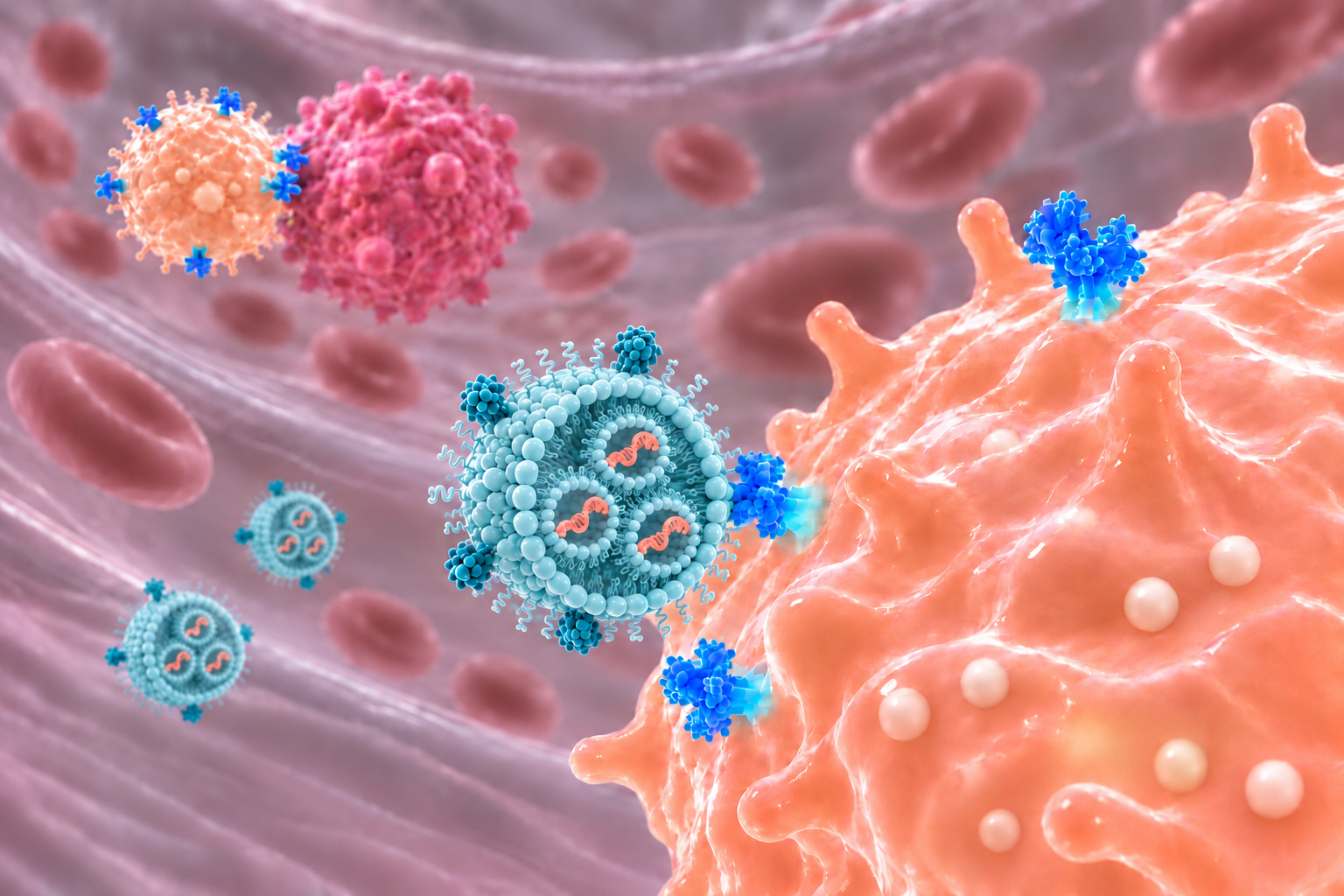
Next came the engineering. The team equipped the cells with a CAR designed to recognise a marker on the surface of cancer cells. Some cells also carried an extra immune-activating signal intended to recruit and stimulate nearby immune cells, including T cells — in effect turning each engineered cell into a rallying point for the body's wider defences.
Crucially, the cells held on to their identity. According to the paper, GMPs kept their ability to produce functional immune cells even after extensive expansion. That challenges the long-held view that lasting self-renewal in the blood system is mainly the preserve of hematopoietic stem cells.
What Happened in the Mice
The results in animals were striking. When the engineered GMPs were given to mice, they settled in the bone marrow, where they went on producing fresh engineered immune cells. That is a very different picture from mature macrophages, which fade quickly after infusion. The CAR-equipped GMPs slowed disease progression in mouse models of both blood cancers and solid tumours, and adding the extra immune signal produced stronger effects.
The platform also showed promise beyond cancer. In a separate mouse model of chronic granulomatous disease, a rare inherited disorder in which the immune system cannot properly fight certain infections, GMPs restored the animals' ability to fend off bacterial infection. The researchers say that points to possible uses in inherited immune deficiencies and infectious diseases.
Importantly, the team also tested donor cells whose immune characteristics did not match the recipient — an early signal that the approach could one day lead to off-the-shelf products rather than bespoke treatments made individually for each patient.
Replicated by Rivals — A Good Sign
Science is littered with exciting results that others could not repeat, so one detail stands out. A separate team at Stanford University, led by Dr Ravindra Majeti, independently showed that GMPs could be maintained and genetically engineered, supporting the reproducibility of the method. The work also involved researchers from Creighton University and from Harvard Medical School and the Dana-Farber Cancer Institute.
The corresponding author is Professor Qi-Long Ying, a stem cell biologist at the Keck School of Medicine of USC; the first author is Shi Yue, from Ying's lab. "The study establishes a scalable and engineerable GMP platform for cellular immunotherapy," Ying said. He added that "the future of immunotherapy may depend not only on designing better CAR receptors" — a pointed suggestion that the choice of cell, not just the targeting device, could be what unlocks progress.
Majeti was similarly upbeat but measured. "This method for the expansion and engineering of GMPs opens the door to numerous translational applications," he said.
The Reality Check
Tabloid headlines love a miracle. Scientists do not. The authors are clear about the limits, and so should we be. All of the cancer results are preclinical and come from mice. Safety and effectiveness in people have not been established, and that matters particularly if the cells must persist and keep generating immune cells over long periods. A treatment that keeps working for years is a wonderful thing if it is safe, and a worry if something goes wrong and cannot easily be switched off. The chronic granulomatous disease findings are also in mice.
History offers caution too. Many treatments that clear tumours in mice fail in human trials, because mouse models only imperfectly mimic human cancers and immune systems. The road from a Cell paper to a clinic involves manufacturing under strict quality standards, safety studies, regulatory approval and, finally, trials in patients. That typically takes years, not months.
It is also worth noting the funding behind the work, which the paper lists. Support came from sources including the Chen Yong Foundation of the Zhongmei Group, the L.K. Whittier Foundation, the Eli and Edythe Broad Innovation Award and the Ming Hsieh Institute for Research on Engineering Medicine for Cancer, along with a sponsored research project from Myelogene Inc. Readers should be aware that a company sponsored part of the work, as is common in translational research.
Why It Matters
So why the excitement? Because manufacturing is the quiet villain of cell therapy. Today's CAR-T treatments are typically made from a patient's own cells, a slow and costly process that not every patient can wait for. A renewable, freezable, engineerable cell population that can be produced in large batches and given to many patients is, in principle, the holy grail. If GMPs can be expanded without limit, stored, and delivered off the shelf, a treatment that today is a bespoke luxury could in theory become something a hospital pulls from the freezer.
The approach also attacks the solid tumour problem from a new angle. By choosing a cell lineage that naturally travels into tissue and by adding signals that recruit T cells, the team hopes to turn the tumour's own neighbourhood against it. Whether that works in human cancers, which are messier and more varied than lab models, is the multi-million-dollar question.
What This Means for You
If you or someone you love is fighting cancer, nothing about this study changes treatment options today, and nobody should seek or promise a therapy based on it. Clinical trials are the only route to testing whether cells like these help real patients, and any such trials are still a future step. The authors say the next priorities are to determine whether engineered GMPs can be used safely and effectively in humans, to explore donor-derived, off-the-shelf products made in larger batches, and to investigate uses beyond cancer.
For the rest of us, the story is a reminder of how the next generation of medicine is being built: not just by inventing new drugs, but by reprogramming the body's own cells and learning to manufacture them at scale. Even small shifts in how those cells are made can decide whether a breakthrough reaches thousands of patients or only a lucky few.
Expert Perspective: A Platform, Not a Pill
Ying's framing is worth dwelling on. He is not simply announcing one more engineered cell; he is arguing for a platform, a reusable foundation on which different targeting devices and immune signals could be swapped in depending on the cancer. That is the sense in which the paper describes GMPs as scalable and engineerable. Majeti's independent confirmation matters here, because a platform is only useful if other laboratories can build on it. Outside specialists will now want to see larger animal studies, longer follow-up on how long the cells persist, and clear data on whether the engineered cells could ever turn against healthy tissue. Those are the questions regulators will ask long before any patient is treated.
The study also nudges a bigger scientific debate. If a progenitor cell that is not a stem cell can renew itself for long periods under the right conditions, textbooks on how the blood system sustains itself may need a footnote, and other lineages may be ripe for the same treatment.
The Bottom Line
A cell type that most people have never heard of may have just earned a place at the centre of cancer research. If the USC and Stanford results hold up in larger studies and, one day, in people, GMPs could offer a route to cheaper, faster, more widely available immune therapies — for cancers that have so far resisted them and possibly for rare inherited diseases too. For now, the army is lined up in the lab and in the mice. The hardest battle, the one in human patients, has yet to begin.
Published By | Tech Wiz




