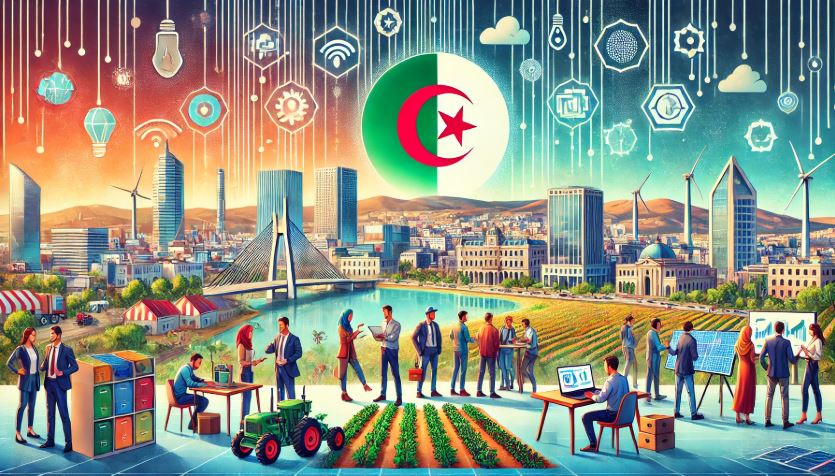
ALGIERS
Algeria, North Africa's largest country by land area and long defined economically by its hydrocarbon exports, is in the middle of an unusually centralized push to build a digital economy from the top down. Over the past eighteen months, the government has rolled out a five-pillar national digital strategy, launched 5G nationwide, opened its first dedicated AI and cybersecurity startup cluster, and put a new Chinese-built earth-observation satellite into orbit — all while setting explicit numeric targets for ICT exports, startup formation and specialist training through 2030. The result is a tech transformation story that looks less like an organic Lagos- or Nairobi-style startup boom and more like a coordinated industrial policy, with the state, state-owned telecom operators and the national oil company Sonatrach all acting as anchor investors.
Digital Algeria 2030: A Five-Pillar Blueprint
The backbone of the effort is the "Digital Algeria 2030" strategy, officially unveiled in May 2025 under the slogan "For a Digital Algeria." The plan is organized around five pillars — infrastructure, training, digital governance, the digital economy and digital society — and is meant to position Algeria as a regional leader in modern public administration as much as in private-sector innovation. Implementation has been front-loaded: the government says more than 500 digital projects are being rolled out between 2025 and 2026, with roughly 75 percent of them focused on modernizing public services, simplifying administrative procedures and reducing the need for citizens to travel in person to government offices. Flagship components include an Interactive National Portal for Digital Services and a cross-agency interoperability platform intended to centralize procedures and improve access for remote communities.
Algeria's starting point on e-government is modest. The country ranked 116th out of 193 countries in the United Nations' 2024 E-Government Development Index, with a score of 0.5956 — an improvement on its 0.5611 score in 2022, but still well behind regional peers such as Morocco and Tunisia. In March 2026, the Information Systems Security Agency, under the Ministry of National Defence, released the country's first National Information Systems Security Strategy for 2025–2029, framed explicitly around digital sovereignty, continuity of essential public services and building public trust in the state's expanding digital footprint — a signal that Algiers views cybersecurity as inseparable from the broader e-government push rather than an afterthought.

Connectivity Catches Up: The 5G Launch
Algeria officially inaugurated commercial 5G service on December 3, 2025, a launch Minister of Post and Telecommunications Sid Ali Zerrouki called a "decisive step" in the country's digital transformation. The country's three licensed mobile operators — Mobilis, the mobile arm of state-owned Algérie Télécom; Djezzy; and Ooredoo Algeria — together paid roughly 63.9 billion dinars (about $492 million) for spectrum. That rollout is being paired with new domestic compute capacity: Algeria is building an AI supercomputing and data-center facility in Oran, its second major tech hub after the capital, with the center expected to move from foundation-stage to fully operational between 2026 and 2027. Prospective anchor users being discussed publicly include a Sonatrach research program, a Ministry of Health clinical-AI initiative and a university-led climate-modeling project — evidence that state-owned enterprises and public institutions, rather than private cloud customers, are expected to be the first major workloads on Algerian AI infrastructure.
Building a Startup Nation From the Top Down
Algeria's startup policy follows the same state-anchored pattern. On April 21, 2026, the government inaugurated its first dedicated AI and cybersecurity startup cluster at the 87-hectare Chahid Abdelhafid-Ihaddaden technology pole in Sidi Abdellah, outside Algiers. The cluster is co-supervised by three ministries — Higher Education and Scientific Research, the Knowledge Economy and Startups portfolio, and Post and Telecommunications — and is co-located with the National Higher School of Artificial Intelligence (ENSIA), giving it a direct pipeline into newly trained AI graduates. Financing for the ecosystem is similarly state-heavy: the Algerian Startup Fund manages 2.4 billion dinars across twenty sectors, while Algérie Télécom separately committed 1.5 billion dinars (roughly $11 million) in 2025 specifically to fund AI, cybersecurity and robotics startups. Additional support includes an IPO fee exemption for labeled innovative startups as part of a 2026–2028 package of regulatory incentives.
The scale ambitions are explicit and numeric. Algeria currently counts more than 7,800 registered startups and roughly 2,300 formally "labeled" firms eligible for state incentives, against a national target of 20,000 registered startups by 2029. The government has also set a goal of training 500,000 ICT specialists by 2030 and lifting non-hydrocarbon exports — a category where ICT and digital services are expected to play a growing role — to $29 billion by 2030, up from just $5.1 billion in 2023. Ride-hailing and logistics company Yassir remains the ecosystem's most visible success story and the most-funded startup in the wider Maghreb region, though the broader pipeline still runs disproportionately through public accelerators tied to Sonatrach, Algérie Télécom, the state fuel distributor Naftal and major state-linked banks, alongside a network of 56 wilaya-level (provincial) incubators operated by Algeria Venture and private hubs such as Sylabs.
Reaching for Orbit: The Space Program
Algeria's technological ambitions extend into space. The Algerian Space Agency (ASAL), established in 2002 and based in Bouzareah, has now flown five satellites. Its newest, Alsat-3A, launched successfully on January 15, 2026 at 5:01 a.m. local time aboard a Chinese Long March 2C rocket, fulfilling the first half of a dual-satellite optical remote-sensing agreement signed with the China Aerospace Science and Technology Corporation (CASC) in July 2023. Alsat-3A is a high-resolution Earth-observation satellite with a 17.5-kilometer swath width and a three-day revisit cycle, intended for precision cartography, natural-resource management and disaster-risk monitoring. A companion satellite, Alsat-3B, is scheduled for launch later in the 2026–2032 window, according to the World Meteorological Organization's OSCAR satellite database. The mission also underscores the depth of Algeria's strategic technology partnership with China, which now extends from telecommunications infrastructure into space-based earth observation.
Risks and Realities
Independent assessments remain cautious about how quickly Algeria's state-directed model can produce a self-sustaining private tech sector. Analysts covering the country's investment climate continue to describe ambitious official targets running up against investor skepticism, rooted in bureaucratic friction, currency controls and a financing ecosystem still dominated by public funds rather than private venture capital. Algeria's mid-table e-government ranking, its reliance on state-owned enterprises as first customers for new digital infrastructure, and a startup base that remains small relative to regional peers like Egypt or Morocco all suggest the transformation is still in an early, state-scaffolded phase. Whether the Digital Algeria 2030 pillars — and the capital now flowing through the Algerian Startup Fund, Algérie Télécom's innovation fund and the Sidi Abdellah cluster — can convert into a durable, exportable digital economy by the decade's end remains the central open question for Algiers' technology planners.
Published By | Tech Wiz