Technological Transformation
Libya remains a country without a unified government, split between a Tripoli-based Government of National Unity and rival eastern authorities, and still recovering from more than a decade of intermittent conflict. Yet in 2026 its digital economy is expanding at a pace that outstrips much of the region — a case study in how payments infrastructure and telecommunications can advance even where political institutions have not been fully rebuilt. Central bank data, new submarine cable capacity, and an accelerating fintech sector all point to a country using technology to route around the fragmentation that still defines its politics.
A Central Bank-Led Digital Payments Boom
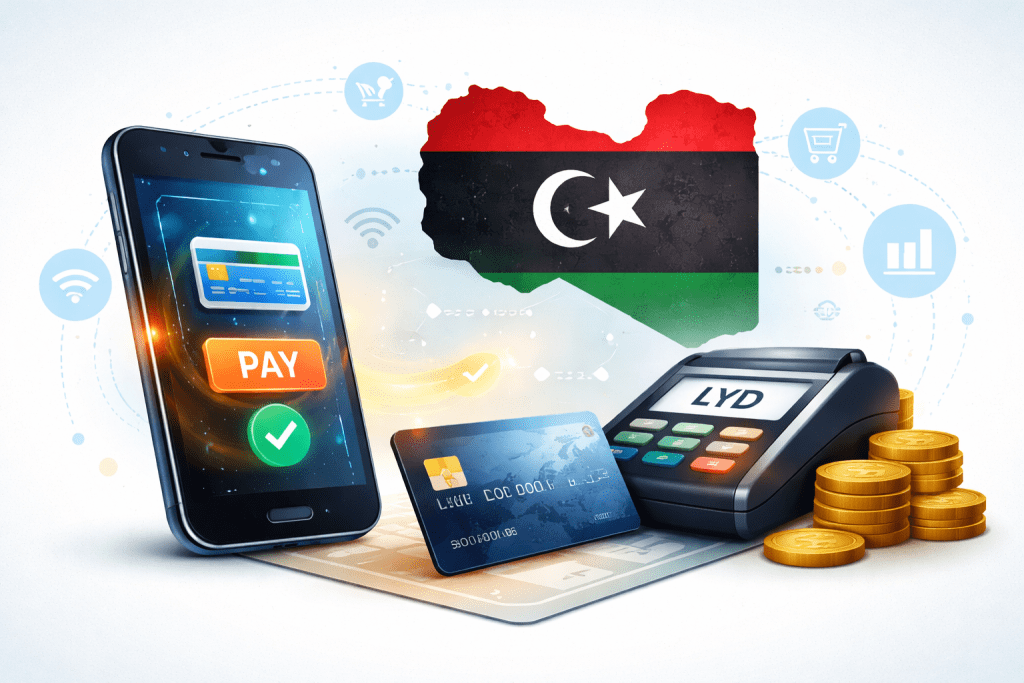
The clearest evidence of the shift comes from the Central Bank of Libya (CBL), which has made digital payments a signature policy priority under Governor Naji Issa. Electronic payment transactions rose 186% in 2025 to reach 389 billion Libyan dinars, according to CBL figures reported by the Libya Herald, and growth has continued into 2026: in the first seven and a half months of the year, e-payment app users reached 4.29 million, with more than 200.7 million transactions worth a combined 313.6 billion dinars. Point-of-sale infrastructure has expanded just as quickly — in the two months from January 1 to February 28, 2026 alone, issued POS terminals rose to 170,149 and activated payment cards reached 5,531,507, alongside 187,335 active e-wallets that processed nearly 90,000 transactions worth 8.2 million dinars in that window.

The CBL formalized this push in June, when Governor Issa inaugurated the second Libya International Exhibition for Electronic Payment and Financial Technologies (EPAIX 2026) in Tripoli on June 17–18, alongside Prime Minister Abdel Hamid Aldabaiba and representatives of local and international payment companies. The event showcased new SoftPOS technology, which lets NFC-enabled smartphones function as payment terminals without dedicated hardware — a low-cost option well suited to a market where merchant banking infrastructure is still uneven. The central bank has also moved this year to allow e-wallet access for foreign residents, widening the base of users beyond Libyan nationals and signaling an intent to formalize payment flows tied to the country's sizeable migrant and expatriate population.
New Undersea Bandwidth: The Medusa Cable
Libya's connectivity backbone took a significant step forward with the inauguration of the Medusa submarine cable on May 11, 2026, a project led by the state-owned Libyan Post, Telecommunications and Information Technology Company (LPTIC). The 8,700-kilometer system is designed to carry up to 480 terabits per second across its 24 fiber pairs — 20 Tbps per pair — and will directly link Libya to Cyprus, Greece, France, Portugal, Italy, and Spain, as well as to fellow North African markets Morocco, Algeria, Tunisia, and Egypt. Full system completion is expected to bring the cable into service later in 2026. Trade press coverage has framed the landing as a catalyst for the cities of Tripoli, Misrata, and Benghazi in particular, where improved international bandwidth is expected to support 5G rollout, data-center growth, and cloud-computing capacity that has previously been constrained by Libya's reliance on more limited legacy links. Separately, the European Commission has extended an additional €14.3 million to expand the broader Medusa/AFR-IX system toward West Africa, with a cable landing there targeted for 2028.
LPTIC and its mobile subsidiary, Libya Telecom & Technology (LTT), have paired the cable landing with domestic fiber expansion, extending corridors connecting Tripoli, Misrata, Benghazi, and Sabha, and launching a program to retire outdated fixed-line telephone exchanges in favor of broadband and fiber-optic infrastructure. At Mobile World Congress Barcelona 2026, LTT signed a memorandum of understanding with China's ZTE to accelerate 4G and 5G network expansion and to build an integrated digital services platform — one of several vendor partnerships aimed at closing Libya's mobile-technology gap with neighboring markets.
Mobile and Internet Penetration
Libya's underlying connectivity base is already substantial by regional standards. DataReportal's Digital 2026 Libya report put mobile subscriptions at 14.9 million as of late 2025 — a headline penetration rate of 199% of the population, reflecting widespread multi-SIM use — with 6.62 million unique mobile users, an 88.5% penetration rate. Notably, 92.9% of all mobile connections now qualify as broadband-capable (3G, 4G, or 5G), a base that positions the country well to absorb the capacity the Medusa cable and forthcoming 5G rollout are expected to unlock. Libyana Mobile Phone Company, the country's largest operator and a GSMA member, has continued to expand 4G coverage and describes 5G and digital-inclusion investment as core to its strategy.
A Small but Growing Fintech Sector
Libya's fintech ecosystem remains modest in absolute terms — The Fintech Times estimates around 20 fintech and digital financial service providers currently operate in the market, concentrated in payments and banking-led solutions. Sadad Libya, an electronic payments provider, is among the most established names, and banks themselves have increasingly rolled out mobile banking and digital wallet products directly rather than waiting for independent fintech entrants. One notable deployment in 2026: Tadhamun Bank engaged India's JMR Infotech to build an AI-powered 'Smart Social Banking' chatbot and voicebot, deployed across the bank's website, WhatsApp, and Messenger channels to handle customer onboarding, fund transfers, and account queries — an early example of generative AI tools being layered onto Libya's expanding digital-banking base.
Analysts covering the sector, including outlets like OneSafe and Libya Tribune, frame Libya's fintech growth less as a discretionary innovation wave and more as a structural necessity: with the banking sector still constrained by liquidity shortages and institutional fragmentation between rival governing authorities, digital payment rails offer a way for both banks and ordinary Libyans to keep money moving despite the absence of a fully unified financial regulatory system. The Central Bank of Libya has also held discussions with Libya's Telecoms Holding Company on integrating undocumented migrants and foreign residents into e-payment systems, extending formal financial access to populations historically excluded from Libya's banking sector entirely.

A Nascent Startup Scene
Beyond banking-adjacent fintech, Libya's broader startup ecosystem is still in an early stage but is drawing attention for ventures built around the country's position between Africa, Europe, and the Middle East — with early activity concentrated in digital banking, crypto-adjacent banking tools, and global payroll systems for a workforce increasingly dispersed by years of conflict and displacement. Ecosystem trackers describe growth as gradual rather than explosive, constrained by the same governance fragmentation, currency volatility, and limited venture capital access that weigh on the wider economy. Even so, the combination of new submarine bandwidth, an aggressive central-bank digitization agenda, and a young, highly mobile-connected population is creating conditions that regional analysts increasingly compare to the early digital-payments booms seen in other post-conflict and dual-governance markets.
Outlook
Libya's 2026 technology story runs directly counter to the country's political narrative. While reunification talks between Tripoli and eastern authorities remain stalled, the Central Bank of Libya has built one of the fastest-growing digital-payments bases in North Africa, LPTIC has landed a major new submarine cable, and mobile broadband penetration already approaches saturation. The risk is that this digital layer becomes a substitute for, rather than a bridge to, institutional unification — a financial and connectivity infrastructure that functions well precisely because it has been built to operate independently of a state that remains split in two. Whether that infrastructure ultimately supports reunification or simply makes fragmentation more tolerable is likely to shape Libya's digital trajectory as much as any single technology investment over the next several years.
Published By | Tech Wiz