Sriharikota, India
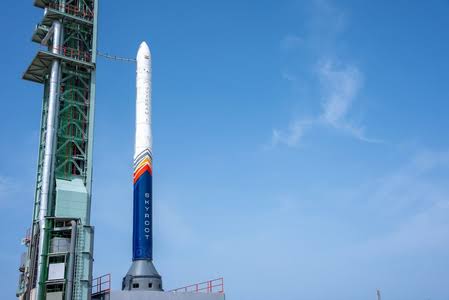
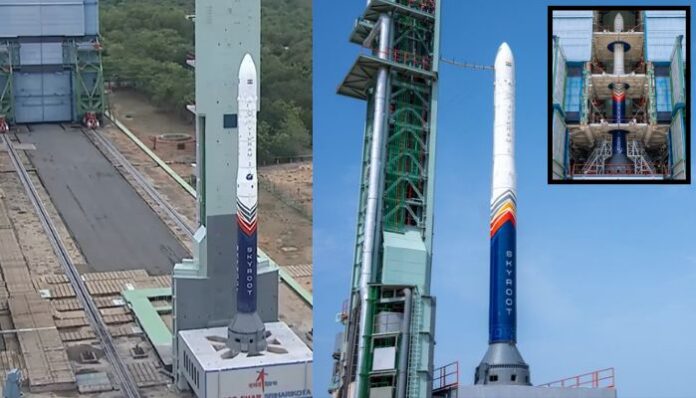
It happened at 12:05 in the afternoon, in the kind of scorching Andhra Pradesh heat that makes even seasoned engineers sweat through their badges. A slim, four-stage rocket, black-and-white and barely as tall as a seven-story building, sat on a pad at India's Satish Dhawan Space Centre, the same launch complex the country's government space agency has used for half a century. Sixteen minutes later, it wasn't just off the ground. It was in orbit, and India had quietly, decisively, joined an exclusive club that until this morning had exactly two members.
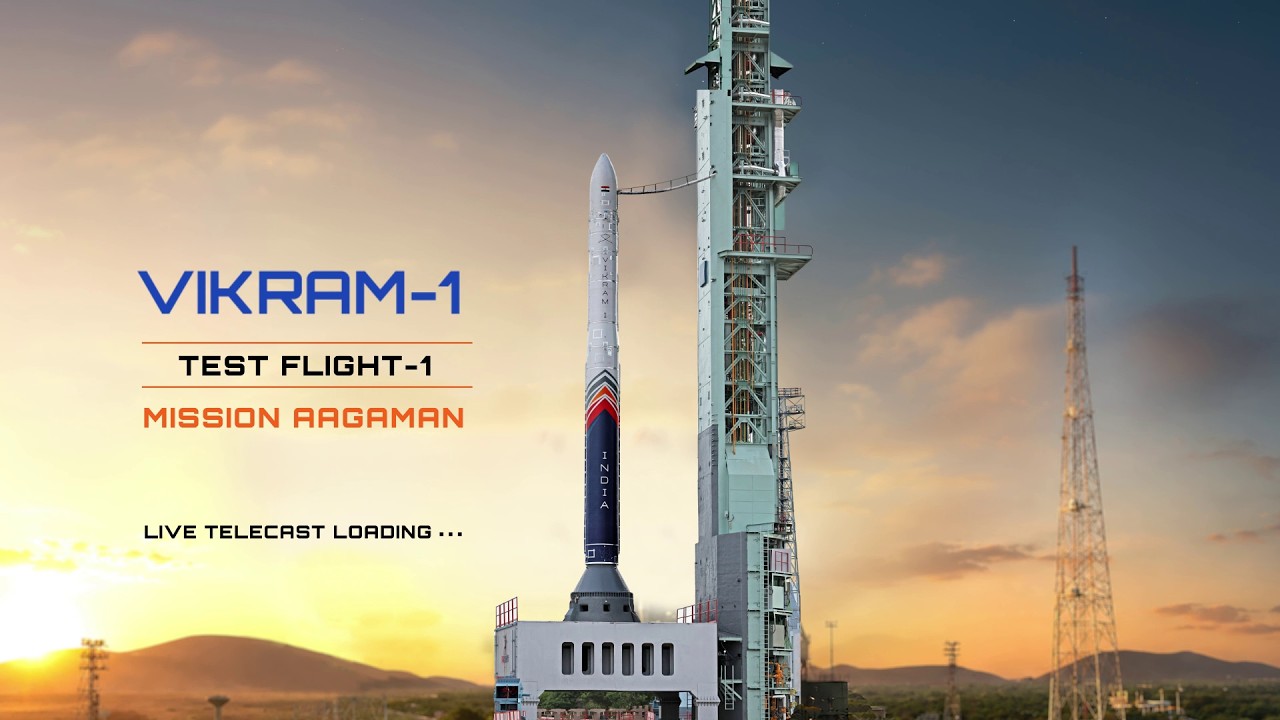
The rocket was Vikram-1. The company was Skyroot Aerospace. And the mission had a name that, in hindsight, could not have been more fitting: Aagaman. Sanskrit for "arrival."
For years the story of the new space race has been told almost entirely in American and Chinese accents — Elon Musk's fireballs over Boca Chica, China's secretive launch pads in the Gobi, the funding wars between Blue Origin and Rocket Lab. On Saturday, India elbowed its way into that story on its own terms, becoming just the third country on Earth — after the United States and China — where a fully private company has designed, built, and flown a rocket into orbit, without the launch vehicle itself being a government program.
No NASA. No ISRO rocket design. No inherited Soviet blueprints. Just a company that didn't exist eight years ago.
The Two Engineers Who Walked Out of ISRO
The origin story reads like the opening chapter of a startup bible. In 2018, two young engineers at the Indian Space Research Organisation — ISRO, the same agency that landed a probe on the Moon's south pole in 2023 — looked at the slow, government-paced cadence of India's launch program and decided they'd rather build the thing themselves.
Pawan Kumar Chandana and Naga Bharath Daka quit their jobs and founded Skyroot Aerospace in Hyderabad. They were joined by fellow former ISRO engineers Anand Ramalingam and Aravind Cherukuri. Their pitch to investors wasn't just "we can build rockets" — India's government had been doing that since the 1960s. It was "we can build them fast, cheap, and on demand," in a market where satellite operators were increasingly tired of waiting years and paying rideshare prices to fly on someone else's schedule.
The timing mattered. In 2020, the Indian government, under a broader economic liberalization push, opened up the country's space sector to private industry for the first time, creating a new regulatory body — the Indian National Space Promotion and Authorisation Centre, or IN-SPACe — to oversee and license private launch companies and grant them access to ISRO facilities and expertise. It was a seismic shift for a sector that had been a strict government monopoly for six decades.
Skyroot moved fast. In 2022, just four years after founding, the company became the first private Indian firm ever to reach space at all, when its smaller Vikram-S sounding rocket flew a brief suborbital hop. It was a proof of concept — impressive, but not orbital, and not commercially useful on its own. Getting to orbit is an entirely different and vastly harder engineering problem, one that has bankrupted or humbled more well-funded startups than most people realize.
Skyroot spent the years since quietly building toward exactly that goal, developing what it calls the Kalam-100 solid rocket motor (named, like much of the company's hardware, after India's revered former president and "Missile Man," APJ Abdul Kalam) as the third-stage engine for its new orbital-class vehicle, alongside carbon-composite airframe structures and 3D-printed engine components designed to slash both manufacturing time and cost compared to traditional aerospace machining.
Investors noticed. By the time Saturday's launch rolled around, Skyroot had raised roughly $160 million from a roster of marquee global backers, including Singapore's sovereign wealth fund GIC and state investor Temasek, pushing the company's valuation past $1.1 billion — making it India's first space-tech unicorn.
Sixteen Minutes That Changed India's Space Industry
The countdown wasn't perfectly clean. A technical snag detected at the T-minus-5-minute mark forced a roughly 35-minute hold while engineers worked through it — the kind of nail-biting delay that has aged rocket engineers prematurely since the dawn of spaceflight. But at 2:35 a.m. Eastern time (12:05 p.m. local time in India), Vikram-1's engines lit, and the four-stage rocket — three solid-fuel stages, believed by launch trackers to closely resemble ISRO's own proven solid-motor architecture, plus a liquid-fueled upper stage for precision orbital insertion — climbed away from Sriharikota.
Skyroot's own telemetry, later corroborated by outside observers, showed the vehicle tracking its planned trajectory almost exactly. Roughly 15 minutes after liftoff, the upper stage delivered its payloads into a low Earth orbit at an altitude of about 450 kilometers (280 miles) — precisely the target the mission had been designed for.
"Mission Aagaman is a grand success," the company declared in a statement, capping eight years of engineering with a single line that Chandana, the CEO, had reportedly not been sure he'd ever get to say. "In the first attempt reaching orbit, I never thought it was possible, but the Skyroot team made it possible," he said.
Vikram-1 is not a large rocket by global standards. It's designed to loft up to 480 kilograms (roughly 1,058 pounds) to low Earth orbit at a 45-degree inclination, or a somewhat lighter 290 kilograms to a sun-synchronous polar orbit favored by Earth-imaging satellites. For Saturday's specific mission, flying to a 60-degree inclination, the vehicle carried roughly 350 kilograms of payload. For comparison, that puts Vikram-1 in the same general size class as Rocket Lab's Electron rocket — the small-satellite launcher that, when it debuted in the late 2010s, kicked off the "smallsat launch" industry that Skyroot is now aiming to challenge on price.
The manifest for Aagaman itself was a showcase of the new companies this kind of rocket is meant to serve: Skyroot's own SCOPE technology-demonstration satellite, built to gather performance data on the rocket during flight; a payload from German company DCUBED; a satellite called SOLARAS S3 from Indian startup Grahaa Space; and, most strikingly, a robotic arm named "Embrace," built by Indian company Cosmoserve Space and designed to test orbital debris-capture technology — a small taste of the kind of "space cleanup" services that will become increasingly necessary as low orbit gets more crowded. The rocket also carried a symbolic 18-karat gold miniature rocket crafted by artist Ajay Kumar Mattewada and a decorative piece called "Cosmic Bloom" from Cosmos Diamonds, plus messages from members of the public around the world.
And in a detail that captures how closely India's political leadership is watching its private space sector, the rocket also carried a "Vande Mataram" card from Prime Minister Narendra Modi. Vande Mataram — "I praise thee, Mother" — is a patriotic song and de facto second national anthem tied to India's independence movement, and its inclusion aboard a private orbital rocket was a pointed piece of political theater as much as sentiment.
Modi didn't stay quiet after the launch, either. Posting on social media, he called the mission a "historic new frontier" for the country's space ambitions. "This four-stage rocket is designed to provide rapid and on-demand launch services," he wrote. "This mission highlights the talent, determination and entrepreneurial spirit of our youth. It also shows how our space-sector reforms are unlocking new opportunities for innovation and enterprise."

The "Cab Service" Pitch — And Why It Matters
The most quotable line to come out of Saturday's launch didn't come from a government minister — it came from Skyroot's own CEO, explaining in strikingly plain terms what his company is actually trying to sell.
"The 'cab' market is what we want to put our mark on with the Vikram series," Chandana said, describing Skyroot's ambitions in terms anyone can understand. "There are very few opportunities for customers to reach customized orbits today."
It's a deliberately unglamorous metaphor, but it captures something real about how the satellite-launch business actually works today for smaller operators. For most of the history of spaceflight, getting a satellite into orbit has resembled taking a long-haul train more than hailing a cab: you buy a ticket on someone else's scheduled route (a "rideshare" mission on a much bigger rocket, typically SpaceX's workhorse Falcon 9), you go where the train is going, on the train's schedule, dropped off wherever the primary customer's orbit happens to be — not necessarily where you actually wanted to go.
For a growing wave of small satellite operators — Earth-observation startups, communications constellations, university research missions, in-orbit servicing companies like the one that flew the Embrace debris-capture arm on Saturday — that mismatch between "the orbit we need" and "the orbit we can get a ride to" has become an increasingly expensive and time-consuming bottleneck. Dedicated small launchers like Vikram-1, or the aforementioned Rocket Lab Electron, exist precisely to solve that problem: fly a smaller rocket, less often, but exactly where and when the customer wants it, for a customer willing to pay a premium for that flexibility and precision.
Industry analysts note that a credible, lower-cost Indian entrant into that market could meaningfully reshape it, both because India's manufacturing and labor costs remain lower than in the US or Europe, and because a domestic Indian launch option gives the country's own fast-growing satellite and space-services sector — companies like Grahaa Space and Cosmoserve, both of which flew payloads on Saturday's mission — a home-grown alternative to buying rides from SpaceX or European launch providers.
What Experts Are Saying
Spaceflight analysts have been quick to frame Saturday's launch as more than just a nice achievement for one company — they're calling it a validation of India's decision to open its space sector to private capital in the first place. The 2020 reforms that created IN-SPACe were controversial at the time, with critics warning that India's government would struggle to give up control of a strategically sensitive sector. Saturday's launch is likely to be held up by the reform's champions as proof the bet paid off: a private Indian company, using its own engineering, its own money (largely from foreign investors), and its own facilities-sharing arrangement with ISRO, delivered a genuine national first that the government's own program had not yet achieved in quite this form.
That said, experts are also cautioning against over-reading a single successful flight. Orbital rockets are notoriously unforgiving, and even the biggest and best-funded companies in the world — SpaceX included — have suffered high-profile failures well after their first successful flights. Skyroot itself has been candid that Saturday's flight was as much a test of its own engineering as it was a commercial delivery, with the company's own SCOPE satellite designed specifically to gather performance data rather than serve a paying customer's operational needs. Turning one successful demonstration flight into a reliable, repeatable commercial launch service — the kind airlines and, yes, cab companies actually run — is a multi-year undertaking that will require Skyroot to fly again, and again, without a repeat of the kind of failures that have plagued even its most experienced competitors.
What This Means for You
If you don't work in the satellite industry, it's tempting to file this under "cool but distant" news. That would be a mistake. The steady proliferation of small, cheaper launch vehicles like Vikram-1 is one of the quiet forces reshaping daily life on Earth, whether you notice it or not. Cheaper, more accessible orbital launch means cheaper Earth-imaging satellites tracking crop yields, deforestation, and natural disasters in near-real time; it means more resilient and redundant communications and broadband satellite constellations, which is part of why rural internet access has been expanding even in places power grids struggle to reach; and it means more experimentation with the kind of in-orbit servicing and debris-removal technology that the "Embrace" robotic arm aboard Saturday's flight represents — technology that will matter enormously as low Earth orbit becomes more congested with satellites and space junk in the years ahead.
There's also a geopolitical dimension worth understanding. Space launch capability has always doubled as a marker of national industrial and technological capacity, and a demonstration like Saturday's reinforces India's positioning as a rising technology power with ambitions well beyond its historical role as a back-office software and services hub. For consumers and businesses in India and beyond, a credible, lower-cost domestic launch option could eventually mean cheaper satellite broadband, cheaper satellite imagery for agriculture and insurance, and a more competitive global launch market overall — competition that has already been a major factor in driving down launch prices over the past two decades.
The Road Ahead
Skyroot isn't stopping here. The company has talked openly about ambitions beyond simple satellite delivery — including, eventually, potentially ferrying cargo or crew to future space stations, a considerably more ambitious and distant goal that would require entirely new categories of vehicle and safety certification. For now, the company's near-term roadmap is expected to focus on turning Saturday's single successful flight into a reliable cadence of launches, building out a backlog of customers who need exactly the kind of "on-demand orbit" service Chandana has been pitching, and proving to increasingly skeptical global satellite operators that a young Indian company can be trusted with genuinely expensive hardware.
For a country that watched, mostly from a distance, as SpaceX rewrote the economics of spaceflight over the past fifteen years, and as China quietly built up its own parallel commercial launch sector, Saturday's flight was a statement: India isn't just watching this revolution anymore. It's flying in it. Vande Mataram, indeed.
Published By | Tech Wiz