Technological Transformation
Most national digital transformation programmes follow a familiar sequence: lay fibre, sell smartphones, get people online, and then build services on top of the connected population. Ethiopia has done it backwards. As of 24 August 2026 the country's National ID Program had completed 49.1 million enrolments in Fayda, its biometric digital identity system. At the end of 2025, according to DataReportal's Digital 2026 report, Ethiopia had 29.5 million internet users — an internet penetration rate of 21.7 percent.
In other words, roughly 20 million Ethiopians now hold a verified digital identity credential and no meaningful internet connection. That inversion is the single most interesting fact about Ethiopian technology policy in 2026, and it explains both the speed of the country's recent gains and the ceiling they are approaching.
The Fayda Machine
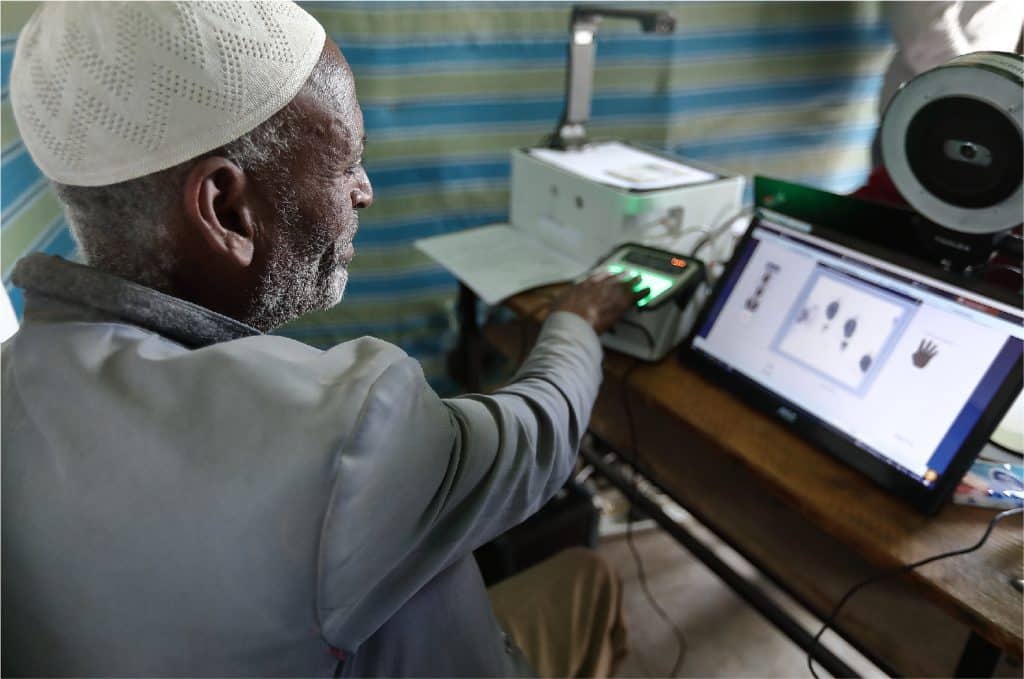
Launched in 2023, Fayda has scaled faster than almost any comparable programme on the continent. The National ID Program reports 12,000 biometric registration kits deployed nationwide, 150 agencies integrated with the system and more than 194 million electronic know-your-customer verifications processed to date. Over 15 million physical ID cards have been issued. The stated target is 90 million enrolments by 2027, which would cover essentially the entire adult and school-age population of a country of roughly 130 million people.
The delivery model is unusual and worth naming, because it is the reason for the pace. Ethio Telecom — the state incumbent — joined the registration effort in April 2024 and has since enrolled close to 32 million citizens, some 69 percent of all Fayda registrations nationally. A telecommunications operator, not a civil registry office, has become the primary front door to legal digital identity. That leverages an existing physical footprint of shops and agents that no ministry could have replicated in two years, but it also concentrates a foundational piece of public infrastructure inside a commercial entity.
Adoption has been driven less by persuasion than by mandate. Ethiopian banks began harmonising customer account information with Fayda in December 2025, and all bank account holders must link their accounts to a Fayda ID by 31 December 2026. From 2026 the ID became a requirement for school registration, and in June 2026 the system was linked to the national passport platform in what officials described as a utility-first adoption push. Prime Minister Abiy Ahmed has claimed Fayda's contribution to GDP will reach 7 percent by 2030 — a figure that should be treated as an aspiration rather than a measurement, but which signals how central the programme is to the Digital Ethiopia 2030 strategy.
In August 2026 the national ID authority was converted into Faydaverse, a commercial government-owned enterprise mandated to develop, operate and scale trusted digital public infrastructure — including, explicitly, beyond Ethiopia's borders. That is a notable move: Ethiopia is positioning a domestically built DPI stack as an export product into a continental market currently served largely by MOSIP implementations and European vendors. The inclusion agenda has been genuine, with the programme prioritising registration of women, refugees and internally displaced people; Fayda is a central pillar of Ethiopia's five-year refugee inclusion strategy, on the reasoning that without legal identity displaced people cannot open accounts, receive loans or participate formally in the economy at all.
The Payments Layer Is Real Money Now
If identity is the foundation, mobile money is the first structure built on it — and the numbers have moved from notional to macroeconomic. Ethio Telecom's telebirr has processed more than 6.8 trillion birr in cumulative transactions since launch, with over 1.9 trillion birr moving in the six months to December 2025 alone. Ethio Telecom's total subscriber base has surpassed 87 million.
Competition, long absent from Ethiopian telecoms, is now producing measurable pressure. Safaricom Ethiopia reported service revenue of 15.9 billion birr for the financial year ended 31 March 2026, a 130.9 percent year-on-year increase. Its active M-PESA subscriber base rose 119.4 percent to 5.2 million; M-PESA Ethiopia processed 442.2 million transactions during the year, up 168.7 percent, with transaction value rising 38.8 percent to KSh 28.6 billion (roughly US$221 million). The operator's 90-day active customer base reached 13.6 million, up 54.2 percent, and by the end of July 2026 had passed 14.7 million after adding a million customers in three months. Ethiopia contributed 15 percent of Safaricom Group's total service revenue growth for the year.
Two observations follow. First, the gap between telebirr's transaction volumes and M-PESA's remains vast — a duopoly in name, a near-monopoly in practice. Second, M-PESA's transaction count grew four times faster than its transaction value, meaning the average transaction is shrinking rapidly. That is the signature of a service moving from remittance-style transfers into everyday retail payments, which is exactly the transition Kenya's M-PESA made a decade and a half ago and the one that eventually reshapes cash usage.
A Stock Market Learns to Price a Telco
The most consequential institutional event of Ethiopia's 2026 tech year happened not in a data centre but on a trading floor. Ethio Telecom listed on the Ethiopian Securities Exchange Main Market on 26 May 2026, following a public offering that attracted more than 47,000 investors; 96 percent of registered subscribers, representing about 45,000 shareholders, had their data fully verified before listing.
The path there was instructive. The initial public offering — the first tranche of the state's privatisation of the incumbent — was undersubscribed, an uncomfortable result for a government that has staked considerable credibility on capital-market development. Once listed, the stock behaved very differently, with the TELE counter climbing sharply in early trading. The lesson is one that will matter for every subsequent Ethiopian privatisation: retail investors who would not commit to a fixed-price primary offering were willing to buy in a liquid secondary market. A functioning exchange changed the demand curve for the same asset.
This matters for the technology sector specifically because Ethiopia's startup financing has been chronically thin. Addis Ababa's ecosystem grew 5.5 percent in 2026 and ranks 422nd globally on StartupBlink, with 93 tracked startups. Tracxn counts 226 funded Ethiopian companies having raised US$1.67 billion cumulatively across all rounds — a figure dominated by a handful of large, mostly telecom- and energy-adjacent transactions rather than a broad venture pipeline. Addis Ababa Angels deployed US$2 million across 12 startups between 2023 and 2025. Against that backdrop, a domestic exchange capable of pricing and trading a large technology asset is arguably more important to the ecosystem than any single fund.
Compute, Universities and the AI Bet
Ethiopia's artificial intelligence programme is unusually state-led even by African standards. The Ethiopian Artificial Intelligence Institute, established in 2022, functions as the central body for AI research, development, deployment and regulation, working under the 2024 National AI Policy. Its declared portfolio spans health, agriculture and services, alongside capability-building in cloud computing, large-scale data centres, data mining, robotics and immersive technologies.
On 2 March 2026 the Council of Ministers formally approved the establishment of Medemer Artificial Intelligence University, a public autonomous institution in Addis Ababa dedicated to artificial intelligence and advanced computational sciences — an unusual move to create a single-purpose university rather than expand existing engineering faculties. The Council also approved a regulation enabling Ethiopia's first dedicated AI research centre. In March 2026 Ethiopia and India deepened an AI partnership through a high-level technical visit, part of a broader pattern of sourcing capability from Asian rather than Western partners.
The physical substrate remains the weak link. Ethiopia currently has six data centre facilities. It is a named beneficiary of a US$100 million International Finance Corporation commitment to expand Raxio Group's data centres across sub-Saharan Africa, and sits within a group of eight African markets — alongside Morocco, Djibouti, Ghana, Tanzania, Uganda, Mozambique and Gabon — expected to attract a combined US$1.36 billion in data centre investment by 2031. Spread across eight countries and five years, that is a meaningful but modest sum, and it is dwarfed by single-site AI campus announcements elsewhere on the continent. Ethiopia's genuine advantage — abundant hydroelectric generation — has not yet translated into hyperscale compute.
The Connectivity Ceiling
Which brings the argument back to where it started. Ethiopia had 93.2 million active cellular mobile connections at the end of 2025, equivalent to 68.4 percent of the population, but only 29.5 million internet users at 21.7 percent penetration and 9.8 million social media identities at 7.2 percent as of October 2025. A large share of those mobile connections carry voice and SMS only.
Every one of the achievements above runs into this constraint. A digital ID with 194 million eKYC verifications is impressive, but authentication requires an authenticating institution with connectivity, which is why bank branches and telecom shops — not citizens' own devices — remain the transaction point. Mobile money that grows transaction counts faster than values is moving toward everyday retail use, but everyday retail use at scale requires data-capable handsets. An AI university and a national AI institute produce researchers who need compute, and compute needs both power and international bandwidth, in a landlocked country dependent on Djibouti for its route to the sea.
Ethiopia's macroeconomic reform programme provides the surrounding context. The IMF Executive Board completed the fourth review of Ethiopia's Extended Credit Facility arrangement on 16 January 2026, part of the multi-year adjustment that began with the flotation of the birr in mid-2024 — a reform that also made every imported handset, base station and server substantially more expensive in local currency terms. Currency liberalisation and device affordability are pulling in opposite directions at precisely the moment the digital agenda needs devices in hands.
The honest assessment is that Ethiopia has built the two hardest and least glamorous layers of a digital economy — foundational identity and a domestic payments rail with real volume — before building the layer everyone else starts with. That sequencing is defensible: identity and payments create the demand case for connectivity, rather than the other way round, and they do so in a way that reaches rural populations a fibre-first strategy would have taken a decade to serve. But it is a bet with a deadline. If internet penetration is still near 20 percent when Fayda hits 90 million enrolments in 2027, Ethiopia will have issued the continent's largest digital identity to a population that mostly cannot use it directly.
Published By | Tech Wiz