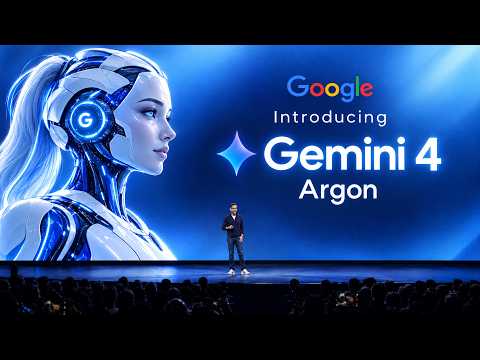
After months of 'where's the new model?' jeers, Google's DeepMind drops a frontier AI that beats OpenAI and Anthropic on most benchmarks, costs a fraction of the rivals' price, and is being handed first to cyber-defenders. Here's what it means for your job, your wallet and your security.
SCIENCE & TECH
For the best part of a year, the whispers around Silicon Valley had a nasty edge: Has Google lost the AI race? The search giant that invented the transformer architecture behind every modern chatbot had gone quiet at the top end, while rivals rolled out one flagship after another. Its last big-number model, the Gemini 3 series, landed back in November 2025. Then, nothing at the very top of the range. For ten long months.
On 30 September 2026, the silence ended with a bang. Google DeepMind unveiled Gemini 4 Argon, a new frontier model that, by Google's own tally, leads or ties on 13 of the 18 benchmarks it chose to disclose. It out-lawyers its rivals, out-codes most of them, out-watches them at video, and does it all at a price that makes accountants sit up straight.
There is a catch, and it is a big one. You can't use it yet. Argon is in a tightly limited release, going first to a hand-picked group of 'trusted cyber defenders' and to U.S. government pre-release testing programmes. Ordinary mortals will have to wait.
Welcome to the strangest, most consequential AI launch of the autumn.

What exactly is Argon?
Google describes Gemini 4 Argon as a model built for 'deep reasoning across complex, long-horizon workflows'. Translate that from corporate: it's designed not to answer one question, but to grind through a huge, messy, multi-hour job — rewriting a software codebase, reviewing a mountain of legal documents, hunting for holes in a company's security — without losing the plot halfway through.
Google is aiming squarely at three areas where businesses already spend serious money: software development, professional knowledge work such as law and finance, and cybersecurity operations. That is no accident. Those are the fields where an AI that can work independently for long stretches turns from a clever toy into a line item on a budget.
One headline spec stands out: Argon can produce up to one million tokens of output in a single go. The previous ceiling was 64,000. A token is roughly three-quarters of a word, so we are talking about an AI that can, in principle, write something like the length of several novels — or an enormous slab of computer code — in one pass.
The scoreboard: where Argon wins
Benchmarks are the AI industry's version of football league tables, and Argon's early numbers are eye-catching. According to figures reported by VentureBeat from Google's own disclosures, Argon outright wins 12 of the 18 tests, ties one, while OpenAI's GPT-6 Astra leads on three and Anthropic's Claude Opus 5.5 on two.
The most dramatic gap is in the legal arena. On Harvey's Legal Agent Benchmark, Argon scored 19.6 per cent, against 5.4 per cent for GPT-6 Astra and just 3.8 per cent for Claude Opus 5.5. Those are low absolute numbers — the test is brutally hard — but Argon is several times better than the pack.
On AutomationBench, which measures how well an AI can carry out real business workflows, Argon hit 51.3 per cent versus 42.5 for Claude Opus 5.5 and 41.4 for GPT-6 Astra. On the Vals Finance Agent test it managed 65.4 per cent against 58.6 and 53.5. On the software-engineering test DeepSWE v1.1 it posted 77.9 per cent, edging Claude (74.2) and GPT-6 Astra (74.1). And on LVBench, a test of understanding long videos, it reached 91.7 per cent, ahead of GPT-6 Astra's 87.5 and Claude's 83.7.
On the cybersecurity-flavoured CWE-bench, which tests fixing known vulnerabilities, Argon and GPT-6 Astra tied at 68 per cent, with Claude a point behind at 67.
Where it stumbles
This isn't a clean sweep, and the tabloid in us wouldn't be doing its job if we skipped the bruises. On FrontierSWE v2, a tough software-engineering test, GPT-6 Astra scored 65.5 per cent to Argon's 55.0 — a gap of more than ten points. On Terminal-Bench Science, GPT-6 Astra again led, 68.1 to 57.6. On the general Terminal-Bench 4.0, Claude Opus 5.5 was ahead, 66.4 to 57.4, and Claude also won on PostTrainBench, 49.3 to 45.3.
In plain English: if your job is wrestling with a command line or doing frontier science-style tasks, the rivals may still have the edge. If your job is law, finance, long-document analysis, video or sprawling business automation, Argon looks like the one to beat.
Independent analysts back up the broad picture. Artificial Analysis, which runs its own intelligence index, scored Argon at 53 — level with GPT-6 Astra and ahead of GPT-6.1 Sol on 52. That is a leap of 23 points from Google's previous best, Gemini 3.1 Pro Preview, which scored 30. 'Google is back as one of the top three labs in intelligence achieved,' ran the headline on its write-up. The firm also found Argon topping its own agentic test, AutomationBench-AA, at 78 per cent, seven points clear of Claude Sonnet 5.5.
The price tag that made rivals wince
If the benchmarks are the sizzle, the pricing is the steak. During an introductory period Google is charging $2 per million input tokens and $10 per million output tokens. Cached input — text the model has already seen — is discounted by 95 per cent. That works out at about one-fifth the cost of GPT-6 Astra, which charges $10 and $50, and half the price of Claude Opus 5.5 at $4 and $20.
Once the promotion ends the rate doubles to $4 and $20, matching Claude Opus 5.5 and still well below GPT-6 Astra. Google hasn't confirmed how long the discount will last.
There is a wrinkle. Artificial Analysis found Argon is wordy: it averaged roughly 62,000 output tokens per task, against about 27,000 for GPT-6 Astra. Even so, the cheaper token price more than compensates. The firm calculated a cost of $1.99 per task on its index at promotional prices — about 60 per cent of GPT-6 Astra's $3.26 — rising to $3.98 once the discount ends.
Inside Google: the bots that fix Google
Google didn't just publish scores; it boasted about using Argon on its own sprawling empire. According to the launch details, Argon-powered agents sifted fleet-wide telemetry from Google's data centres and found memory optimisations expected to free more than 300 tebibytes, with total savings estimated at between 500 TiB and a full pebibyte.
In software, agents have been helping migrate old C and C++ code to the memory-safe Rust language, including core libraries and parts of the Zircon kernel in Google's Fuchsia operating system. In one showpiece project, an AI replaced 32,000 lines of hand-tuned SIMD code, producing a memory-safe video decoder that runs 2.7 times faster than the previous Rust port.
Google even says Argon found a 40 per cent improvement on a published baseline when optimising a bottleneck routine in quantum computing. Take those internal claims with a pinch of salt — they are Google grading its own homework — but they show the ambition: not a chatbot, but a digital engineer.

Why the cyber-defenders go first
The unusual rollout is the real story. Rather than throwing the doors open, Google is giving Argon first to participants in its Fairwind Program, introduced earlier in September, and to a U.S. government voluntary pre-release testing process. Only then will it move to paid API customers and Google AI Ultra subscribers, 'as soon as possible'.
The logic is the double-edged nature of cyber skills. A model that is superb at finding and fixing software vulnerabilities is, by definition, also good at finding ways in. Giving defenders a head start is a bet that the good guys can patch faster than the bad guys can exploit. Security firm Wiz, using Argon through its 'Scan for Good' initiative, has reportedly already uncovered a critical flaw in healthcare software that exposed sensitive personal information.
Google says it is hardening safeguards 'against cyber and CBRN misuse, indirect prompt-injection attacks, model misalignment and insecure agent environments' before a wide release, including monitors that can halt the model mid-task.
The experts: impressed, but asking questions
Not everyone is cheering unreservedly. The security-focused analysis from NeuralTrust points out that while Google says Argon leads Gray Swan's indirect prompt-injection benchmark, the company published no actual score in its own materials, and reports suggest the Fairwind group received the model without its cyber safeguards. 'Several vendors can claim a lead without published scores to settle it,' the analysis warns. (VentureBeat's reporting cites a 0.7 per cent attack success rate for Argon versus 1.0 for Claude and 8.5 for GPT-6 Astra — a reminder that figures are still being pinned down.)
The deeper worry is scale. As that same analysis puts it, 'an agent that writes 800,000 lines in one pass produces a diff no human can review line by line.' Prompt injection — hiding malicious instructions in a document or web page an AI reads — is still ranked as the number-one risk for large language models by the OWASP security project. Its advice: 'Control has to sit where the agent acts, whichever model sits behind it.'
On the plus side, Artificial Analysis measured Argon's hallucination rate — how often it confidently makes things up — at just 15 per cent, the lowest of the top-tier models it tested, compared with 51 per cent for GPT-6 Astra and 54 per cent for GPT-6.1 Sol.
The wider AI soap opera
Argon arrives in a week of high drama across the industry. Reports this week say OpenAI parted ways with three safety researchers over alleged mishandling of sensitive information, and Bloomberg reports Anthropic is eyeing a November stock-market debut at a valuation that could reach or exceed $2 trillion. Meanwhile OpenAI has launched GPT-6.1 Sol and Anthropic Claude Sonnet 5.5. The top three labs are now trading blows almost weekly.
For Google, Argon is as much about narrative as numbers. After months of criticism over its release cadence, the company needed to show it can still produce a model at the very front of the pack. On the evidence so far, it has.
What this means for you
If you work in a profession built on reading, drafting and checking — law, accounting, finance, consulting — the AI that can handle long, complex jobs is getting uncomfortably good, and cheap. Expect your employer to start asking what an hour of your time costs compared with a few dollars of Argon.
If you're a developer, the million-token output and low prices could reshape how code gets written and migrated, though the review burden on human engineers will grow, not shrink.
If you're a consumer, there is nothing to download today. Google AI Ultra subscribers should see Argon first when the rollout widens. And if you simply worry about online security, the early-defender approach is, on balance, good news: the first people to wield this tool are the ones paid to protect your data.
Finally, if you're an investor or just a spectator, the lesson is that the AI leaderboard is a moving target. Six months ago Google was written off. Today it's back in the three-way fight.
Verdict
Gemini 4 Argon is not the end of the AI race — no model is — and its best numbers are Google's own, awaiting wider scrutiny. But the combination of top-tier scores, aggressive pricing and a cautious, defender-first release makes this one of the most significant launches of 2026. The sleeping giant has woken up. Now everyone is waiting to see who blinks first: Google on access, or OpenAI and Anthropic on price.
Published By | Tech Wiz