In the pitch-black hours before dawn off a tropical Chinese island, engineers bet everything on a landing method nobody had ever pulled off outside a laboratory whiteboard — a rocket booster flying itself backward into a net strung across a ship. It worked. On the first try.
HAINAN ISLAND, China
A Rocket, a Net, and a Ship Waiting in the Dark
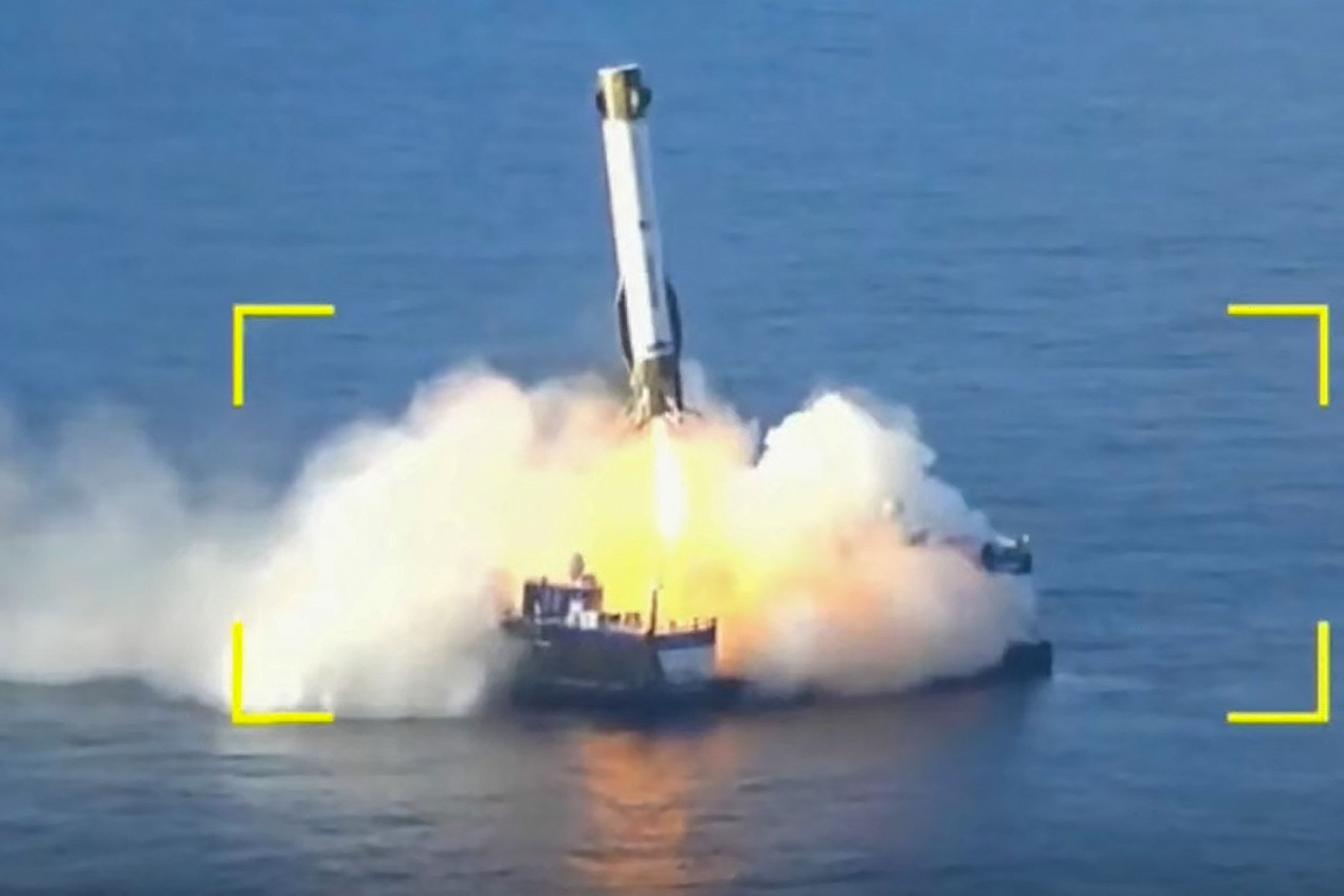
At 12:15 a.m. Eastern Time — already deep into Friday morning local time — a Long March-10B rocket lit up the sky over the Hainan Commercial Space Launch Site, a brand-new facility on China's southern resort island. Eleven minutes later, halfway around a routine satellite-delivery mission, something extraordinary happened roughly six minutes after the booster separated from its upper stage: instead of tumbling into the ocean as space junk, the first-stage booster flipped around, reignited its engines, and steered itself toward a waiting ship called Linghang Zhe — "Navigator" — floating in the recovery zone of the South China Sea.
What happened next had never been done before, by any country, on any rocket, ever. Rather than touching down on four spindly landing legs the way SpaceX's Falcon 9 and Blue Origin's New Glenn do, the Chinese booster deployed a hook. That hook caught a tensioned net strung across the deck of the recovery vessel, and a system of hydraulic dampers absorbed the shock, gently reeling the multi-story rocket stage to a stop like a fish being landed on a very expensive line.
"This mission marks my country's first successful controlled recovery of a launch vehicle and the world's first network-based recovery of a launch vehicle," the China Aerospace Science and Technology Corporation, or CASC, announced on social media within minutes of the catch, according to reporting from SpaceNews and Xinhua. It wasn't hyperbole. In one maiden flight, China had just become the second nation on Earth — after the United States — to successfully recover an orbital-class rocket booster.
How Do You Land a Rocket Without Legs?
For nearly a decade, "reusable rocket" has meant one thing in the public imagination: the surreal sight of a Falcon 9 booster dropping tail-first out of the sky and settling onto a drone ship or landing pad on a pillar of fire, landing legs unfurling like a spider at the last second. SpaceX pulled off that trick for the first time in December 2015 and has since turned it into a routine spectacle, relaunching the same boosters dozens of times and, in the process, rewriting the economics of spaceflight.
China's engineers looked at that playbook and decided to skip a step. The Long March-10B's net-capture system means the booster itself doesn't need landing legs at all — no heavy, complex, retractable hardware bolted to the bottom of the rocket. Instead, virtually all of the "catching" infrastructure lives on the ship. As the booster descends under its own guided control, a hook mechanism mounted on its body deploys and snags the net; the net and its damping system do the rest, bleeding off the rocket's remaining momentum so it doesn't shred itself, or the ship, on impact.
It's a fundamentally different bet on where the engineering complexity should live. SpaceX put the shock absorbers on the rocket. China just put them on the boat. CASC says the approach reduces the mass the booster has to carry into orbit and back, since it no longer needs legs, in theory boosting how much payload it can lift — CASC lists the Long March-10B's reusable capacity at up to 16 tonnes to low-Earth orbit, enough to loft the kind of large satellite-constellation payloads that have become the hottest commodity in the launch business.
China says it isn't finished proving the concept, either. The state-owned launch giant has already announced plans to refly this exact booster — the one caught in the net off Hainan — before the end of 2026, a turnaround that would put China on a path toward the kind of rapid-reuse cadence that has made SpaceX's Falcon 9 the most-launched rocket family in history.
Second Place, But Closing Fast
Every story about a Chinese space milestone eventually runs into the same shadow: SpaceX got there first, and got there a decade ago. CNN's coverage of Friday's launch was blunt about the framing, describing it as a breakthrough that comes "as [China] vies to catch up with the US." That gap is real, and it's still wide. SpaceX has landed and reflown Falcon 9 boosters well over 400 times combined, refining the process into something close to routine, with turnaround times between launches now measured in days. China just did it once.
But "just once" undersells how hard the underlying problem is. Landing an orbital booster — any orbital booster, by any method — requires threading a needle: the vehicle has to survive re-entry heating, reignite engines with pinpoint timing, navigate itself through wind and current to a moving or fixed target, and arrest tens of thousands of miles per hour of velocity without tearing itself apart, all while carrying no crew and getting essentially one shot to prove the physics works. Blue Origin, backed by Jeff Bezos's fortune and founded a year before SpaceX, only pulled off its first New Glenn booster landing in the past couple of years. Europe, Japan, and a swarm of well-funded American startups have yet to land an orbital booster at all. China skipped the failures that public accounts suggest even SpaceX suffered through — including several booster losses before the first successful 2015 landing — and nailed a genuinely novel recovery method on its maiden flight.
That's the detail rippling through the space industry this week: not that China matched SpaceX, but that it found a different, untested way to solve the same problem and got it right immediately. Whether the net-and-hook method scales as reliably as leg-and-thrust landing over hundreds of flights is an open question — but China has bought itself real engineering data to answer it with, while the rest of the industry is still watching from the sidelines.
The Money and the Motive
None of this is happening for the love of engineering. Reusability is, bluntly, about money — and about who controls the fastest-growing real estate in the modern economy: low-Earth orbit. Launch costs have historically run somewhere between $2,000 and $10,000 per kilogram to orbit for expendable rockets; SpaceX's reuse of the Falcon 9 is widely credited with dragging that number down dramatically, which is a large part of why Elon Musk's company has been able to deploy over 8,000 Starlink satellites and still turn a profit on launch services.
China wants that same economic unlock, and it wants it specifically to build out its own answer to Starlink — two planned mega-constellations, known as Guowang and Qianfan ("Thousand Sails"), that together are slated to put upward of 26,000 satellites into orbit over the coming decade to deliver broadband internet and, unspoken but understood, strategic and military communications independent of American infrastructure. Launching tens of thousands of satellites on expendable rockets, at tens of millions of dollars a pop with the hardware burning up or splashing into the ocean every single time, is not a viable path to that goal. Reusable rockets are the only way the math works.
The Hainan Commercial Space Launch Site itself is a tell: it's a purpose-built commercial facility, separate from China's traditional inland military-linked launch complexes, explicitly designed to host a wave of private and quasi-private Chinese launch companies racing to build their own reusable rockets — outfits with names like LandSpace, iSpace, and Space Pioneer that have been quietly testing vertical-landing technology on hopper vehicles for the past two years. Friday's success by state-owned CASC sets the bar — and the pressure — for all of them.
Skeptics Say Not So Fast
Space analysts are cautioning against reading Friday's single successful catch as proof China has closed the reusability gap. A rocket that lands once is a demonstration; a rocket that lands, gets refurbished, refuels, and reflies dozens of times on a tight schedule is an industry. SpaceX's real advantage isn't that a Falcon 9 booster can land — it's that a Falcon 9 booster can land, get a fresh coat of paint, and be back on the pad ready to fly again inside of a week, over and over, with failure rates now low enough that customers barely think about it.
The net-capture method also raises its own unanswered questions. Every landing now depends on a ship being in exactly the right place, in workable sea conditions, with a net system that has to perform flawlessly at the exact moment a multi-ton object is hurtling toward it at speed — a more choreographed, weather-dependent operation than a booster settling itself onto a fixed drone-ship deck. How that holds up in rough seas, at night, in a monsoon, over dozens of flights, is precisely the kind of question that only gets answered by doing it again. And again.
Expert Perspective
CASC's own statement leaned hard into the historic framing without hedging on the challenge ahead, calling the mission a validation of "key technologies, including booster recovery, sea-based capture and a full-profile flight mission" — engineer-speak for: we proved the physics, now we have to prove we can do it reliably. Independent space analysts covering the launch for SpaceNews and Bloomberg noted the milestone's real significance isn't matching SpaceX's decade-old feat, but demonstrating that a fundamentally different recovery architecture — one that shifts weight and complexity off the rocket and onto ground infrastructure — can work at all, on an orbital-class vehicle, on the very first attempt. That's a data point the rest of the reusable-rocket world doesn't have yet, from anyone.
What This Means for You
If you've never thought about who's landing rockets in the South China Sea, here's why it's about to matter more than you'd guess. The launch industry's price war is a big part of why satellite internet has gotten cheaper and more available worldwide, why weather forecasting and disaster monitoring keep improving, and why the next generation of GPS, broadband, and Earth-imaging satellites are getting cheaper to build and replace. A second country that can reliably land and reuse orbital rockets means more competition for launch contracts, which historically pushes prices down for everyone from NASA to your local telecom provider trying to lease bandwidth on a satellite constellation.
It also matters geopolitically in a way that will show up in the news well beyond space blogs. Launch capacity is increasingly treated as strategic infrastructure — the same rockets that loft broadband satellites can loft military reconnaissance hardware, and the nations that can launch cheaply and often hold real leverage in everything from telecommunications standards to defense posture in the Asia-Pacific region. Expect Friday's landing to feature in Washington policy discussions about export controls, satellite competition, and the pace of America's own reusable-rocket programs at Blue Origin, Rocket Lab, and a crowded field of newer entrants.
For one nervy night off Hainan, a hook, a net, and a ship called Navigator did something no launch vehicle outside SpaceX's fleet had ever managed. China insists it will fly that same booster again before the year is out — and if it does, the world's two-decade-old reusable-rocket monopoly will have officially become a duopoly. The rest of the industry, from Blue Origin to the crowd of ambitious Chinese startups waiting in the wings at Hainan, is watching very closely to see what happens the second time around.
Published By | Tech Wiz




