Economic & Social Transformation
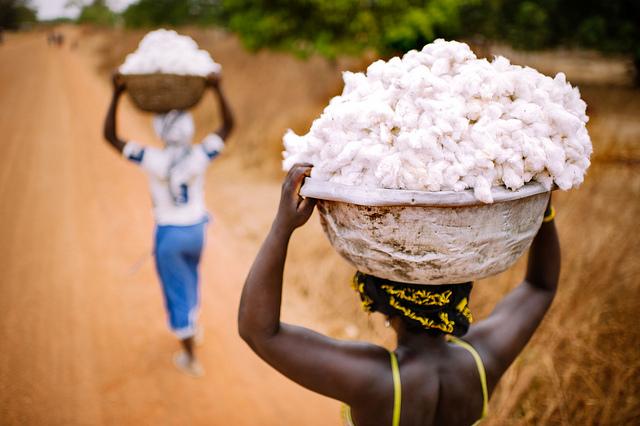
Cotton is not a glamorous subject in conversations about African transformation. It lacks the headline appeal of oil discoveries, lithium deals or fintech unicorns. Yet across the savannah belt that stretches from northern Benin through Burkina Faso and Mali to northern Côte d'Ivoire and Cameroon, cotton remains the crop that pays school fees, finances motorbikes and anchors rural credit. It is also the clearest example of a pattern African policymakers have spent decades trying to break: a region that grows a valuable raw material, ships it abroad almost untouched, and imports the finished goods back. In 2026 that pattern is being challenged from two directions at once — by a harvest shock that has exposed how fragile the raw-export model is, and by a new, investment-led push to spin, weave and sew the crop at home.
A Harvest Shock Across the CFA Cotton Zone
The 2025/26 campaign was a bad one. According to data from the Regional Program for Integrated Cotton Production in Africa (PR-PICA), seed-cotton output across the main CFA franc zone producers fell to roughly 1.98 million tonnes, down 14.2% from 2.31 million tonnes the previous season. PR-PICA attributes most of the losses to attacks by jassids — leafhopper pests that have repeatedly ravaged West African fields since 2022 — and to irregular rainfall. Over two seasons, the zone has lost close to a quarter of its harvested volume.
The country picture is uneven. Benin kept its place as the zone's largest producer with 533,590 tonnes, but that figure was itself a 16.3% decline. Mali, long the regional heavyweight, suffered most: PR-PICA's early forecast put its crop at 433,700 tonnes, a 34% drop, far below the 777,000-tonne peak of 2021/22. Burkina Faso was the rare gainer, rising about 7% to 313,042 tonnes to take third place, while Côte d'Ivoire was broadly flat at 310,407 tonnes (−0.4%).
Prices have offered no cushion. The International Cotton Advisory Committee (ICAC) reports that the Cotlook A Index, the global benchmark, fell for a third consecutive season to an average of 79.6 US cents per pound in 2024/25, a 13.4% decline and the lowest average since 2020/21. ICAC's mid-2026 outlook put the 2025/26 midpoint at around 78 cents. Mali's experience shows what lower volumes and weaker prices do together: Trade Map data cited by Ecofin show Malian cotton exports collapsing from about US$256 million in 2020 to roughly US$69.7 million in 2024.

States Step In: Targets, Subsidies and Nationalisation
Governments have responded with ambitious recovery targets and a heavier state hand. Mali's cotton company CMDT announced at its February 2026 board meeting a goal of more than 650,000 tonnes for 2026/27 — over 50% above the previous crop — by expanding planted area by 96,000 hectares to 630,000 hectares and lifting yields 17% to 950 kg per hectare. A later government figure of 598,500 tonnes suggests some recalibration, and CMDT's leadership has acknowledged that insecurity, floods, localised droughts, jassids and late input deliveries all weigh on the plan.
Burkina Faso went further. On 16 April 2026 the Council of Ministers decided to buy out the remaining private shareholders of Sofitex, which handles about 80% of national output. A 2025 valuation put the company at CFA338.14 billion (about US$607 million), with the private stake worth just over CFA75 billion. The government cited heavy debts as part of the rationale, after production fell 24% to 292,660 tonnes in 2024/25 — the third straight decline — and it has since backed the 2026/27 campaign with a reported CFA15.8 billion subsidy.
Elsewhere, the instinct has been to hold farm-gate prices steady. Côte d'Ivoire kept its first-grade seed-cotton price at CFA310 per kg (CFA285 for second grade) and has set a 400,000-tonne target for 2026/27. Togo announced in early November that it would keep prices at CFA300/kg for first-grade and CFA280 for second-grade cotton despite rising costs. In Benin, farmers interviewed by the Associated Press described a price of about CFA300/kg that has barely moved in years — tolerable mainly because it is guaranteed and cotton earns more than maize at around CFA120/kg.
The Real Prize: Processing at Home
The deeper problem is not the size of the crop but what happens after harvest. Speaking in Yaoundé during the WTO's 14th Ministerial Conference in March 2026, Director-General Ngozi Okonjo-Iweala noted that 98% of the cotton produced in the region is still exported in raw form. The C-4+ group — Benin, Burkina Faso, Mali, Chad and Côte d'Ivoire — produces more than a million tonnes a year, roughly half of Africa's output and close to 4% of global production. On 25 March the group unveiled an investment platform under the WTO-backed Partnership for Cotton, aimed at building a credible framework across the value chain over 2026–2030. Its promoters estimate that around US$12 billion will be needed over ten years to develop spinning, textile and apparel capacity.
This represents a meaningful strategic shift. For more than two decades, the C-4 used the WTO mainly to challenge cotton subsidies in rich economies, with limited results. The new emphasis is industrial: attract investors, build mills, and capture more of the value chain domestically.
Benin's Glo-Djigbé Experiment
Benin is the test case. Through a 2020 public-private partnership with Arise IIP, it established the Glo-Djigbé Industrial Zone (GDIZ), 45 km from Cotonou, and adopted policies discouraging raw exports in favour of finished goods. According to AP reporting from September 2026, GDIZ now processes about 40,000 tonnes of Beninese cotton a year into 7 to 10 million garments, with brands such as US Polo Association and Kiabi represented. The African Development Bank credits the zone's expansion and the shift to finished exports with helping narrow Benin's current-account deficit from 6.2% of GDP in 2024 to 5.7% in 2025.
Scale remains the question. Forty thousand tonnes is a small share of a national crop that has ranged between roughly 530,000 and 640,000 tonnes of seed cotton in recent seasons. GDIZ management reports some 16,000 direct textile jobs and an aspiration of 300,000 direct jobs within a decade, but these figures are self-reported and not independently verified. Reports also point to continued reliance on imported machinery and foreign technical expertise.
The social stakes are large. Benin's cotton producers' federation counts at least 183,746 producers organised in 2,206 village cooperatives, and says the sector supports the livelihoods of more than two million rural people. Small processors show what local value can mean at household level: one weaver employed by a Parakou-based 'Made in Benin' textile business told AP she earns around US$545 a month — well above typical rural incomes.

Central Africa Joins the Race
The ambition is not limited to the Sahel. In Cameroon, Sodecoton reported 2024 revenue of CFA223.35 billion and value added of CFA44.39 billion, while raw cotton exports earned CFA177.2 billion, or 5.4% of national export receipts. The country's National Development Strategy 2020–2030 targets 600,000 tonnes of cotton a year and industrial processing of at least 50% of local fibre by 2030, supported by a planned CFA180 billion facility with 12,000 tonnes of annual capacity. Even that project, if delivered, would process only a modest slice of current production — a reminder of how far targets sit from today's reality.
What Stands in the Way
Turning cotton into an industrial engine runs into familiar constraints:
- Energy costs and reliability: spinning and weaving are power-intensive, and grid tariffs across the Sahel are among the region's highest.
- Competitiveness: African mills compete with integrated Asian producers in Bangladesh, Vietnam and China that have decades of scale, skills and supplier networks.
- Financing: the C-4+ estimate of US$12 billion over a decade dwarfs what national budgets or cotton companies — several of them heavily indebted — can mobilise.
- Agronomy and security: jassid outbreaks, erratic rainfall and insecurity in Mali and Burkina Faso undermine the steady raw-material supply that mills require.
- Market access: textile exporters depend on preferential schemes and stable trade rules, and the region's apparel sector is still too small to exploit them fully.
Outlook: Value Capture Over Volume
The 2025/26 downturn has made one argument hard to ignore: a model that depends on exporting nearly all of the crop as raw fibre leaves farmers and governments fully exposed to pests, weather and the global price cycle. Higher volumes will help, and the 2026/27 targets in Mali, Benin (700,000 tonnes), Burkina Faso and Côte d'Ivoire are designed to restore them. But the more durable gains lie in processing. If Benin can scale GDIZ beyond a few percent of its crop, and if the C-4+ investment platform can turn its US$12 billion estimate into financed mills rather than conference communiqués, the region's white gold could start to underpin manufacturing jobs rather than only rural incomes. The next two campaigns will show whether 2026 marked a turning point or simply another bad year in a long cycle.
Published By | Features Editor