Written By | Torch Media Africa
A 33-year-old mystery about the exact moment ordinary space collapses into a black hole has just been solved with pencil, paper, and a very strange trick involving infinite dimensions
SCIENCE & TECH
Somewhere between "nothing happens" and "a black hole is born," physicists have just found a hidden structure in the fabric of reality — and they're calling it a crystal.
Not a crystal like the quartz on your windowsill. A spacetime crystal: a bizarre, fleeting, perfectly repeating pattern that space and time themselves can fall into during the split-second when a collapsing cloud of matter teeters on the exact knife's-edge between dispersing harmlessly and imploding into a black hole. Researchers from TU Wien in Vienna and Goethe University Frankfurt say they've done something physicists have tried and failed to do for more than thirty years: write down the exact mathematical formula describing that crystal, and show precisely how the smallest nudge of energy tips it over into forming a microscopic black hole.
The findings, published in the prestigious journal Physical Review Letters, don't just satisfy a longstanding theoretical itch. They hand physicists a new analytical tool for probing the most extreme and least understood events in the universe — the birth of a black hole, frozen and dissected in mathematical slow motion, without needing a supercomputer or a telescope pointed at a dying star.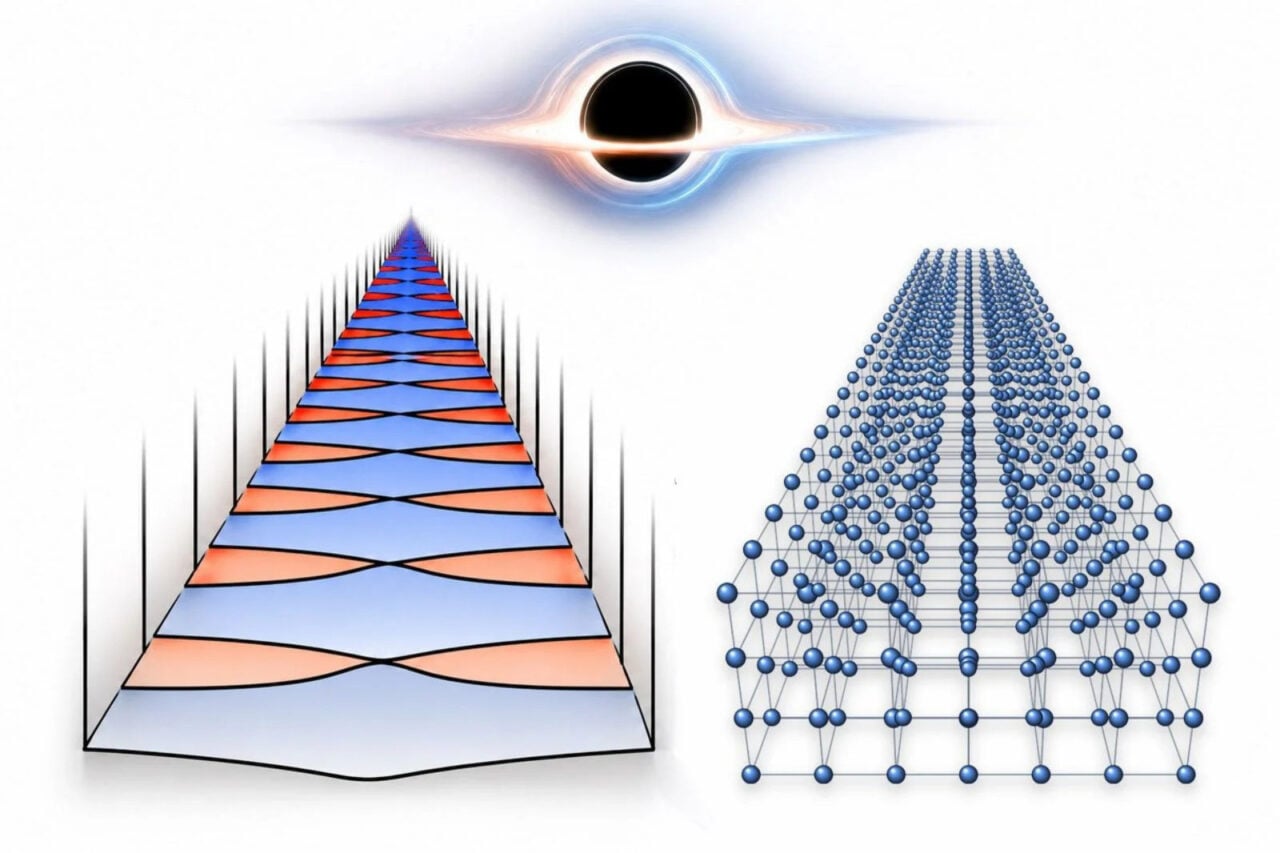
A MYSTERY BORN IN 1993
To understand why physicists are excited about a formula, you have to go back to 1993, when a Canadian physicist named Matthew Choptuik was running computer simulations of collapsing matter — modeling, essentially, what happens when you cram more and more mass into a smaller and smaller space and watch to see if, and when, a black hole forms.
What Choptuik found was strange. Right at the threshold — the precise critical point between "this collapses into a black hole" and "this doesn't" — spacetime doesn't behave randomly or smoothly. Instead, it organizes itself into a repeating, self-similar pattern: a structure that looks the same at smaller and smaller scales, echoing itself over and over as you zoom in, the way a fractal does. Physicists call this behavior "discrete self-similarity," and it became known as critical collapse.
It was a genuinely bizarre discovery — spacetime, the smooth, continuous backdrop of the entire universe, apparently freezing into something crystal-like at the exact moment of maximum violence. But for three decades, nobody could write down an exact formula for it. Choptuik's result lived almost entirely in computer simulations — reproducible, verifiable, but stubbornly resistant to pencil-and-paper mathematics. Researchers could see the pattern in their simulations, but they couldn't derive it from first principles the way physicists prefer: with clean equations rather than numerical approximations.
THE TRICK: SOLVE IT IN INFINITE DIMENSIONS
The breakthrough, credited to researchers including Christian Ecker, Florian Ecker, and Daniel Grumiller, came from an approach that sounds almost like a magic trick: instead of trying to solve the fiendishly complicated equations in our familiar four dimensions — three of space, one of time — the team solved the problem in a mathematical limit involving infinitely many dimensions, then worked their way back down.
It's a classic physicist's sleight of hand. Certain problems that are essentially impossible to solve exactly in the real, four-dimensional universe become dramatically simpler, and sometimes exactly solvable, when you imagine a version of the universe with far more dimensions and then extrapolate the pattern back to the dimensions we actually live in. Using that trick, the team says they derived the first exact, analytic description of the discrete self-similarity Choptuik first glimpsed in his simulations three decades ago — describing both the delicate, crystal-like critical state itself, and the precise mathematical trigger that flips it into a black hole.
"Depending on the desired precision, we can systematically improve our formulas using additional approximation methods," said Florian Ecker of TU Wien, describing the significance of the result. "This gives us a new method for studying black-hole-related phenomena that could previously not be analyzed analytically."
That last point is the crux of why physicists care. Simulations are powerful, but they're numerical approximations — run the same setup with slightly different starting conditions or computing power, and you can get slightly different answers, or miss subtle effects buried in the noise. An exact formula is different. It's a piece of mathematical bedrock that other physicists can build on, stress-test, and extend, the same way Einstein's field equations became a foundation for a century of subsequent discoveries once they were written down cleanly.
WHAT A "SPACETIME CRYSTAL" ACTUALLY IS
Here's the part that sounds like science fiction but is, according to the researchers, a fairly literal description. During critical collapse, the curvature of spacetime — the actual geometric warping that Einstein's general relativity describes as gravity — organizes itself into a highly ordered, repeating structure. It's reminiscent of "time crystals," an exotic and only recently confirmed state of matter in which a physical system repeats a pattern through time the way an ordinary crystal repeats its atomic structure through space.
In this case, it isn't atoms repeating — it's the geometry of space and time itself, folding into a self-similar echo of its own structure at ever-smaller scales, for the brief, unstable instant before it decides its own fate. Push that unstable structure with even a whisper of additional energy, and instead of dissolving back into ordinary, boring spacetime filled with freely moving particles, it collapses catastrophically inward, crossing the point of no return and becoming a black hole — potentially an extraordinarily small one, far tinier than the stellar-mass and supermassive black holes astronomers typically observe.
That's part of what makes this research so tantalizing: it offers, at least theoretically, a mechanism for forming black holes far smaller than the kind created when a giant star collapses at the end of its life. Microscopic and "primordial" black holes — hypothetical black holes that some cosmologists think may have formed in the extreme density and chaos of the very early universe, moments after the Big Bang — have long been a favorite subject of speculation, partly because some theories suggest they could make up at least part of the universe's mysterious dark matter. A precise mathematical description of exactly how and when such tiny black holes might form gives researchers a sharper tool for testing those ideas.
EXPERT PERSPECTIVE
Science writers and physicists covering the result have leaned hard into the drama of finally cracking a three-decade puzzle. Coverage in outlets ranging from ScienceAlert to Live Science and Gizmodo framed the work as resolving one of general relativity's stranger and more stubborn open questions, with several pieces noting that Choptuik's original 1993 finding had become something of a benchmark problem in the field — a result everyone accepted was true, because simulations kept confirming it, but that nobody could actually prove analytically.
The Frankfurt-Vienna collaboration's own institutional announcements emphasized the "paper and pencil" nature of the achievement — a pointed contrast with a field of physics increasingly dominated by massive supercomputer simulations. In an era when discovery often means bigger data centers and more computing power, deriving an exact formula the old-fashioned way, through analytical mathematics, is itself part of the story here. It's being described by researchers as a new method for studying black-hole-related phenomena analytically — phenomena that, until now, could only be approached numerically, one simulation at a time.
WHAT THIS MEANS FOR YOU
No, a spacetime crystal is not going to appear in your backyard, and no, this doesn't mean scientists are about to switch on a machine that manufactures black holes (despite what certain corners of the internet will inevitably claim). This is fundamental theoretical physics — the kind of research that doesn't put a product on a shelf, but instead sharpens the tools scientists use to understand the most extreme physics in the cosmos.
Where it matters practically is in the toolkit of astrophysicists and cosmologists. A validated, exact mathematical description of critical collapse gives researchers modeling real astrophysical events — like the aftermath of neutron star collisions, or the theorized formation of primordial black holes in the universe's first fractions of a second — a firmer analytical foundation to check their simulations against. It also feeds directly into the hunt for dark matter, one of the biggest open questions in all of physics, since primordial black holes remain one of the more durable, if unproven, candidates for what that invisible mass throughout the universe might actually be made of.
There's also a broader, more human takeaway: this is a reminder that not every scientific breakthrough requires a billion-dollar telescope or a mile-long particle accelerator. Sometimes the frontier of physics still gets pushed forward the way it always has — with two researchers, a stubborn thirty-year-old puzzle, and the nerve to try solving it in infinite dimensions just to see what falls out when you bring the answer back down to the world we actually live in.
THE BOTTOM LINE
Matthew Choptuik's 1993 discovery that spacetime crystallizes on the edge of catastrophe has waited three decades for someone to explain, in exact mathematical terms, exactly what that means and exactly when the crystal shatters into a black hole. Researchers in Vienna and Frankfurt say they've finally done it — not with a bigger telescope or a faster supercomputer, but with an audacious mathematical detour through infinite dimensions.
It won't make headlines the way spotting an actual black hole does. But for physicists trying to understand how the universe's most violent objects are born, it might matter more: a precise, provable answer to a question the universe has been quietly demonstrating, in simulation after simulation, for over thirty years.



