Kampala
Uganda's economy is entering the second half of 2026 at a crossroads. Fresh figures from the national statistics agency show growth slowing markedly in the most recent quarter, even as the government and its oil-sector partners insist that the long-promised start of crude production remains on track to transform the country's economic prospects. The result is an economy running on two clocks at once: a near-term slowdown in agriculture and other sectors, and a longer-term bet that oil revenues will push Uganda into a period of double-digit expansion.
What the latest numbers show
According to data released by the Uganda Bureau of Statistics in early July, the economy expanded 5.8 percent year-on-year in the third quarter of the 2025/26 fiscal year — a considerable step down from the 8.5 percent recorded in the same quarter a year earlier. The deceleration was led by agriculture, whose gross value added rose just 2.1 percent, compared with a striking 10.3 percent in the corresponding quarter of 2024/25. Industry held up more firmly, with value added up 5.9 percent on the back of 4.8 percent manufacturing growth and 7.2 percent construction expansion, though even that was softer than the prior year.
The monetary backdrop remains relatively benign. Annual headline inflation for the year ending March 2026 stood at 2.8 percent, easing from 2.9 percent in February and well within the central bank's comfort zone. The Uganda shilling, however, weakened: the official mid-rate averaged about 3,620 shillings to the US dollar in the third quarter, a depreciation of roughly 2.3 percent from the previous quarter's average of 3,538. Credit to the private sector continued to grow, with outstanding commercial bank loans and advances rising 2.7 percent to 76.8 trillion shillings, up from 74.7 trillion the quarter before — a sign that lending activity is expanding even as headline growth cools.
The oil story underpinning the outlook
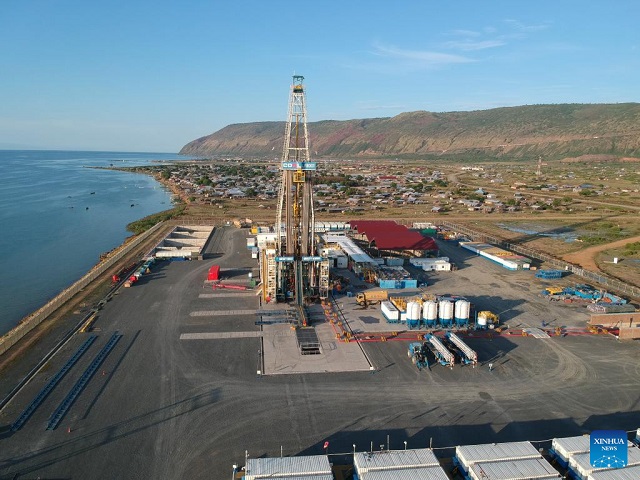
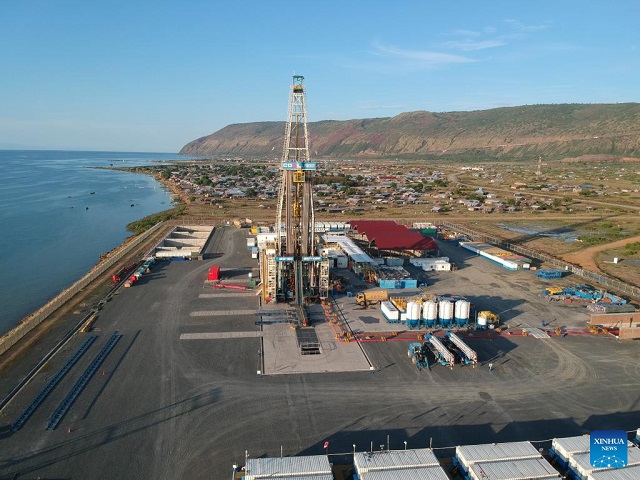
Looming over every economic forecast is the Lake Albert oil development, which the government has framed as the single most important driver of Uganda's medium-term prospects. Authorities and their joint-venture partners are targeting first commercial oil in the second half of 2026, with the expectation that production will lift growth into double digits during the 2026/27 fiscal year. Uganda has also raised its estimate of recoverable reserves to about 1.65 billion barrels, reinforcing the scale of the prize.
Progress on the ground is well advanced. TotalEnergies' Tilenga project has drilled 164 of a planned 170 wells — roughly 97 percent complete — and is designed to produce up to 190,000 barrels per day. CNOOC's Kingfisher field has finished all 19 wells needed for initial production and will add around 27,000 barrels per day. The 1,443-kilometre East African Crude Oil Pipeline (EACOP), which will carry Ugandan crude to the Tanzanian port of Tanga, has received all its line pipe, with more than 1,000 kilometres already welded. Combined peak capacity from the Lake Albert developments is projected at around 240,000 barrels per day.
The caveats and the risks
Not everyone is convinced the mid-2026 target will hold. Independent analysts have cautioned that slippages in engineering, procurement and construction make the second-half-2026 timeline optimistic, with some suggesting that first oil could realistically slip into the first quarter of 2027. Because so much of the growth upgrade for the coming fiscal year is predicated on crude beginning to flow, any delay would ripple directly through the national accounts and government revenue projections.
There are structural risks beyond timing. The EACOP project has drawn sustained opposition from environmental and human-rights campaigners, who have pressured banks and insurers to withhold financing over concerns about displacement and climate impact. A heavy reliance on a single commodity also exposes Uganda to global price swings and to the well-documented dangers of resource dependence, including currency effects that can squeeze non-oil exporters. The recent softness in agriculture — still the backbone of employment for most Ugandans — is a reminder that the pre-oil economy remains vulnerable to weather and to shifts in commodity cycles.
Why it matters
For ordinary Ugandans, the interplay between the current slowdown and the coming oil boom is not an abstraction. Agriculture employs the majority of the workforce, so a sharp fall in farm-sector growth — from double digits to barely 2 percent — is felt directly in rural incomes and food supply. At the same time, the promise of oil revenue carries expectations of new infrastructure, jobs and public services, and the government has staked much of its economic narrative on delivering that windfall. How the transition is managed — whether oil money is invested productively and whether the non-oil economy is nurtured rather than neglected — will shape living standards for years.
Institutions such as the World Bank and the African Development Bank have generally described Uganda's medium-term outlook as positive, with growth expected to accelerate toward the 6.5 to 7 percent range in 2026 before oil pushes it higher. The Uganda Investment Authority has pointed to GDP approaching the 66-billion-dollar mark. But those projections rest heavily on execution: on crude flowing roughly on schedule, on prudent management of the proceeds, and on macroeconomic stability holding through a politically turbulent year.
What to watch next
The most important signal in the coming months will be any concrete announcement on first oil — a firm start date, or conversely a formal acknowledgement of delay. Movements in the shilling bear watching too, as further depreciation would raise import costs and could feed into inflation despite the currently low headline rate. Observers will also track the next quarterly GDP release for evidence of whether the agricultural slowdown was a one-off, weather-driven dip or the start of a more sustained softening. Finally, the financing and construction status of EACOP, and the resolution of the environmental and legal challenges around it, will help determine whether Uganda's oil-era ambitions arrive on the timeline the government has promised — or on a slower one the sceptics anticipate.
Published By | Tech Wiz