Written By | Torch Media Africa
A small island economy stacks a national AI strategy, a fintech roadmap, and a $434 million infrastructure build atop decades of financial-services diversification
Mauritius has spent a year methodically stacking digital-economy policy on top of an already-built financial-services base, and by mid-2026 the outlines of a deliberate strategy are clear: use artificial intelligence and fintech regulation to defend the island's position as one of Africa's most sophisticated digital economies, at a moment when larger markets on the continent — Nigeria, Kenya, Egypt, South Africa — are drawing far more venture capital and international attention. Mauritius cannot compete on population or market size. Its bet is that it can compete on regulatory clarity, connectivity, and proximity to India, and 2026 has been the year that bet was formalized into policy.
From Sugar to Servers
The digital push sits atop a broader economic recalibration. Mauritius's real GDP grew 3.2% in 2025, a deceleration from 4.9% in 2024, with growth on the supply side led by financial services, wholesale and retail trade, agriculture, tourism, and transport. That growth mix reflects more than fifty years of structural transformation: an economy that began as a monocrop sugar producer at independence has become a diversified, upper-middle-income services economy in which financial services alone contribute roughly 13.5% of GDP. The island's offshore financial sector, launched in the 1990s, has drawn more than 32,000 offshore entities, many structured to channel investment into India, South Africa, and China — the same three geographies now central to the government's digital ambitions. Analysts increasingly describe the financial centre, rather than tourism, as the country's primary growth engine, a shift that provides the institutional and regulatory backbone the government is now trying to extend into fintech and AI.
A Fintech Strategy for an Already-Built Financial Center
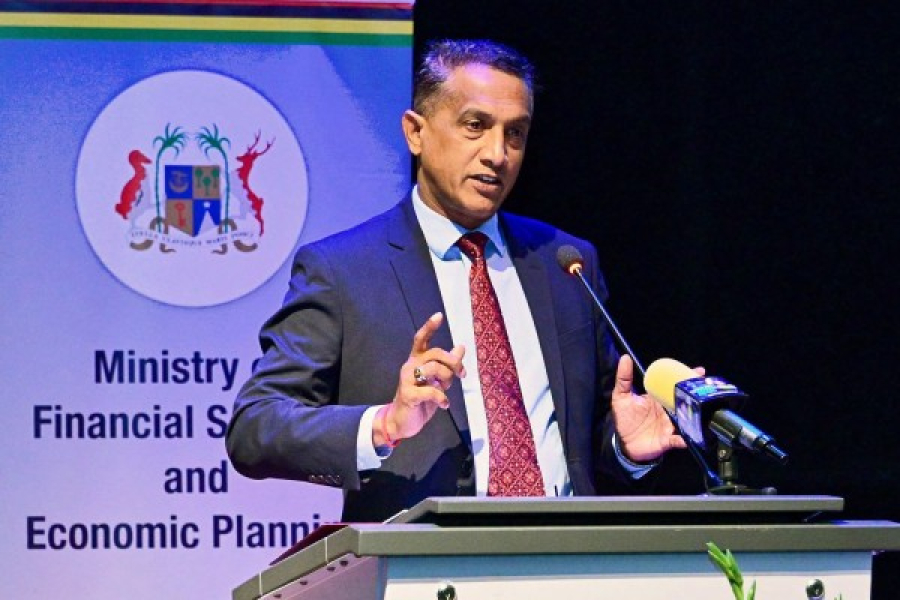
On June 25, 2026, Mauritius's Minister of Financial Services formally launched the National Fintech Strategy 2026-2030 at the Atal Bihari Vajpayee auditorium in the Côte d'Or Technopole, explicitly framing the plan around positioning Mauritius as Africa's trusted fintech hub while advancing financial inclusion and innovation-led growth. The strategy builds on regulatory groundwork laid years earlier: the Virtual Asset and Initial Token Offering Services (VAITOS) Act of 2021 gave Mauritius one of the earliest comprehensive digital-asset frameworks on the continent, with the Financial Services Commission licensing virtual asset service providers across categories including broker-dealers, custodians, wallet providers, and marketplaces, alongside notably strong anti-money-laundering and counter-terrorism-financing requirements. In 2026 regulators went further, issuing additional guidance on stablecoins and beginning work on a more comprehensive stablecoin regulatory framework — a signal that Mauritius intends to compete for the next wave of cross-border digital-payment infrastructure rather than only traditional offshore banking. The Mauritius Africa Fintech Hub association, launched in 2018 to promote the island as a continental fintech innovation center, provides an existing industry body around which the new strategy can organize private-sector input.
Unlike many African fintech markets, Mauritius's ecosystem is not built primarily around mobile money for the unbanked; domestic digital payments are anchored instead by bank-linked applications such as Mauritius Commercial Bank's Juice platform and non-bank services like My.T Money, reflecting a population that is already largely banked. The strategic opportunity Mauritius is chasing is different from the financial-inclusion story playing out elsewhere on the continent — it is about becoming the licensing and settlement hub through which fintech and digital-asset firms serving African, Asian, and Gulf markets choose to operate.
AI as the First Strategic Pillar
Mauritius's digital pivot extended into artificial intelligence on April 9, 2026, when the government launched its National AI Strategy alongside a set of FAIR guidelines — Fair, Accountable, Inclusive, and Responsible — at a ceremony in Phoenix supported by the United Nations Development Programme, following months of stakeholder consultation. The strategy frames AI adoption around ethical, inclusive, and people-centred principles rather than pure deregulation, an approach UNDP helped shape through broad engagement with government, industry, and civil society. The strategy's weight was underscored on June 19, 2026, when Prime Minister and Minister of Finance Dr. Navinchandra Ramgoolam delivered the national budget speech and named artificial intelligence as the first of seven strategic pillars underpinning the country's economic plan for the year ahead.
The budget backed that framing with concrete commitments: a pledge to train 50,000 people in practical AI skills over the coming year, a ten-year tax exemption and innovation grants for qualifying startups, and a new dedicated startup law intended to give technology companies a clearer regulatory framework than the general commercial code previously offered. An AI Innovation Start-Up Programme is being established under the Ministry of Information Technology, Communication and Innovation specifically to support AI-focused ventures, positioning the state as an early co-investor in the sector it is simultaneously trying to regulate.
Wiring the Island: A $434 Million Infrastructure Bet
None of this policy activity would matter without the physical infrastructure to support it, and Mauritius Telecom has committed to a three-year, $434 million investment roadmap covering expanded fiber coverage, 5G-Advanced network rollout, GPU clusters to support AI workloads, and an expansion of Tier IV data center capacity. The plan also includes development of a sovereign cloud and new submarine cable capacity, building on an already-dense connectivity position: Mauritius Telecom operates the SAFE cable (commissioned 2002), LION (2009), METISS (2021), and the T3 system, which landed in 2023. A fourth cable, T4, is now in development at an estimated cost of $150-200 million and is designed to connect Mauritius directly to India and Singapore, reinforcing the island's role as a regional interconnection point between Africa and Asia.
That ambition was reinforced in 2026 when Prime Minister Ramgoolam announced Mauritius would join the America-India Connect subsea cable programme, a move officials described as a major milestone for the country's digital resilience and global connectivity. Alongside the cable investments, the government is developing a high-tech special economic zone at Côte d'Or — the same site hosting the fintech strategy's launch event — intended to draw investment specifically into AI, data centers, and digital services, effectively clustering the physical and regulatory elements of the strategy in a single geography.
Why It Matters Regionally
Mauritius's approach stands in contrast to the venture-capital-driven tech-hub narratives associated with Lagos, Nairobi, or Cairo. With a population under 1.3 million, Mauritius cannot generate the domestic user bases that attract growth-stage investors to those markets. Its strategy instead leans on regulatory credibility built over three decades as an offshore financial center, a geographic position astride Africa-Asia trade and data routes, and a state willing to co-invest directly in AI skills and startup incentives rather than relying primarily on private capital to build the ecosystem. Whether that combination is enough to convert Mauritius from a back-office financial jurisdiction into a genuine AI and fintech innovation hub — rather than simply a well-regulated pass-through for capital and data destined elsewhere — will depend on execution over the strategy's 2026-2030 horizon, including whether the promised skills training, startup incentives, and cable capacity translate into homegrown companies rather than only inbound compliance business. For now, the island has done something few African economies have managed: sequencing an AI strategy, a fintech strategy, an infrastructure investment plan, and a special economic zone into a single coherent policy year.



