SAN FRANCISCO / SAN JOSE
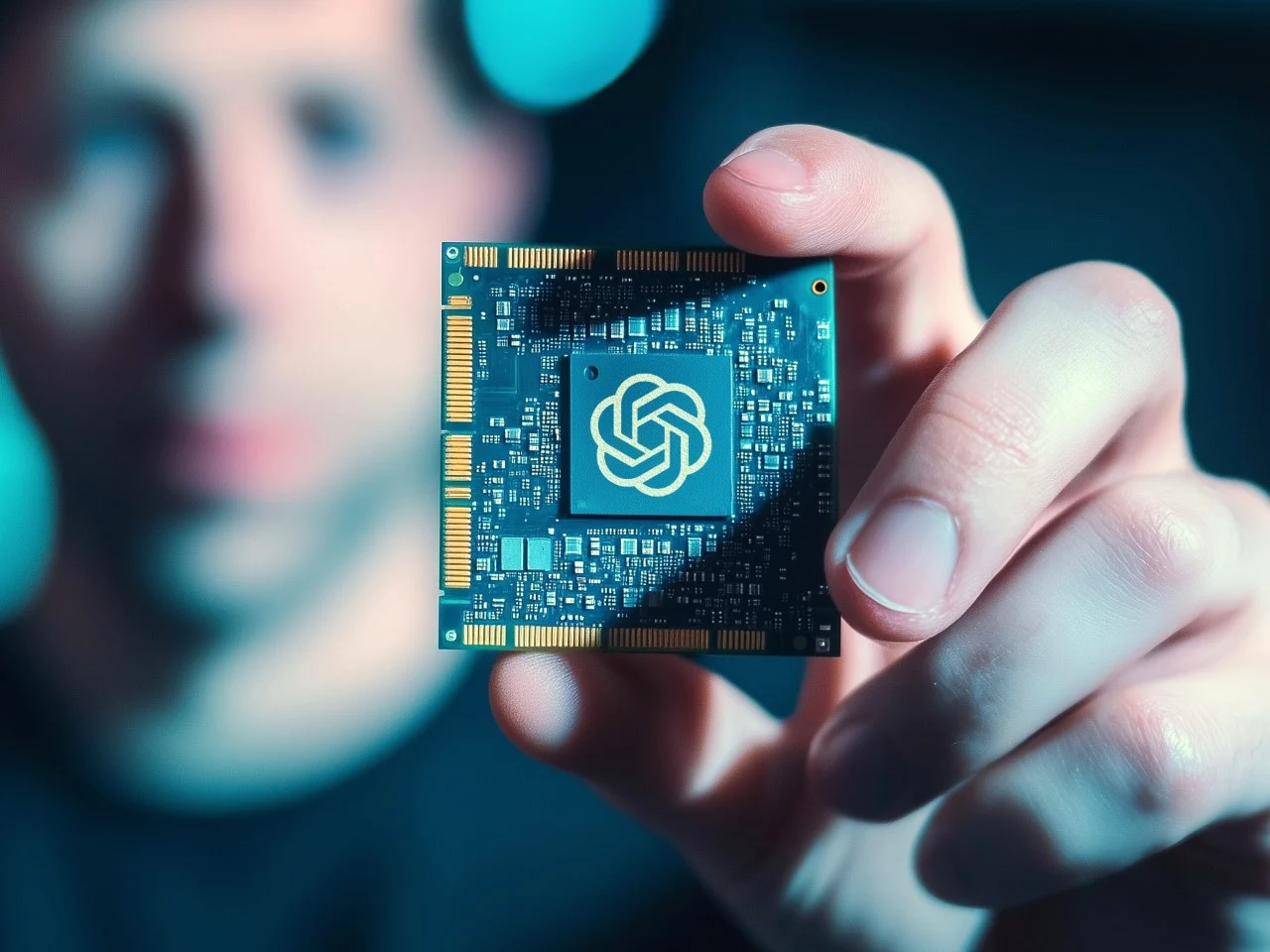
There's a photograph circulating in tech circles this week that tells you everything about where the AI arms race is headed. OpenAI CEO Sam Altman and co-founder Greg Brockman stand shoulder-to-shoulder with Broadcom's leadership, grinning over a slab of black silicon the size of a dinner plate. Etched in fine print on the chip's packaging is a motto that reads like something between a prayer and a corporate slogan: "May we scale smoothly, exponentially and uneventfully through AGI."
The chip is called Jalapeño. And depending on who you ask, it's either the opening shot in dismantling Nvidia's multi-trillion-dollar AI hardware monopoly — or the first sign that OpenAI is quietly transforming from a software company into a vertically integrated hardware empire.
A NINE-MONTH MIRACLE
Custom AI chips (ASICs) typically take two to three years to go from concept to manufacturable design. Jalapeño did it in roughly nine months — potentially the fastest development cycle ever for a chip of this scale.
How? OpenAI used its own AI models to help design the chip. Engineers fed optimization and verification work to the company's internal models, compressing months of human labor into weeks. In other words, OpenAI used AI to build the AI chip.
Jalapeño is manufactured on TSMC's cutting-edge 3-nanometer process — the same technology used for Apple's M4 chips and Nvidia's flagship Blackwell GPUs. It pairs OpenAI's design with Broadcom's networking technology, allowing thousands of these chips to communicate at extreme speed inside data centers.
WHY INFERENCE MATTERS
To understand why this chip has Nvidia investors nervous, you need to know the difference between two AI chip jobs: training and inference.
Training is teaching a model from scratch — feeding it vast amounts of data over weeks or months. It's brutally expensive, requires flexibility, and is dominated by Nvidia's general-purpose GPUs.
Inference is what happens after: running the finished model — answering your ChatGPT questions, writing code, summarizing documents. It doesn't need flexibility. It needs raw, repetitive efficiency, billions of times a day, as cheaply as possible.
Inference has quietly become OpenAI's single largest expense. Jalapeño is built to fill that gap. OpenAI and Broadcom claim it delivers roughly 50% lower inference costs than top-tier Nvidia GPUs, with dramatically better performance per watt. Early samples are already running OpenAI's flagship coding model at target speeds.

THE INSATIABLE APPETITE
Greg Brockman put it bluntly: OpenAI "cannot get compute fast enough." Broadcom's CEO agreed — demand from AI customers is "simply insatiable."
That one word — insatiable — explains why OpenAI felt compelled to build its own chip. Nvidia's GPUs are expensive, supply is tight, and OpenAI is burning through cash to rent enough computing power. Building cheaper chips is one of the few ways to bend the financial math back in their favor.
Broadcom framed the partnership as much bigger than a one-off order: "This is just the beginning of a multi-generation roadmap," enabling gigawatt-scale data centers — enough electricity to power 750,000 American homes — beginning in 2026.
SHOULD NVIDIA BE WORRIED?
The honest answer: a little, but not yet existentially.
Jalapeño only does inference — it cannot train new models, the most lucrative slice of the AI hardware market, which still belongs almost entirely to Nvidia. There's also Nvidia's CUDA platform — more than a decade of accumulated tooling and developer muscle memory. Ripping that out doesn't happen overnight.
Still, the symbolism is hard to overstate. OpenAI created the demand that turned Nvidia into one of the most valuable corporations on Earth. If even OpenAI is building its own silicon — following Google, Amazon, and Microsoft — it confirms a trend: every major AI lab eventually tries to build its own hardware rather than stay dependent on one supplier.
THE EXPERT TAKE
Analysts see this as a "diversification" story, not a direct confrontation. Broadcom describes it as the first chip in a "multi-generation compute platform" — signaling OpenAI intends to keep building its own chips, getting more ambitious each generation, following the same playbook Apple used when it moved from Intel to its own M-series chips.
WHAT THIS MEANS FOR YOU
The AI tools you use every day all cost money to run on the back end. If OpenAI really can cut inference costs by roughly half, that's downward pressure on subscription prices — or fuel to offer more powerful features for the same price.
It also matters for anyone holding Nvidia stock. Every customer that builds a credible alternative chips away at the assumption that AI labs will keep buying Nvidia's premium-priced GPUs indefinitely.
THE BOTTOM LINE
For now, Jalapeño is a lab experiment wrapped in a press release: engineering samples running in OpenAI's facilities, with commercial deployment at Microsoft data centers still penciled in for "by the end of 2026." But that photograph — Altman and Brockman flanked by Broadcom's leadership, joking about scaling "smoothly, exponentially and uneventfully through AGI" — is the kind of image historians will point to when looking back at how the AI hardware landscape splintered away from a single dominant supplier. Nvidia isn't going anywhere soon. But it just got a very expensive reminder that its biggest customers are no longer content to simply write checks.
Sources: OpenAI, TechCrunch, CNBC, Broadcom, VentureBeat, Tom's Hardware, Axios, EE Times
Published By | Tech Wiz