Share
For any society that values the rule of law, justice delayed is more than an adage; it is an indictment of a system that claims fairness but delivers injustice. In Uganda, delayed rulings and case backlogs in courts have become a structural barrier to justice, deepening corruption, entrenching inequality, and eroding public trust in the Temple of Justice.
A Constitutional Promise Unfulfilled.
The Constitution of the Republic of Uganda, 1995 (as amended), establishes the Judiciary as an independent arm of government mandated to administer justice in the name of the people. Article 126 provides that judicial power is derived from the people and shall be exercised in conformity with the law and with the values, norms, and aspirations of the people. Article 128 guarantees the independence of the Judiciary and shields judicial officers from interference in the exercise of their functions.
Further, Article 146 establishes the Judicial Service Commission (JSC), mandated to advise the President on the appointment, discipline, and removal of judicial officers. The legal profession is regulated under statutory frameworks governing the Uganda Law Society (ULS) and institutions such as the Law Development Centre (LDC), whose mandate is to train and regulate legal practitioners and support the administration of justice.
Yet, despite this elaborate constitutional and legal architecture, justice in Uganda remains elusive for many citizens.
Case Backlogs: A Deepening Crisis
Uganda’s courts are burdened by an overwhelming backlog of cases, a crisis that has been officially admitted by the Judiciary itself and scrutinized by Parliament’s Public Accounts Committee (PAC). Recent Judiciary performance reports indicate that Uganda’s courts are handling well over 160,000 pending cases nationwide, with more than 40,000 classified as backlog cases, matters that have exceeded the constitutionally and administratively acceptable timelines for disposal.
The situation is particularly dire in the lower courts and specialized divisions such as commercial and land courts, where thousands of cases have remained unresolved for five years or more. The Chief Justice and senior judicial administrators have repeatedly informed Parliament that the Judiciary is operating with less than half of its required judicial officers, forcing some courts to share a single magistrate or judge across vast jurisdictions and multiple case dockets.
The Parliamentary Public Accounts Committee, while reviewing justice-sector expenditure and accountability, further revealed that over 120,000 criminal prosecution files were stalled at various stages within the court system. PAC attributed this paralysis to chronic understaffing, endless adjournments, weak supervision, and poor case-management systems. The Committee warned that such delays do not merely inconvenience litigants but actively undermine public confidence in the rule of law and create fertile ground for corruption and selective justice. In response to these alarming figures, the Judiciary has consistently sought increased funding from Parliament to recruit more judges and magistrates, operationalize additional High Court circuits, and fully roll out digital case-management systems. However, PAC has repeatedly noted that persistent underfunding, coupled with weak accountability mechanisms, continues to frustrate these efforts, allowing the backlog to grow year after year.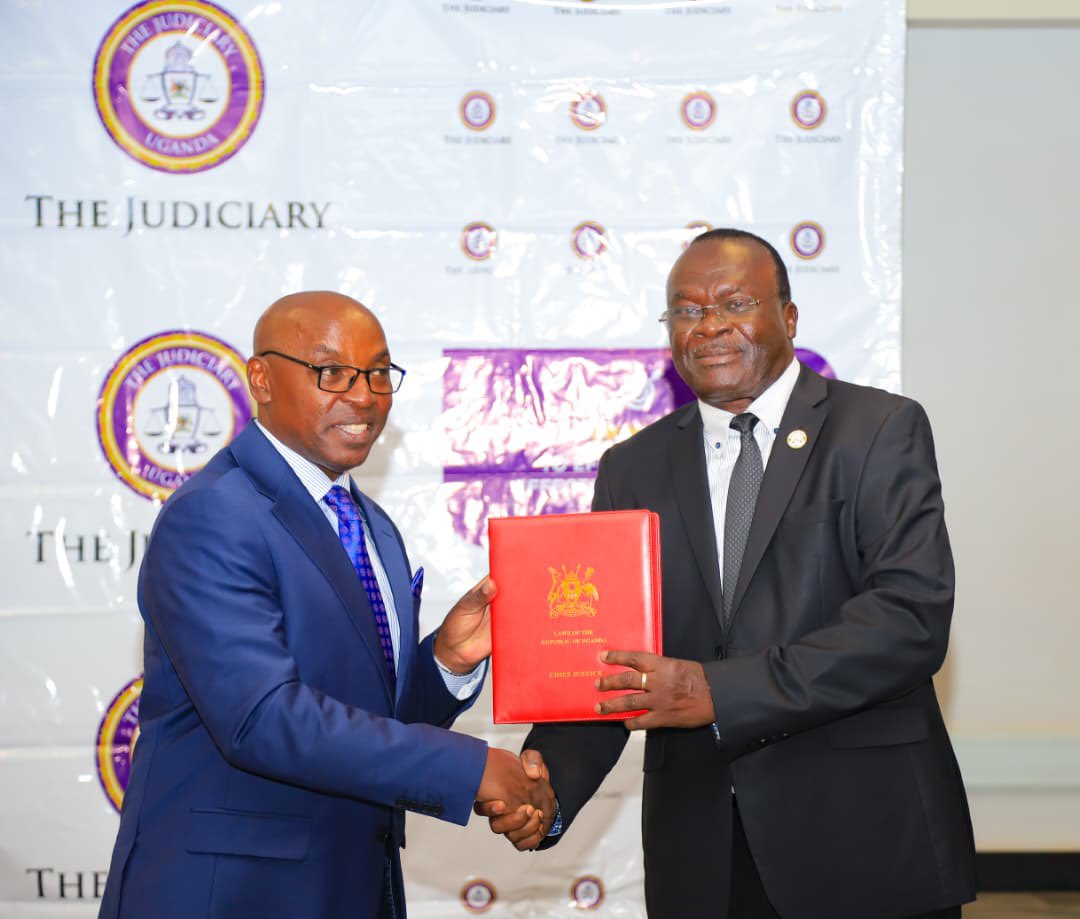
Owiny Dollow hands over to Zeija. When Dollo had just been appointed, he promised to tackle the case backlogs
Justice for the Wealthy, Delay for the Poor
Within this broken system, a disturbing reality has taken root: justice increasingly follows money. Wealthy litigants, politically connected individuals, corporations, and powerful elites often see their cases handled expeditiously. Their files move swiftly, hearings are fixed promptly, and rulings are delivered with remarkable speed. Meanwhile, the poor watch their cases gather dust on registry shelves. Their matters are endlessly adjourned, jumped by newly filed cases involving “big people,” or stalled under flimsy procedural excuses. This disparity creates a perception, and in many cases a reality, that justice in Uganda is purchasable.
When Delay Becomes Corruption
As the saying goes, justice delayed is justice denied. In Uganda, delay has become a fertile breeding ground for corruption. Prolonged cases increase litigation costs, transport expenses, legal fees, and informal payments. For litigants without money to sustain these expenses or to pay bribes, justice becomes unattainable.
Delayed judgments also allow defendants with deep pockets to exhaust claimants financially and psychologically. Many cases collapse not because they lack merit, but because the weaker party can no longer afford to continue. In such circumstances, delay itself becomes a silent verdict.
Contempt of Court as a Weapon
One of the most troubling manifestations of judicial unfairness in Uganda is the growing misuse of contempt of court proceedings. Powerful litigants, often working through well-connected legal teams, weaponize contempt applications against opponents to intimidate, financially punish, or silence them before substantive cases are heard. In many instances, the party with the stronger legal case finds itself fined, jailed, or dragged through contempt proceedings, while the original dispute remains unresolved. Contempt of court, instead of protecting judicial authority, has become a tool of coercion and extortion within the system.
Institutional Silence and Complicity
Equally disturbing is the silence of institutions mandated to defend justice. The Uganda Law Society, which should be at the forefront of condemning delayed justice and professional misconduct, has remained largely quiet on systemic case delays and selective fast-tracking of cases.
Many legal practitioners benefit from prolonged litigation through increased legal fees and endless appearances, often at the expense of their clients. This creates a conflict of interest where delay becomes profitable, and silence becomes convenient.
Economic and Social Consequences
Delayed justice has far-reaching economic consequences. Companies embroiled in shareholder disputes or commercial litigation lose capital, investor confidence, and operational stability while cases stagnate in court. Billions of shillings remain locked in unresolved disputes, money that could otherwise stimulate business growth and absorb unemployed Ugandans.
Socially, unresolved disputes breed hostility and resentment. The Judiciary is aware that prolonged commercial, land, and family disputes often escalate into criminal acts, threats, violence, kidnappings, and even murder as parties lose faith in legal remedies. Yet little is done to address the root cause: delay.
Who Benefits?
The critical question remains: who benefits from delayed judgments, case backlogs, and abuse of contempt proceedings? Certainly not the ordinary Ugandan. The beneficiaries are those with power, money, influence, and the ability to manipulate a weakened justice system.
Conclusion: A Temple in Crisis
Uganda’s Temple of Justice stands today not as a sanctuary of fairness, but as a mirror reflecting inequality, corruption, and institutional failure. Constitutional promises mean little when courts cannot deliver timely, impartial justice. The continued silence of legal and judicial institutions in the face of suffering Ugandans amounts to complicity.
Justice delayed is justice denied, but in Uganda, justice delayed has also become justice sold.
Unless urgent reforms are undertaken to address case backlogs, corruption, and professional accountability, the rule of law will remain a constitutional illusion rather than a lived reality.
About the Author.
Evan Sande Ndahura is a Ugandan political and legal commentator, columnist, poet, and social justice advocate whose writings focus on governance, constitutionalism, democracy, and the political economy of power in Africa. He is widely published on issues of judicial accountability, electoral justice, human rights, and institutional reform, with a particular emphasis on Uganda’s political and legal systems. Ndahura writes from a Pan-African critical perspective, interrogating the failures of state institutions and the lived realities of ordinary citizens under entrenched systems of power. He believes that the liberation of Africa will occur through a mighty pen, not the gun.



