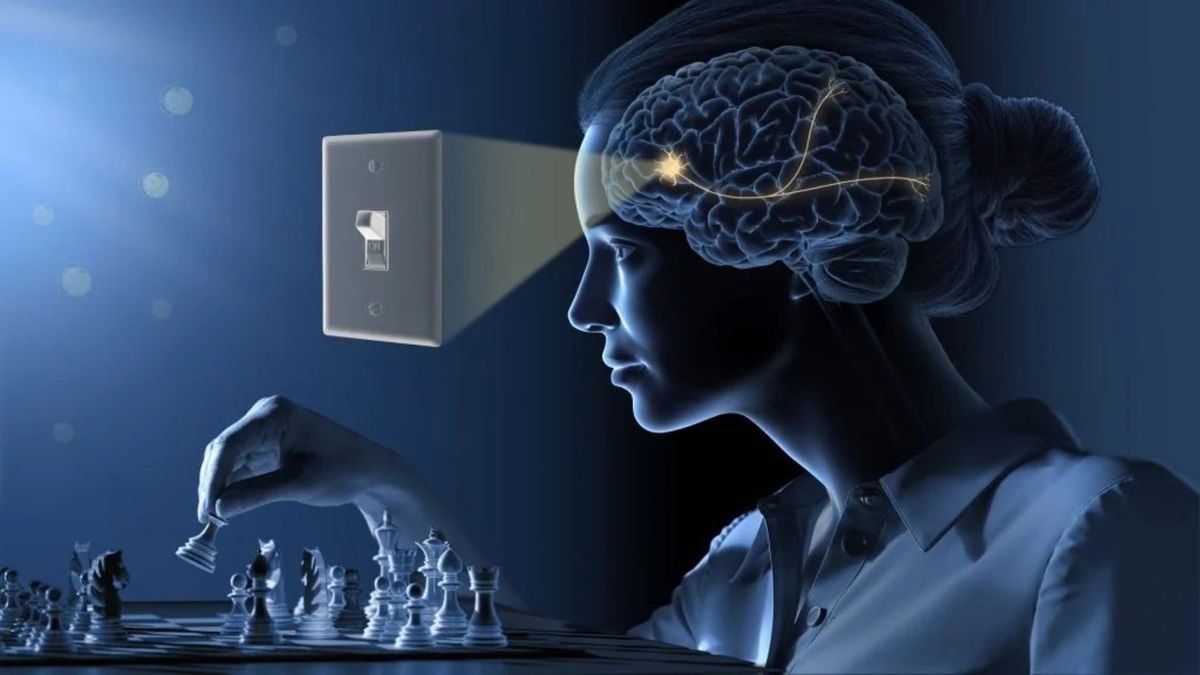
The 2026 Nobel Prize in Physiology or Medicine honours the discovery of channelrhodopsin and the birth of optogenetics, a technology that can switch fear, memory and movement on and off in living brains — and is now helping blind patients see
STOCKHOLM
Imagine flicking a switch and making a mouse feel fear, forget a painful memory or suddenly dash across its cage. Now imagine the switch is a flash of blue light, and the wiring is a protein borrowed from a tiny green alga that lives in ponds.
That is not science fiction. It is the real, Nobel-winning science that stunned the world of neuroscience on Monday, 5 October 2026, when the Nobel Assembly at Sweden's Karolinska Institute announced that the Prize in Physiology or Medicine would go to three researchers: Karl Deisseroth of Stanford University in the United States, Peter Hegemann of Humboldt University of Berlin, and Georg Nagel of the University of Würzburg, both in Germany.
They were recognised, in the words of the announcement, for discovering a "molecular switch for nerve cells" — the foundation of a field called optogenetics, which uses light to control nerve signals. The trio will share a prize of 12 million Swedish crowns, about $1.2 million, and receive their awards on 10 December.
A Brain Too Complicated to Poke
To appreciate why this matters, you have to understand how hard the brain is to study. Your skull holds tens of billions of nerve cells, packed together and talking constantly in electrical pulses. For decades, neuroscientists could do only a few things. They could listen in, recording electrical activity. They could notice that certain regions light up during certain mental states. Or they could zap tissue with electricity.
As Neuroscience News explains, that electrical stimulation hits many neighbouring cells at once, like trying to fix a single piano key by hitting the whole keyboard with a hammer. The approach made it extremely difficult to prove that a specific circuit actually causes a specific behaviour, rather than just happening at the same time.
What scientists needed was a way to switch on one type of cell, and only that type, at an exact moment. They found it in a very strange place.
The Algae That Chased the Sun
The story begins not in a brain lab but with a microscopic green alga called Chlamydomonas reinhardtii, which swims toward light. Hegemann, working in Germany, studied how this organism senses brightness and steers itself toward it.
In the early 2000s, Hegemann and biophysicist Georg Nagel isolated a family of membrane proteins known as channelrhodopsins. According to Neuroscience News, the discovery was remarkable for its elegance. Animal eyes need a complex chain of chemical steps inside cells to turn light into a signal. Channelrhodopsin does it all by itself: it is a single protein with seven membrane-spanning segments that functions both as a light sensor and as a pore for ions.
When blue light hits it, the channel opens within milliseconds, letting positively charged ions, mainly sodium and calcium, rush into the cell and creating an electrical impulse. Crucially, when the researchers placed the protein in cells that are not algae, those cells became light-sensitive too.
From Pond to Brain
That is where Deisseroth came in. The Stanford neuroscientist and bioengineer recognised that brain cells also communicate through rapid, sodium-driven electrical spikes. If a neuron could be made to carry channelrhodopsin, light might fire it on demand.
In 2005, his team delivered the gene for channelrhodopsin-2 into cultured rat neurons using viral vectors. Brief flashes of blue light made individual neurons fire action potentials with millisecond timing. By 2007, the approach worked in living, awake, freely moving animals. The trick combined genetic promoters that target specific cell types with hair-thin fibre-optic implants placed in chosen brain structures.
In those animals, light could selectively command behaviours, shift emotional states and alter learned memories. The brain had, for the first time, been given a remote control.
What the Nobel Committee Said
Per Svenningsson, chair of the Nobel Committee, captured the excitement. "Optogenetics provides opportunities for mapping the brain in a way that we could once only dream of," he said, as quoted by Neuroscience News.
Thomas Perlmann of the Nobel Assembly said the method makes it possible to switch the activity of individual nerve cells in a living brain on or off, according to Al Jazeera's report on the announcement. The assembly also said researchers hope it could improve cochlear implants by stimulating the auditory nerve more precisely than today's electrical devices.
Unlocking the Secrets of Fear, Addiction and Depression
In the two decades since, thousands of laboratories have adopted the technique, according to Neuroscience News. The results read like a tour of the human mind's trouble spots.
In psychiatry research, scientists have used light to stimulate projections among the ventral tegmental area, the nucleus accumbens and the prefrontal cortex, helping them study circuits linked to anhedonia — the loss of pleasure seen in depression — as well as compulsive drug seeking and the panic seen in post-traumatic stress disorder.
In models of Parkinson's disease, optogenetics helped clarify how two pathways of the basal ganglia interact, including why deep brain stimulation works, and pointed to possible clinical targets.
Perhaps most striking is memory research. Scientists have tagged sparse groups of neurons that encode specific memories and shown that light can reactivate, modify or even erase traumatic recall in animals. Al Jazeera's report adds that the method helps researchers study how specific cell types contribute to learning, fear, addiction and movement.
It is important to be clear about what this does and does not mean. These are experiments in animals and cell cultures. Nobody is flipping a switch on a person's memories, and the work is a research tool for understanding the brain, not a mind-control device.
Expert Perspective: Cause, Not Just Correlation
The deepest change optogenetics brought is philosophical as much as technical. Before it, brain science was largely a science of correlation: this region glows when a person feels afraid, this pattern appears when a mouse remembers a maze. As Neuroscience News describes it, the older tools limited researchers' ability to establish causal links between particular circuits and behaviour.
Light changed that. Because the switch can be flipped on a single cell type, in a chosen brain structure, with millisecond timing, scientists can now ask the experimental question that matters most: if I turn this on, does the behaviour follow? And if I turn it off, does the behaviour stop? Svenningsson's remark about mapping the brain "in a way that we could once only dream of" is, in essence, a statement about moving from watching to testing.
There is also a lesson in the way the technology spread. The tool is not a single machine that only a rich lab can afford. It is a gene, a viral delivery system and a thin optical fibre. That recipe is why, in the words of the Neuroscience News report, thousands of laboratories have taken it up in two decades, and why the knowledge it generates keeps compounding.
The Road Ahead
Challenges remain. Delivering genes into the brain still requires viral vectors, and shining light deep inside tissue needs implanted fibres, which is a big step to ask of human patients. That is why the retina, which light reaches naturally, has become the early frontier for clinical use. Researchers and the Nobel Assembly alike are also watching hearing, where light might one day replace the electrical stimulation used by today's cochlear implants.
For now, the prize is a reminder that the biggest advances sometimes start with a question that looks wildly impractical: how does a little green alga know where the sun is? The answer has given humanity a new way to read, and perhaps one day repair, the most complex object in the known universe.
Helping the Blind See
The most hopeful chapter is only now being written in the clinic. Neuroscience News reports that descendants of this work are in human trials, where gene therapy vectors place channelrhodopsins into the remaining retinal ganglion cells of patients with retinitis pigmentosa, a disease that destroys the light-sensing cells in the eye. The aim is to partially restore visual perception.
The idea is wonderfully direct. If the eye's own photoreceptors have died, borrow the algae's light sensor and install it in the cells that remain. The article does not give trial sizes or specific outcomes, so it is too early to promise a cure, but the principle has moved from pond water to patient.
Why a Prize Took So Long, and Why Now
The technique has been transforming labs for roughly twenty years, and the field was long tipped as a Nobel contender. The 2026 award finally recognises both halves of the story: the basic curiosity-driven discovery of how an alga detects light, and the engineering ingenuity needed to bring that protein into mammalian brains.
That pairing is the reason the prize is so popular with scientists. Hegemann and Nagel were not hunting for a neuroscience tool. They were trying to understand a pond organism. Deisseroth then saw what that organism's protein could do inside a brain. It is a textbook case of why funding for basic research, with no obvious payoff, can change medicine decades later.
What This Means for You
For most people, optogenetics will not change daily life tomorrow. But it is quietly changing the research behind conditions that touch almost every family: depression, addiction, anxiety, post-traumatic stress, Parkinson's disease and blindness.
By showing exactly which circuits cause which symptoms, the technique helps drug developers and surgeons aim at the right target. That could mean more precise forms of deep brain stimulation, better implants and, eventually, therapies that do not blast the whole brain to treat one small part of it.
For people with inherited blindness, the retinal trials are the nearest-term hope. For those with hearing loss, the idea of light-driven cochlear implants raised by the Nobel Assembly offers a glimpse of sharper sound.
The Bottom Line
A swimming alga, a curious German pair and an ambitious Stanford neuroscientist and bioengineer have given neuroscience one of the most powerful tools in its history. Before optogenetics, scientists mostly watched the brain from the outside. Now they can reach in with light and ask it direct questions.
The Nobel Prize ensures that story will be told for generations. The next chapter, from restored sight to better treatments for the mind, may be the one that matters most to the rest of us.
Published By | Tech Wiz