SCIENCE & TECH
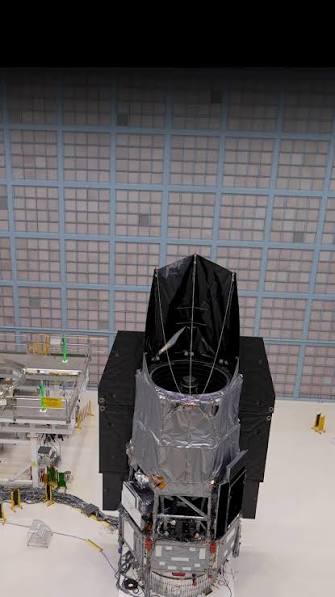
It is sitting inside a 43-foot rocket fairing right now, wires tucked, mirrors sealed, engineers holding their breath. In four days, if the weather cooperates and nothing goes sideways on the pad, NASA is going to fling a $4 billion telescope into space that its own scientists say could rewrite the astronomy textbooks — and this time, it's not just about pretty pictures.
The Nancy Grace Roman Space Telescope cleared its final flight readiness review on Friday, August 21, at Kennedy Space Center, and on Monday it was sealed inside the payload fairing of a SpaceX Falcon Heavy rocket at Launch Complex 39A — the same pad that sent Apollo astronauts to the Moon. NASA is targeting 7:26 a.m. EDT on August 30 for liftoff, though officials are careful to call it a "no earlier than" date. Weather, range availability, or a last-minute technical snag could still push it back. But barring disaster, in less than a week humanity will have its most powerful planet-and-dark-energy-hunting machine ever built, screaming toward orbit atop 5 million pounds of thrust.
And here's the kicker: it's arriving nine months ahead of schedule. NASA's formal commitment was "no later than May 2027." Roman beat its own deadline by the better part of a year — a rarity in an agency more accustomed to slippage than early delivery.
A MIRROR THE SIZE OF HUBBLE'S — BUT A HUNDRED TIMES THE VIEW
To understand why scientists are so worked up about this thing, you have to understand what it actually does differently from its famous predecessors.
Roman's primary mirror is 2.4 meters wide — functionally identical in size to the Hubble Space Telescope's. Its images will be every bit as sharp and crisp as anything Hubble has ever produced. But here's where it gets wild: Roman's field of view is at least 100 times larger than Hubble's. Point Hubble at a patch of sky and it captures a tight, gorgeous postage stamp. Point Roman at the same patch, and it swallows a hundred postage stamps in a single exposure.
Do the math on what that means for productivity. Over its first five years of operations, Roman is projected to image more sky than Hubble managed to cover in three decades. NASA estimates the telescope could measure light from roughly a billion galaxies over its lifetime. It's not a replacement for Hubble or the James Webb Space Telescope — it's a different tool entirely, built to survey vast swaths of the cosmos quickly rather than zoom in tight on single targets. Astronomers have taken to calling it a "wide-field workhorse," the machine that finds the needles so Hubble and Webb can zoom in on them later.
Named after Nancy Grace Roman, NASA's first chief astronomer and the woman often credited as "the mother of Hubble" for championing space telescopes decades before they were politically fashionable, Roman is arguably her final and biggest gift to astronomy — arriving more than a decade after her death in 2018.
THE 100,000-PLANET HUNT
Here's the headline number that has planet hunters losing sleep: Roman is expected to discover somewhere in the neighborhood of 100,000 new exoplanets over its mission — more than every previous planet-hunting telescope combined, including Kepler and TESS.
It won't do this the way most people assume. Roman isn't primarily watching for the tiny dip in starlight when a planet crosses in front of its star (the "transit method" that made Kepler famous). Instead, its signature technique is gravitational microlensing: when a foreground star with orbiting planets drifts directly between Earth and a background star, its gravity acts like a lens, bending and brightening the background star's light in a very specific, telltale pattern. A planet tagging along adds its own tiny blip to that signal.
Microlensing is uniquely good at finding cold, distant worlds — planets in the outer regions of their solar systems, the kind of real estate equivalent to Jupiter, Saturn, even free-floating "rogue" planets that were flung out of their systems entirely and now drift alone through the galaxy with no star to orbit at all. It's a category of world that transit surveys are almost blind to. Roman will stare at roughly 100 million stars toward the crowded center of the Milky Way for extended stretches, waiting to catch these gravitational flickers.
"Whether you want to explore dark energy, dying stars, galactic powerhouses, or probably even entirely new things we've never seen before, this survey will be a gold mine," said Benjamin Rose, a physicist at Baylor University who studies the telescope's core science cases.
HUNTING THE INVISIBLE: DARK ENERGY AND 100,000 EXPLODING STARS
Exoplanets are only half of Roman's job description. Its other mission — arguably the one that got it funded in the first place — is dark energy, the mysterious force that makes up roughly 68% of the universe and is actively pushing it apart at an accelerating rate. Along with dark matter, these invisible components are believed to account for around 95% of everything that exists, and scientists still don't know what either of them actually is.
Roman will attack this problem in two ways. First, it will survey the large-scale structure of the universe — the distribution of galaxies across billions of light-years — to measure how dark energy has shaped cosmic growth over time. Second, it will hunt for exploding stars: NASA expects Roman to find and track roughly 100,000 supernovae, including some of the most distant, ancient explosions ever observed by humanity. Because supernovae explode with a known, calibrated brightness, astronomers use them as cosmic "standard candles" to measure distances across the universe with extraordinary precision — and by tracking how that measurement changes with distance, they can chart whether dark energy's grip on the cosmos is constant, strengthening, or evolving.
NASA officials have gone so far as to say Roman could "settle" long-standing arguments about whether dark energy is truly a fixed cosmological constant, as Einstein's equations originally assumed, or something stranger that changes over cosmic time. That's not a small claim. It's one of the biggest open questions in physics.
RIDING A FALCON HEAVY OFF THE SAME PAD AS APOLLO
The launch vehicle itself is worth pausing on. SpaceX's Falcon Heavy — currently the most powerful operational rocket in the world after the still-experimental Starship — will haul Roman to a gravitationally stable perch called the second Sun-Earth Lagrange point, or L2, located roughly 1 million miles from Earth. It's the same cosmic parking spot used by James Webb, chosen because it lets a telescope keep the Sun, Earth, and Moon all blocked behind a single sunshield while staring endlessly out into deep space, undisturbed by stray heat or light.
Launch Complex 39A carries its own mythology: it's the pad that launched Apollo 11 to the Moon in 1969 and dozens of space shuttle missions afterward, now leased and operated by SpaceX. There's something almost poetic about a telescope named for the woman who fought to build Hubble lifting off from the same scorched concrete that once launched Neil Armstrong.

EXPERT PERSPECTIVE
Scientists across the field have been near-giddy in the run-up to launch, treating Roman less as an incremental upgrade and more as a fundamentally new kind of instrument. The consensus among mission scientists is that Roman's true value won't be any single discovery — it'll be the sheer statistical power of surveying so much sky, so many stars, and so many galaxies that astronomers can finally ask population-level questions that a narrow-field telescope like Hubble or Webb simply can't answer alone. How common are Jupiter-like planets in the outer solar systems of other stars? How has the expansion of the universe actually changed over 10 billion years, not just estimated from a handful of data points? Roman is built to answer questions that require overwhelming sample sizes, not single dazzling snapshots.
That's also why NASA leadership has repeatedly framed Roman as complementary to, not competing with, Webb and Hubble — a "discovery machine" that flags the most interesting targets in the cosmos so the more powerful, narrow-focus telescopes can zoom in and study them in exquisite detail.
WHAT THIS MEANS FOR YOU
You won't feel Roman launch, and you won't get a new gadget out of it. But over the next five-plus years, expect a steady drumbeat of headlines that trace back to this single spacecraft: newly discovered planets (some of them potentially rocky and Earth-sized), refined estimates of how old and how big the universe really is, and possibly the first real evidence about what dark energy actually is. If you've ever looked up at the night sky and wondered whether there's another Earth out there, or whether the universe as we understand it is even correct, the data that eventually answers that question has a good chance of coming from this exact telescope, riding this exact rocket, off this exact launch pad, in the next few days.
It also matters for a more grounded reason: Roman came in on budget and ahead of schedule, at a moment when NASA's science programs have faced funding pressure and public scrutiny. A clean, early, successful launch would be a significant vote of confidence for the agency's ability to deliver ambitious space science on time — something increasingly rare in an era of ballooning costs and multi-year delays across the space industry.
CONCLUSION
Four days from now, if all goes to plan, a Falcon Heavy will light up the Florida coast before dawn, carrying a telescope built in the image of Hubble but seeing a hundred times more sky, hunting for tens of thousands of hidden worlds and the ghostly force that's tearing the universe apart. Nancy Grace Roman spent her career convincing skeptics that space telescopes were worth the money and the risk. On August 30, her namesake gets to prove her right one more time — from a million miles away.
Published By | Tech Wiz




