Technological Transformation
Most African digital transformation stories begin with a connectivity gap. Morocco's does not. The country enters 2026 with the highest internet penetration on the continent and a broadband base that would be unremarkable in southern Europe. Its distinctive problem is a different one: having largely solved access, Morocco is now attempting to move up the value chain into artificial intelligence compute — the most capital-intensive, most energy-hungry and least labour-intensive segment of the digital economy — and the arithmetic of that bet is more awkward than the headline investment figures suggest.
The base Morocco is building from
According to DataReportal's Digital 2026 report, Morocco had 35.5 million internet users at the end of 2025, equivalent to 92.2 percent of the population — the highest penetration rate in North Africa. There were 57.1 million active cellular mobile connections, some 148 percent of the population, of which 87.7 percent were classified as broadband. Social media identities numbered 22.8 million in October 2025, about 59.1 percent of the population. Mobile internet usage rose a further 48 percent through 2026 as fifth-generation networks and fibre expanded.
That 5G layer arrived quickly. Morocco's telecoms regulator, the ANRT, awarded licences to Maroc Telecom, inwi and Orange Maroc following a competitive process: Maroc Telecom took a 120 MHz block for MAD 900 million (about US$90 million), while inwi and Orange each acquired 70 MHz for MAD 600 million (about US$60 million), a MAD 2.1 billion (US$210 million) package in total. Commercial services launched in November 2025, covering eight cities and their airports at launch. The licence obligations require at least 45 percent population coverage by the end of 2026 and 85 percent by 2030; collectively the three operators have signalled around MAD 80 billion (roughly US$8 billion) of network investment over the coming decade. Orange Maroc says its 5G footprint now spans more than 100 cities.

Two strategies, one ambition
The policy scaffolding sits in two documents. Digital Morocco 2030, adopted in 2024, frames digital technology as a matter of sovereignty, competitiveness, public-sector modernisation and social inclusion. Its headline targets are 240,000 direct digital jobs, more than 100,000 people trained per year, a digital economy worth around 5 percent of GDP, 3,000 startups, and the top-ranked e-government performance in Africa by 2030.
In January 2026 the government added a second, more specific layer: AI Made in Morocco. The strategy targets a MAD 100 billion (about US$10 billion) contribution to GDP from artificial intelligence by 2030, 50,000 AI-related jobs, and training for 200,000 graduates in AI disciplines. It is structured around three pillars — sovereignty and trust, covering governance, regulation and infrastructure; innovation and competitiveness, covering human capital, research and industrial development; and impact, adoption and influence, covering deployment and international positioning. Its institutional components include a National Data Factory, a National Software Forge, sovereign cloud infrastructure, a network of regional AI centres of excellence, the planned JAZARI Industry X.0 Institute, and a 500-megawatt renewable-powered data centre at Dakhla, designed to serve Morocco and neighbouring markets including Mauritania and Senegal.
The Nexus AI Factory and the megawatt-to-jobs ratio
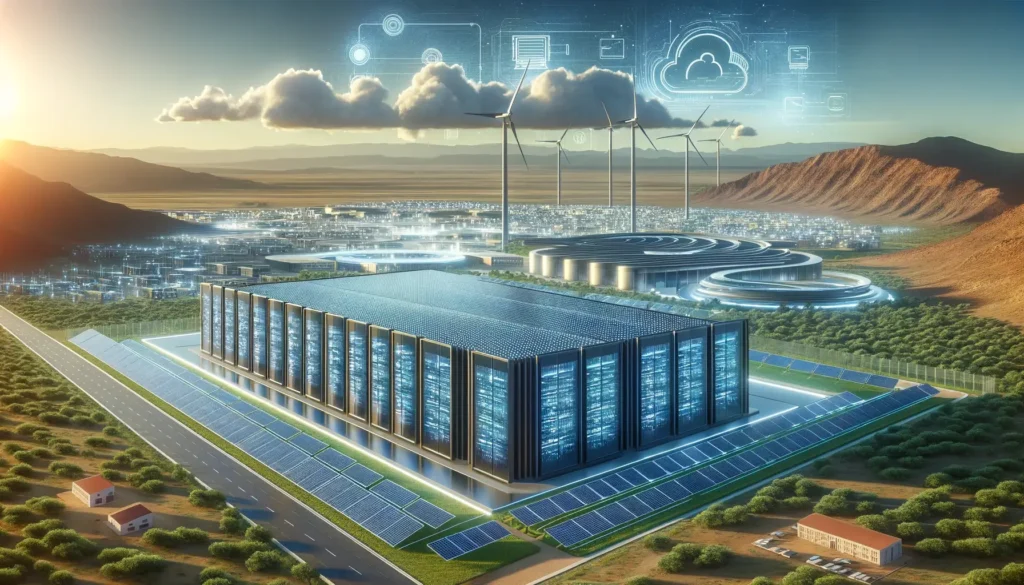
The flagship project was formalised at GITEX Africa 2026 in Marrakech in April, when London-based Nexus Core Systems signed a memorandum of understanding with Morocco's Ministry of Digital Transition and Administrative Reform, the Ministry of Investment and the investment agency AMDIE to build an AI data centre valued at MAD 12 billion, or roughly US$1.28 billion. The consortium behind it is notable: Nexus Core Systems, founded in 2025 in partnership with Dubai-based Lloyds Capital, with technology from Nvidia — including Blackwell GB200 processors — and South Korea's Naver Corporation, which will co-operate the platform and deliver integrated AI services. The US Ambassador to Morocco attended the signing, underlining the geopolitical dimension of American technology anchoring North African digital infrastructure.
The build is phased. Phase one allocates MAD 5 billion (about US$550 million) to a 16-megawatt hub at Nouaceur, outside Casablanca, where Nexus Core has acquired roughly 20 hectares of land. Phase two adds MAD 7 billion (about US$750 million) and a further 20 megawatts at a northern site, bringing capacity to 36 megawatts by the end of 2027, with an eventual ceiling cited at 500 megawatts. The facility will use sovereign cloud and AI architecture so that storage, processing and management remain within Moroccan jurisdiction — a requirement for European clients operating under GDPR and emerging AI governance rules. Morocco's position roughly 15 kilometres from Europe, with multiple direct submarine cable connections, is the structural advantage the project is selling.
The scale is real in continental terms. Africa's total data centre capacity is expected to reach only about 400 megawatts by the end of 2026, with Morocco accounting for roughly 35 percent of it. Announced pipelines — including Iozera's US$500 million, 386-megawatt project at Tetouan and Naver's separate 500-megawatt scheme at the same site — could push planned capacity toward two gigawatts. But the employment arithmetic deserves attention: phase one of the Nexus project is expected to create 50 direct jobs, and the full 36-megawatt build 125 direct jobs by 2027. A billion-dollar investment producing roughly one direct job per US$10 million is normal for data centre economics worldwide; it is simply a different proposition from the labour-absorbing digital growth Morocco's demographics require. The attached Centre of Excellence and innovation hub are the mechanism intended to bridge that gap, and their delivery matters more than the megawatts.

Where the jobs actually are: offshoring
The employment-heavy pillar of Morocco's digital economy remains business process and IT offshoring, and the government has treated it accordingly. By the end of 2024 the sector supported 148,500 jobs and generated MAD 26.22 billion in service exports. A revamped offshoring incentive framework, unveiled in late 2025, targets roughly MAD 40 billion in export revenue and 270,000 sector jobs by 2030, with 130,000 additional stable direct positions to be created over the period and around 50,000 of them expected by 2026. Compared with the AI factory's 125 posts, offshoring is where the near-term labour-market case is made — and where currency, language and time-zone alignment with France, Spain and increasingly the Gulf give Morocco a defensible advantage.
The state layer: sovereign wallet and digital identity
On 12 June 2026 the World Bank's Board approved two programmes for Morocco totalling US$650 million, of which US$250 million funds the Morocco Digital Transformation Acceleration Program over five years, targeting measurable results by 2031. The programme is designed to deploy user-centric digital public services through a unified national portal, move government systems to cloud infrastructure, strengthen startup financing and capacity building, advance AI innovation through centres of excellence, digitalise micro, small and medium enterprises, create offshoring jobs and expand the digital talent pool. Its signature deliverable is a National Sovereign Wallet anchored to the national identity card, allowing citizens to store and share official documents digitally. Through risk-sharing mechanisms, the Bank expects it to mobilise close to US$200 million in private capital for startup financing and SME digitisation. The companion US$400 million Climate & Risk Finance Program addresses climate, disaster and cyber risk, including plans for US$1 billion in pre-arranged disaster financing and cyber risk coverage for at least 20 financial entities.
The identity foundations are further along than in most of the region. The DGSN's CNIE 2.0 biometric identity card won an African Excellence E-Government Award, and a framework agreement signed on 3 May 2025 between the Ministry of Digital Transition and the DGSN set the terms for integrating digital identity into public services. By 2026 national identity card renewal had moved substantially online — application, document upload and payment digitally, with biometric capture in person — alongside the Mon e-ID mobile application and plans for a national digital wallet. Legislatively, the Digital X.0 Framework Law is expected to trigger implementing decrees on AI interoperability and digital identity standards, with a National Agency for AI Governance anticipated in late 2026. New foreign exchange rules under IGOC 2026 let firms certified by the Digital Development Agency invest up to MAD 10 million a year abroad without the usual three-year track record — a small but meaningful concession for startups building regionally.
Capital: from thin rounds to a fund-of-funds
Morocco's startup funding has been modest relative to its infrastructure ambitions. Disclosed 2025 startup funding was about US$108.4 million across 48 rounds, with total venture capital of roughly US$128.4 million, placing Morocco sixth on the continent. The state response has been to build the supply side of capital rather than wait for it. In December 2025 the government announced a MAD 1.3 billion (about US$140 million) package under Digital Morocco 2030 — MAD 750 million for business creation programmes, MAD 450 million for venture capital financing and MAD 70 million for the Technopark network. Separately, a MAD 2.5 billion (about US$269 million) fund-of-funds was activated, bringing together the Ministry of Digital Transition, the Mohammed VI Investment Fund, CDG and the state guarantee agency Tamwilcom, with nine venture capital managers selected to deploy it. FM6I has also solicited applications for a roughly US$150 million vehicle aimed at late-stage growth capital, the ecosystem's most conspicuous gap. The stated targets are 1,000 startups by 2026, 3,000 by 2030, and at least one unicorn before the decade closes.
The binding constraints: power, water and delivery
The hardest questions are physical. AI-optimised data centres consume up to five times the electricity of conventional cloud facilities, according to the African Data Center Association. Morocco had reached 45.5 percent renewable installed capacity by mid-2025 and could plausibly hit its 52 percent target by 2028, and the announced projects are structured around dedicated solar and wind supply — the Nexus facility under a supply contract with the UAE-headquartered producer TAQA. But analysts tracking the grid argue that transmission readiness and renewable stability may not reach the levels these projects require until well into the 2030s, and water use for cooling is a genuine risk in a country that has been in prolonged drought. Delivery risk is already visible: the first Nexus phase slipped from an initially advertised 40 megawatts to 16 megawatts, and large data centre announcements routinely underdeliver against their first public timelines by eighteen to twenty-four months.
The judgement to make
Morocco is doing something few African states have attempted: not buying AI capacity from abroad, but assembling the conditions to produce and export it — sovereign jurisdiction over data, dedicated renewable power, submarine cable proximity to Europe, and a state balance sheet willing to co-invest. The connectivity base is already there, the identity and e-government layers are maturing faster than most peers, and the capital stack now includes a real fund-of-funds rather than a press release. The open question is whether compute capacity translates into domestic capability. Thirty-six megawatts of Nvidia silicon at Nouaceur will serve European demand efficiently whether or not Morocco trains 200,000 people in AI skills. Whether it becomes an anchor for a domestic industry, or a well-sited export platform with 125 employees, depends on the parts of the plan that generate no headlines: the centres of excellence, the software forge, the offshoring pipeline, and the grid that has to carry all of it.
Published By | Tech Wiz