Written By | Staff Writer
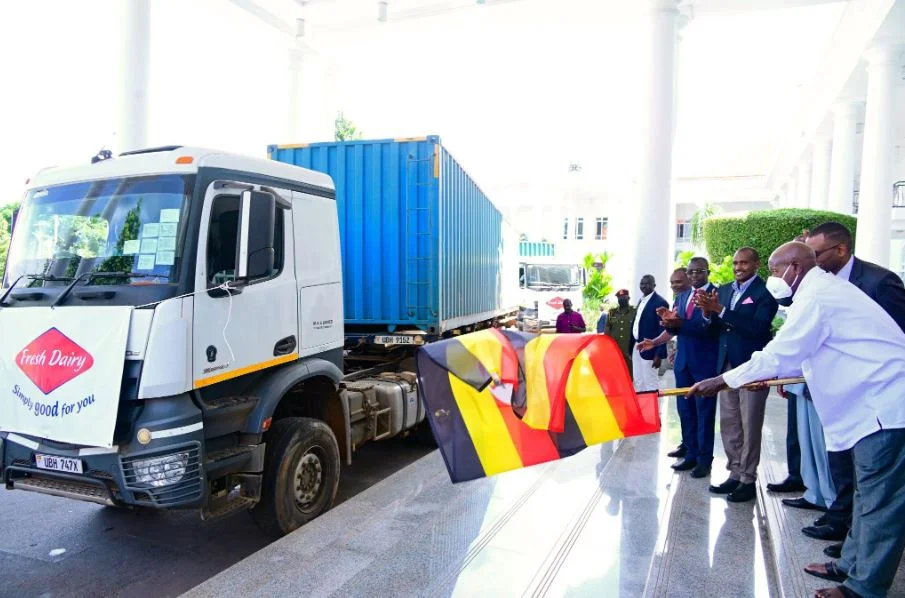
National milk production has climbed to 5.4 billion litres a year, more than double the 2.5 billion litres recorded in the 2017/18 financial year, according to figures cited by President Yoweri Museveni.
Agriculture
Kampala — Uganda's dairy sector has quietly become one of the country's most consequential agricultural success stories, and the numbers now bear that out in dramatic fashion. National milk production has climbed to 5.4 billion litres a year, more than double the 2.5 billion litres recorded in the 2017/18 financial year, according to figures cited by President Yoweri Museveni. Export earnings from milk and milk products have followed the same trajectory, rising from $92.4 million in the 2020/21 financial year to $280 million in 2024/25 — a three-fold jump in just four years.
The latest and arguably most significant milestone in that climb is a landmark trade agreement with Nigeria, under which Uganda will supply roughly 200,000 tonnes of powdered milk to West Africa's most populous nation. Concluded in mid-December 2025, the deal is valued at close to $1 billion and is set to make Nigeria Uganda's single largest dairy export market, ahead of long-standing buyers such as Algeria, which currently takes about 20,000 tonnes annually. For an industry that a decade ago was still overwhelmingly informal and domestically focused, the scale of the Nigerian order marks a genuine turning point.
From backyard herds to an export machine
The transformation did not happen by accident. Over the past several years, Uganda has invested heavily in processing infrastructure, disease control, and breed improvement in the cattle corridor stretching from the southwest through central Uganda. According to industry data, the country now has 145 dairy processing facilities with a combined installed capacity of 3.4 million litres per day, though they are currently operating at only about 68.7 percent of that capacity — a gap that officials and processors alike see as room for further growth rather than a warning sign.
That processing base has allowed Uganda to move beyond simply exporting raw or lightly processed milk to neighbouring East African markets, where it has often faced non-tariff barriers, including periodic restrictions in Kenya. Instead, the country is increasingly converting raw milk into higher-value, shelf-stable products — milk powder, UHT milk, cheese and butter — that can travel further and command better prices. It is precisely this capability that made the Nigeria deal possible: powdered milk can be shipped in bulk over long distances without the cold-chain demands of fresh milk, opening West African and other overseas markets that would otherwise be out of reach.
Industry analysts note that Nigeria's own dairy gap made it a natural partner. Despite having one of Africa's largest cattle populations, Nigeria imports the bulk of its dairy needs — a bill estimated in the region of $1.5 billion annually — because its pastoral herds are raised primarily for meat and are poorly suited to intensive milk production. Uganda's ability to step into that gap, alongside its existing foothold in Mali, signals a deliberate strategy by Kampala to diversify away from traditional COMESA and EAC markets and build a presence in West Africa's much larger and faster-growing consumer base under the framework of the African Continental Free Trade Area (AfCFTA).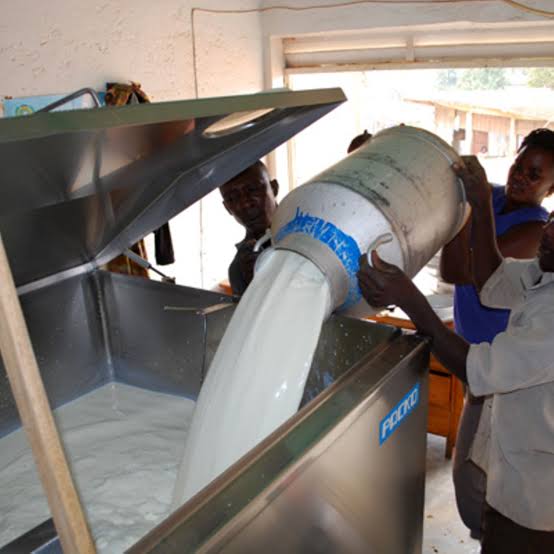
What it means for farmers
For Uganda's dairy farmers — estimated to number in the hundreds of thousands, from smallholders with two or three cross-bred cows to larger commercial ranchers in Mbarara, Kiruhura and Nakasongola — the export surge translates most directly into demand. When processors need more raw milk to feed powder plants and meet export contracts, farm-gate prices tend to firm up, and cooperative milk collection networks expand their reach into areas that previously had no reliable buyer.
That dynamic has already been visible in the wave of new processing investment moving into the sector. Egyptian investors, backed by President Museveni, have committed to building a mega dairy-processing plant in Ngoma, Nakaseke District, designed to handle up to one million litres of milk a day once fully operational — a scale that would roughly triple the country's current daily processing capacity on its own. Smaller entrants are following the same logic: Bennifoods, a newly commissioned processing plant with a 10,000-litre daily capacity, is among a string of mid-sized facilities betting that Uganda's milk surplus and export pipeline will keep growing.
For smallholders, however, the benefits are not automatic. Milk is highly perishable, and Uganda's rural road network and cold-chain infrastructure remain patchy outside the main cattle corridor districts. Farmers far from a functioning collection centre or chilling plant often still sell into informal, low-price channels, or lose milk to spoilage altogether during the rainy season when roads become impassable. Veterinary extension services, feed availability during dry spells, and access to affordable breeding stock also remain uneven, meaning the national production curve is being pulled upward disproportionately by better-resourced, semi-commercial farmers rather than by the poorest herders.
There is also a structural risk in leaning so heavily on a single new buyer. Nigeria's own currency volatility, import policy shifts, or a decision to invest in its own domestic dairy capacity could just as easily unwind the arrangement as strengthen it over time. Uganda's dairy sector has direct experience of this kind of shock: it was, in part, Kenyan restrictions on Ugandan milk imports in recent years that pushed processors to look further afield for buyers, culminating in the pivot toward West Africa. Diversifying export destinations, rather than becoming dependent on any one, will likely be the next test of the sector's resilience.
Wider economic stakes
Beyond the farm gate, the dairy boom carries broader significance for Uganda's economy. Agriculture, forestry and fisheries expanded by 6.7 percent in the most recent financial year, according to the Uganda Bureau of Statistics, and livestock products — dairy chief among them — have been consistently cited by government economists as one of the more reliable drivers of that growth, less exposed to the year-to-year price swings that batter cash crops like coffee and cocoa on international commodity markets.
Government officials have also framed the dairy push as part of a wider effort to move the agricultural economy away from raw commodity exports and toward processed, value-added goods — a long-standing ambition under Uganda's agro-industrialisation strategy. NSSF Managing Director Patrick Ayota recently argued publicly that Uganda's priority should shift from simply producing more food to securing dependable markets for what farmers already grow, a philosophy that the Nigeria dairy deal embodies almost exactly: production capacity built over years, finally matched to a buyer large enough to absorb it at scale.
If Uganda sustains its current growth trajectory, industry observers such as the Netherlands Development Organisation (SNV) believe the country is well positioned to become the largest dairy exporter in Africa within the coming years, overtaking established players in North and Southern Africa. That would represent a remarkable shift for a sector that, within living memory of many farmers now supplying export-grade powder plants, consisted mainly of a few cows kept for household consumption and the local market. Whether that promise reaches the ordinary herder in Kiboga or Rakai as reliably as it reaches the balance sheets of processors and exporters will determine whether Uganda's "white gold" moment becomes a broad-based rural income story, or simply a good year for a handful of large dairy companies.



