Written By | Staff Writer
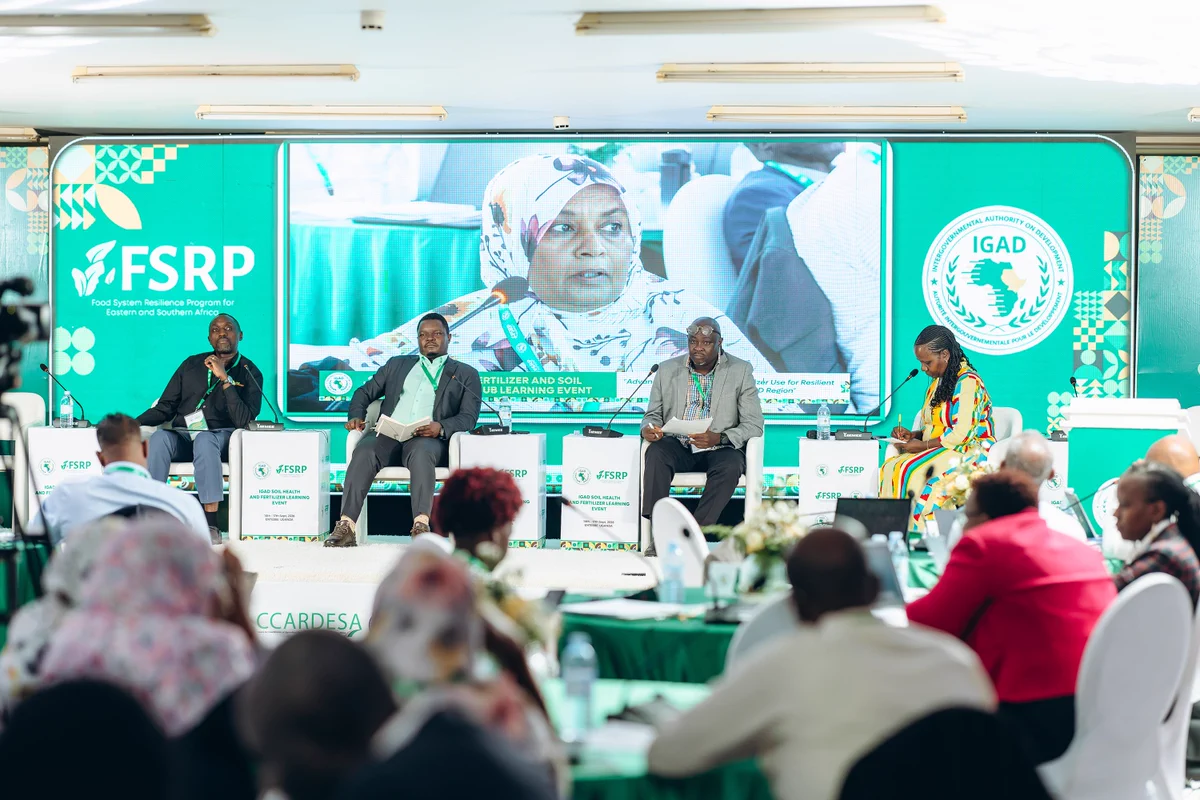
IGAD's new Fertilizer and Soil Health Hub opened a four-day learning event in Entebbe this week
Agriculture
A regional hub, a Ugandan venue, and a familiar problem
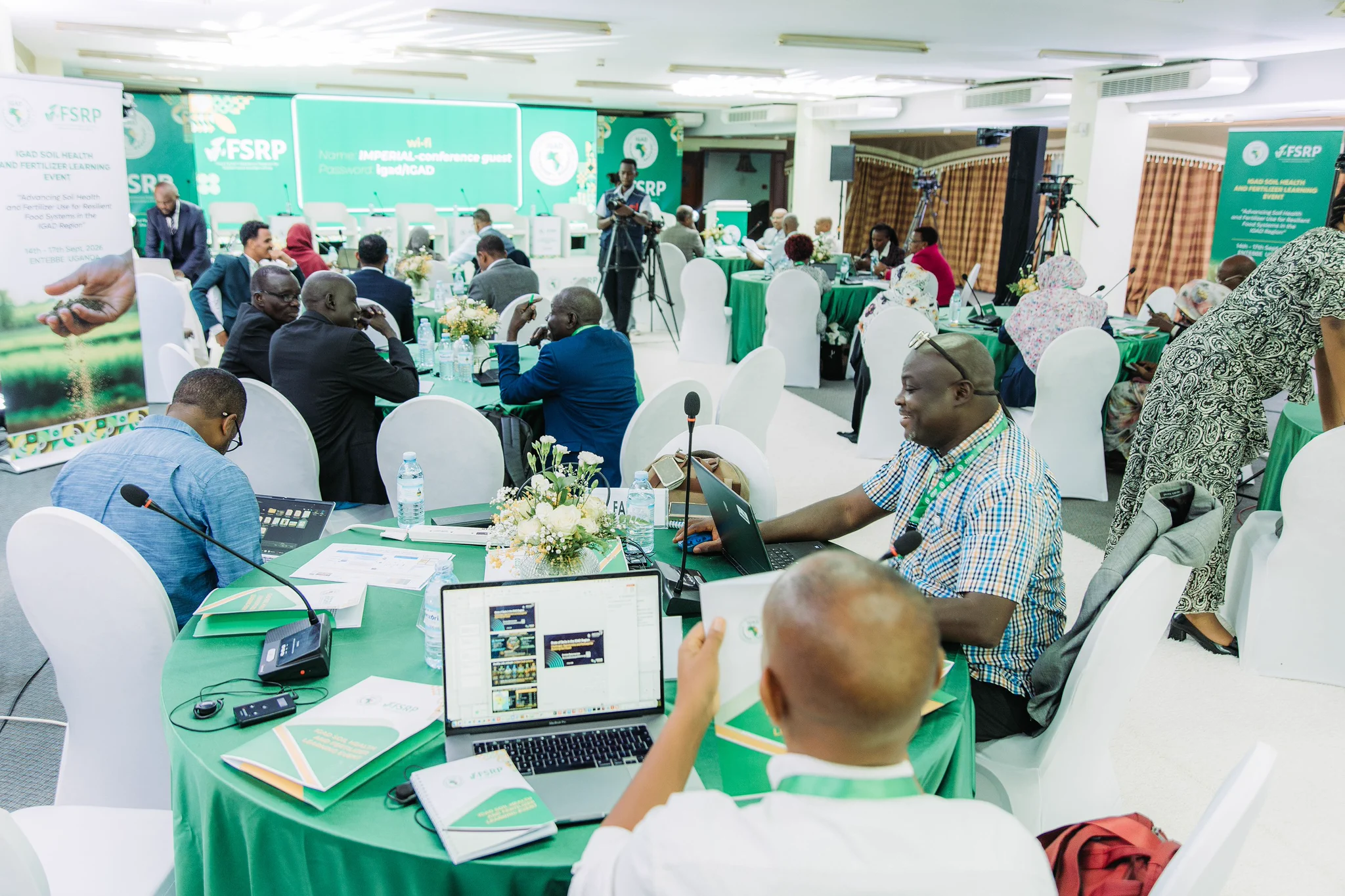
On Monday, 14 September 2026, delegates from the member states of the Intergovernmental Authority on Development (IGAD), along with participants from West Africa, the private sector, research institutions and development partners, convened in Entebbe for a four-day learning event under the theme "Advancing soil health and fertiliser use for resilient food systems in the IGAD region." The meeting runs to Thursday, 17 September.
The event is organised under the IGAD Fertilizer and Soil Health Hub, delivered through the Food Systems Resilience Program (FSRP), and has drawn at least 60 participants. Its most practical component sits outside the conference hall: a learning visit to Uganda's National Agricultural Research Laboratories at Kawanda.
For Uganda, hosting this conversation is pointed. Fertiliser application here has been estimated at between one and 2.4 kilogrammes per hectare — among the lowest rates recorded anywhere, and a fraction of the 50 kg/ha African governments pledged to reach by 2015 under the 2006 Abuja Declaration. That deadline passed more than a decade ago.
The line that reframed the meeting
The sharpest contribution came from Dr Ermias Betemariam, speaking on behalf of technical partners. His argument was that the continent's soil problem has been consistently misdiagnosed as a knowledge problem.
"What we lack most in Africa is not like a technical deficit, but sometimes we have a deficit of delivery," he said.
That distinction matters more than it may sound. Decades of investment have produced soil maps, recommendation blends, lime protocols for acidic soils and a large body of trial evidence. Very little of it reaches the farmer who would act on it. The binding constraint is not the science; it is extension coverage, input distribution, affordability, and the absence of any mechanism to get a site-specific recommendation from a laboratory to a garden.
Dr Betemariam tied the failure to a figure that governments find harder to ignore than yield curves: Africa spends an estimated US$60–80 billion a year importing food, despite holding a large share of the world's uncultivated arable land. Soil health, on that framing, is not an environmental file. It is a balance-of-payments file and a jobs file.
Uganda's position: committed on paper
Opening the event on behalf of the Permanent Secretary of the Ministry of Agriculture, Animal Industry and Fisheries (MAAIF), Assistant Commissioner for Food and Nutrition Security Alex Bambona placed soil health at the centre of Uganda's food-systems agenda.
"Looking at the subject at hand, there is no doubt that this discussion fits very well in our broad priorities to ensure rapid transformation of the country's food systems," Mr Bambona said. He confirmed Uganda's commitment to translating the Nairobi Declaration on Fertilizer and Soil Health into action, working with partners including the International Fertilizer Development Centre (IFDC).
"The starting point for food system transformation is basically the harnessing of soil resources, conservation of our soil health, and the use of fertilizer," he said — before adding a caveat that deserves more attention than it will probably get: "Even fertilizer per se is not a solution. It can be misused in the treatment of the soils if it is not used well."
Why that caveat is the whole story
The warning cuts directly against how fertiliser policy is currently being executed in Uganda. On 31 August 2026, MAAIF flagged off 173,913 bags of fertiliser — 50 kilogrammes each — for free distribution to farmers of strategic crops, supplied by ITRACOM Fertilizers Uganda and destined first for tea growers, with coffee and cocoa to follow. The programme was directed from the top and framed as a response to declining soil fertility.
A mass distribution of a standard blend is a fertiliser programme. It is not, by itself, a soil health programme. Ugandan soils vary enormously in pH, organic matter and deficiency profile between the Kigezi highlands, the Lake Victoria crescent and the northern and eastern plains. Applying nitrogen-heavy blends to acidic soils that need lime first can produce a poor response and, on some soils, accelerate acidification — precisely Mr Bambona's point about misuse.
The bridge between the two is soil testing and site-specific recommendation — what the Kawanda laboratories exist to provide, and what almost no smallholder currently accesses. A regional delegation walking through those labs is, in that sense, useful theatre — but only if it ends in a resourcing decision.
What the Hub is actually mandated to do
Speaking for the IGAD Executive Secretary, Daher Elmi, Director of the Agriculture and Environment Division at IGAD, set out the diagnosis at regional scale. "Across our region, soil degradation, declining soil fertility and low fertilizer use efficiency continue to undermine agricultural productivity, food security and livelihoods," he said, describing healthy soils as the foundation of resilient food systems and the Hub as a platform for knowledge sharing, innovation, policy dialogue, partnerships and investment.
Denis Kibuuka of the IGAD Secretariat explained the Hub's origins and its concrete deliverables. It was established following the African Union's Africa Fertilizer and Soil Health Summit held in Nairobi in May 2024. Its stated objectives are to share experiences among member states, build their technical capacity, and establish a regional soil information system.
That last item is the one worth tracking. A functioning regional soil information system — harmonised sampling, shared analytical standards, data that crosses borders — would be the first piece of infrastructure capable of turning declarations into field-level recommendations. It would also be the first thing to quietly disappear from a work plan if funding tightens.
Mr Kibuuka was blunt about the underlying necessity: "There is no other option apart from using fertilizers to improve the soil because when you are talking about soil health, it is like human health. You have to keep supporting the soils."
The commitments the region is measured against
The Nairobi Declaration that Uganda says it is domesticating carries specific, dated targets. African leaders committed to tripling domestic production and distribution of certified quality organic and inorganic fertilisers by 2034 to improve access and affordability for smallholders. They committed to reversing land degradation on 30 percent of degraded soils by 2034 through integrated soil and water management. They committed to ensuring at least 70 percent of smallholder farmers have access to quality extension and advisory services on fertiliser and soil health. And they committed to operationalising the Africa Fertilizer Financing Mechanism.
The summit that produced those targets drew more than 4,000 participants and ten heads of state and government. The Abuja Declaration that preceded it by eighteen years drew similar attendance and produced a target missed by a wide margin.
The money question Uganda has not answered
Uganda's fiscal position was aired publicly only days before the Entebbe event. At a high-level policy dialogue in Kampala on 10–11 September on domesticating the CAADP Kampala Declaration — the framework that replaced Malabo from 1 January 2026 — participants confronted the gap between the continental target of allocating at least 10 percent of public expenditure to agriculture and Uganda's actual allocation.
Against a national budget of roughly Shs84.3 trillion for FY2026/27, the agro-industrialisation allocation is about Shs2.26 trillion — in the order of 2.6 percent. Analysis by FAO's Monitoring and Analysing Food and Agricultural Policies programme put Uganda's agricultural spending at roughly 4 percent of public expenditure over 2018–2022. Closing to 10 percent would require something on the order of an additional Shs5 trillion a year.
Soil health sits at the thin end of that already thin allocation. Laboratory capacity, extension staffing and a soil information system are unglamorous recurrent costs that compete, inside the same envelope, with input handouts that photograph well.
Delivery, tested against two known failures
If "deficit of delivery" is the diagnosis, Uganda offers live illustrations of what that deficit looks like in practice.
The first is extension. Advisory coverage remains thin enough that most farmers receive recommendations, if at all, from input sellers — whose commercial interest is in volume sold rather than in correct rates. A 70 percent extension-access target is not reachable on current staffing.
The second is last-mile information. Dr Isaac Mugume of the Department of Meteorological Services set out earlier this year why seasonal forecasts largely fail to reach farmers: a meteorology budget of roughly Shs20 billion, no funding to translate advisories into the roughly 35 languages spoken nationally, and no district meteorologist post. Soil advisories face the same last mile, with the same infrastructure missing.
What to watch after Thursday
Three things will indicate whether Entebbe was more than a communiqué. Whether the regional soil information system gets a funded work plan and a host institution rather than a mandate. Whether Kawanda's laboratories emerge with expanded throughput and soil tests priced within a smallholder's reach. And whether Uganda's FY2027/28 Budget Framework Paper moves agriculture toward the 10 percent line it has now pledged to twice.
The rest is already known. As Mr Kibuuka put it, soil is like human health — it has to be supported continuously, not treated in an emergency. Uganda has spent roughly two decades treating it in emergencies, and this year's drought showed what happens when soils with almost no organic matter meet a season that goes wrong. The technical answer has been on the shelf the entire time.