Written By |
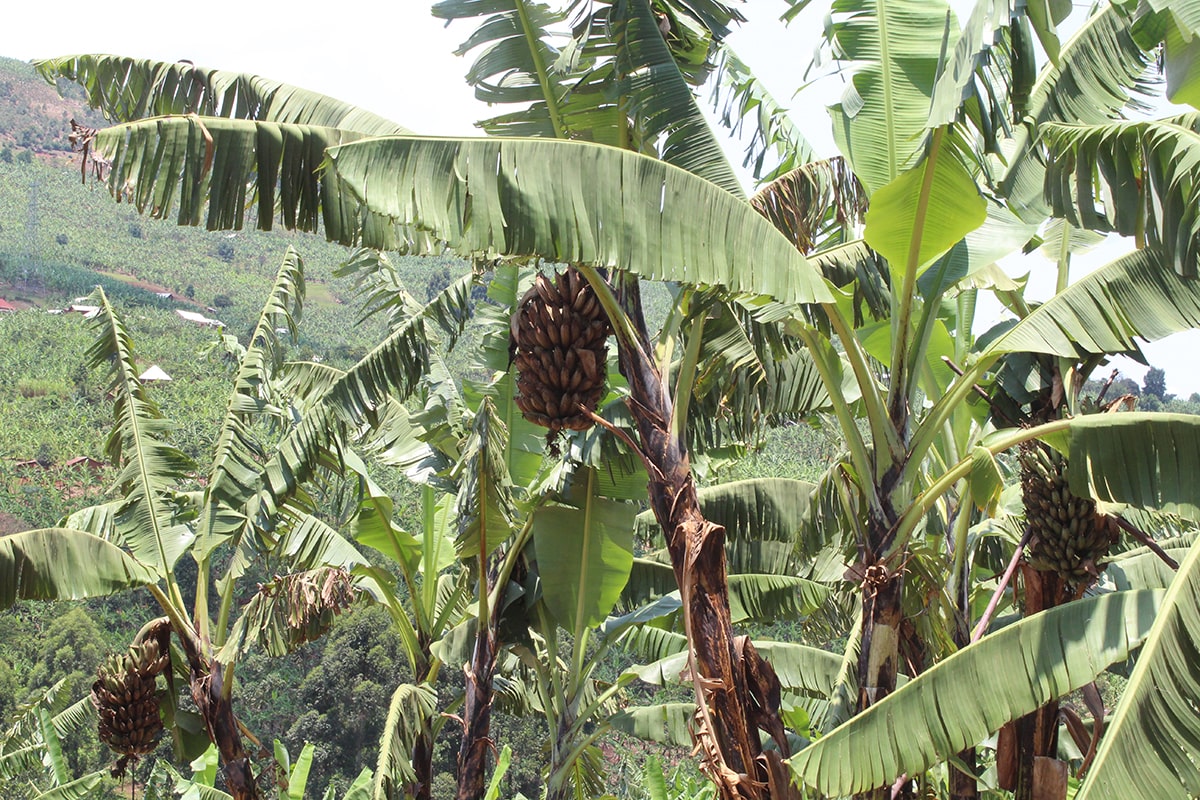
Affected banana plantation. Farmers say the disease turn the matooke brown which affects its growth. PHOTO: JOVITA HASTO
By Jovita Hasto
Residents of Rwampara District are alarmed by a strange banana disease that has affected most plantations, causing matooke to turn brown. As one of the leading matooke-producing areas in western Uganda, farmers are counting huge losses since bananas are their main source of livelihood.
The most affected subcounties include Mwizi, Bugamba, Nyabikungu, Kitoha, Nyaruhandagazi, and Kigando. Farmers say the disease spreads mainly during the dry season, causing banana fingers and bunches to turn brown, ripen prematurely, and eventually dry up.
Ms. Miriam Nimusiima, a farmer from Kigando Village in Bugamba Subcounty, said they first noticed the disease when their bananas began turning brown. “The disease started during the dry season. When the rains came, all the bananas that had started producing bunches turned brown. Some dried up, others ripened prematurely, and the growth became stunted. This is where we get school fees, but now we have no hope of getting matooke for our clients,” she explained.
At first, farmers thought it was the banana wilt disease, but later realized it was different. “This matooke can still be eaten, but it becomes very hard once cooked, unlike the normal soft matooke,” she added. Ms. Nimusiima said her family is now relying on posho and yams while reserving whatever little matooke remains for buyers to raise school fees.
Mr. Gersom Mpairwe, a banana trader at Kigando Market, said the brown matooke is hard to sell. “The affected matooke takes a long time to be bought. Even when someone takes it, they return with complaints that it becomes as hard as cassava when cooked. What used to fetch Shs15,000 in wholesale now cannot raise even Shs5,000,” he lamented.
Mr. Moses Namanya Rutahunga, a farmer from Nyaruhandagazi Parish, said finding a solution has been difficult. “You cannot just uproot banana trees and replant because it takes over a year to mature. We only pray that the unaffected bananas remain safe so that we can at least survive on them,” he said.
He appealed to the government for urgent intervention. “Matooke is our main source of income. The disease once appeared and disappeared, but it came back during the dry season. We are very worried,” he added.
Ms. Dinavance Kemyeri, also from Nyaruhandagazi, said her family now lacks food and money for school fees. “We are becoming poorer every day. The diseased matooke has no value in the market. Our children will soon be chased from school because we used to pay fees by selling bananas, but now there is nothing to sell,” she said.
Mr. Milton Tumusiime Rwakoma, councillor for Nyaruhandagazi Parish, said plantations across at least three subcounties are affected. He criticized the lack of government response. “This outbreak has lasted nearly three years, but we have never seen any agricultural officer sensitizing farmers on how to control or prevent it. The government should treat it with the same urgency as foot-and-mouth disease,” he urged.
However, Mr. Deogratious Begumisa, the Rwampara District Production Officer, said the disease is caused by banana red rust thrips, a parasitic pest. “This is not a new disease to farmers, and it is self-limiting in terms of spread. It has not affected the entire district, and we are working to ensure it is contained before it spreads further,” he said.
Torch Media Africa



