Written By | Torch Media Africa
Eight years. Six billion miles. Nine planetary flybys. One near-fatal power failure that almost ended everything
Eight years. Six billion miles. Nine planetary flybys. One near-fatal power failure that almost ended everything. On Thursday, Europe and Japan's BepiColombo threw away its own engine above the least-explored planet in the inner solar system — and began what mission controllers openly call the most complicated arrival in the history of planetary exploration.
DARMSTADT, GERMANY — Friday, September 4, 2026
At exactly 8:00 a.m. Eastern time on Thursday morning, in a fluorescent-lit control room in western Germany, a spacecraft that has been flying since Barack Obama was still a recent memory in the White House cut itself in half on purpose.
Then came the worst part. Nothing.
For more than an hour, the flight controllers of the European Space Agency's BepiColombo mission sat in silence, staring at screens that told them absolutely nothing about whether the most important manoeuvre of the last eight years had worked or catastrophically failed. Signals from the inner solar system take time. Confidence, it turns out, takes longer.
Just before 10 a.m. Eastern, the carrier signal came back. Then telemetry. Then the numbers that everybody in the room had been rehearsing in their heads for years: the spacecraft was exactly where it was supposed to be, in exactly the configuration it was supposed to be in.
“I'm again extremely relieved,” said Elsa Montagnon, BepiColombo's operations manager. “That the telemetry comes exactly at the moment we expect it, and that we see in the telemetry that the configuration of the spacecraft is the correct one — this is the best case scenario.”
The Mercury Transfer Module — the workhorse propulsion unit that has hauled two science orbiters across roughly 6 billion miles (10 billion kilometres) of inner solar system since October 2018 — had let go. Its job is over. It will be abandoned. And the two robot explorers it delivered are now flying alone toward a planet that only two spacecraft in human history have ever properly visited.
“It will basically be a new mission starting today,” said Bruno Sousa, ESA's head of operations definition and engineering, during Thursday's live broadcast.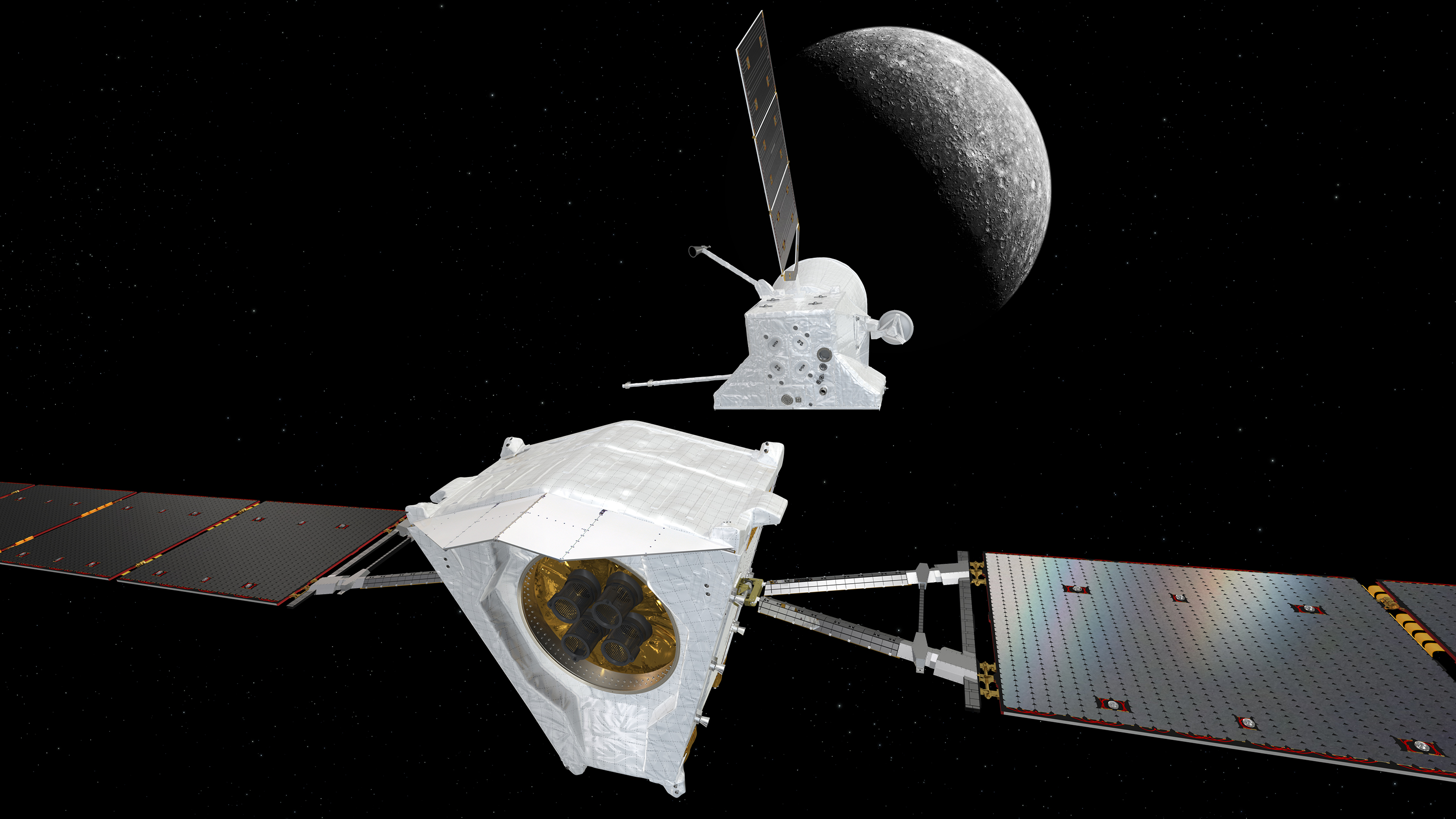
THE PLANET THAT IS CLOSE BUT IMPOSSIBLE
Here is the thing about Mercury that almost nobody outside mission control understands: it is one of our nearest neighbours, and it is one of the hardest places in the solar system to reach.
Earth sits roughly ten times closer to Mercury than it does to Jupiter. And yet BepiColombo has taken longer to arrive at the tiny scorched world than NASA's Galileo and Juno missions took to reach the largest planet in the outer solar system. That sounds absurd until you understand the physics.
Falling toward the Sun is easy. Stopping is not.
“You can go faster to Mercury if you take a direct way to it,” explained Frank Budnik, flight dynamics manager for BepiColombo at ESA. “But the problem is we want to insert into an orbit with respect to Mercury. You have to bring the spacecraft to the same velocity as Mercury has, and this is a very energy-demanding transfer.”
Translation for the rest of us: the Sun's gravity acts like an enormous downhill slope. Any object dropping toward the inner solar system picks up terrifying speed. Mercury itself is racing around the Sun at enormous velocity, completing a full orbit every 88 days. To slip into orbit around it rather than simply screaming past it, a spacecraft has to shed a colossal amount of energy first.
BepiColombo did it the slow way — the only way that was affordable. Nine separate planetary flybys: one of Earth, two of Venus and six of Mercury itself, each one used as a gravitational brake pad, bleeding off speed a slice at a time. In between, its electric ion thrusters ran for months at a stretch, pushing with roughly the force of a sheet of paper resting on your palm, but pushing continuously.
Only two missions have ever made it into Mercury's neighbourhood before: NASA's Mariner 10, which flew past in 1974, and NASA's MESSENGER, which entered orbit in 2011 after a journey of nearly seven years. BepiColombo, named after the Italian engineer and mathematician Giuseppe “Bepi” Colombo — the man who worked out Mercury's strange rotation and designed the trajectories that made Mariner 10's flybys possible in the first place — has taken nearly eight.
THE MONTH THE MISSION ALMOST DIED
It was supposed to take less. When BepiColombo launched on an Ariane 5 rocket from Europe's Spaceport at the Guiana Space Centre in Kourou, French Guiana, on October 19, 2018, the plan called for a journey of around seven years and an arrival in December 2025.
Then came April 2024.
A problem in the spacecraft's solar power system cut the electricity available to the transfer module's electric thrusters. For an ion drive, power is thrust — less current means less push, and less push means the entire carefully choreographed sequence of gravitational braking no longer closes. For a period, the mission's future was genuinely in question.
Engineers responded by redesigning the arrival from scratch around a weaker engine, threading a lower-thrust trajectory through the same gravitational gates. It worked. The cost was a year: arrival slipped from December 2025 to November 2026. The alternative was losing a mission that had already consumed decades of European and Japanese scientific effort.
“It's one of the most complicated missions we have ever flown,” Sousa said.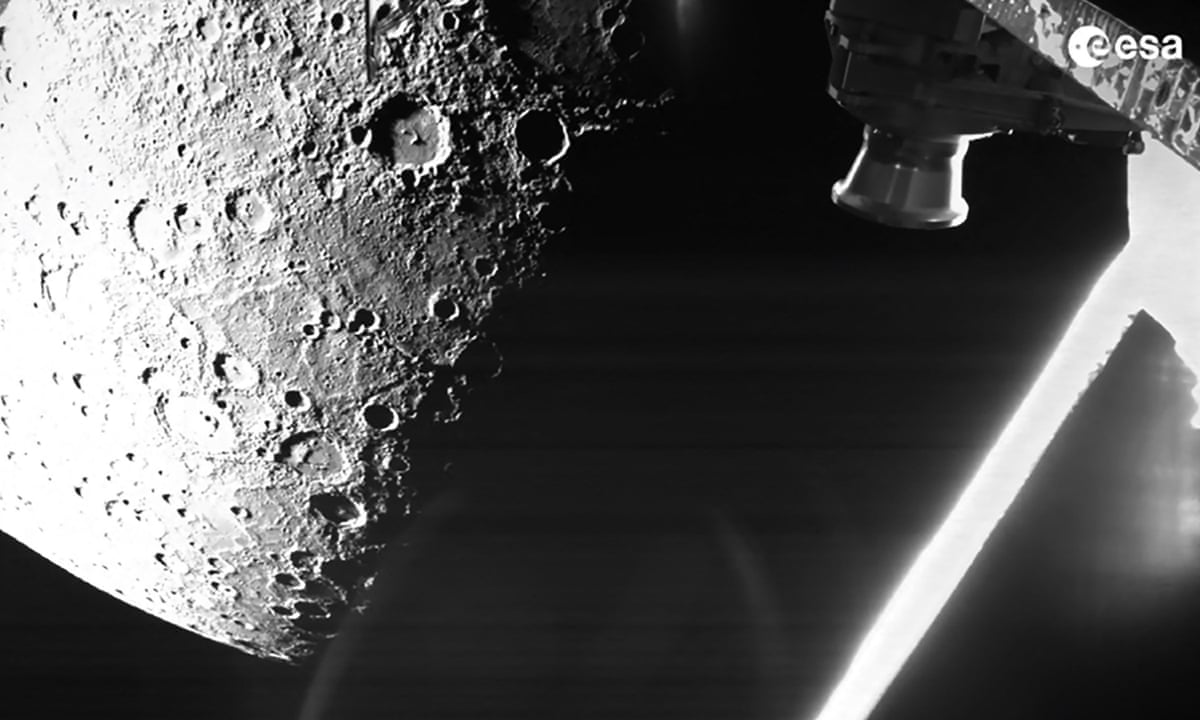
SIXTEEN MANOEUVRES, TWO SEPARATIONS AND A SUNSHADE IN THE BIN
Thursday's separation did not put anything into orbit around anything. That is the part casual observers keep getting wrong. Arrival at Mercury is not an event. It is a season.
“Unlike in other missions, BepiColombo's arrival doesn't mean a single event,” said Ignacio Tanco, head of Inner Solar System Mission Operations at ESA. “We have about half a year of intense operations ahead of us.”
Montagnon put it even more bluntly: “Arriving to Mercury is not as simple as other missions that do a big manoeuvre and they are there. In our case, it's going to be six months of continuous activities.”
Here is the calendar that now governs the lives of several hundred engineers across Europe and Japan.
November 21, 2026: Mercury's gravity captures the stacked pair — ESA's Mercury Planetary Orbiter, known as MPO, and the Japan Aerospace Exploration Agency's Mercury Magnetospheric Orbiter, known as Mio. That capture kicks off a sequence of sixteen separate manoeuvres designed to progressively lower and reshape the orbit.
Around December 9, Mio separates from MPO and settles into a highly elliptical polar orbit, where it will sample the wild magnetic environment far from the planet's surface.
December 16: MPO jettisons the MOSIF — the Magnetospheric Orbiter Sunshield and Interface Structure, the protective shell that has kept Mio alive on the journey inward. It is thrown away as space junk, its purpose served.
March 10, 2027: MPO finally reaches its own tight polar orbit after months of patient altitude-lowering.
April 6, 2027: science operations formally begin, with both spacecraft studying Mercury simultaneously from complementary vantage points.
That last detail is a genuine first. “It will be the first time that a mission releases two fully independent, fully operational separate spacecrafts around a different planet,” Tanco said.
He had warned before Thursday's manoeuvre that the risks were unlike anything the agency has managed before. “The separation of the transfer module will take place in conditions which are exceedingly challenging, and we will have to face a considerable risk that things don't go as planned,” he said. “It's going to be equivalent to launching a new spacecraft, only this spacecraft happens to be around a different planet. We are going to see for the first time systems in operation that we have not been able to fully test.”
Read that last sentence again. Systems that have never been fully tested, switched on for the first time, a hundred million miles away, with no possibility of repair.
OPERATING INSIDE A PIZZA OVEN
Mercury orbits an average of about 36 million miles (58 million kilometres) from the Sun. Daytime surface temperatures reach roughly 800 degrees Fahrenheit (430 degrees Celsius) — hot enough to melt lead, tin and zinc.
Every piece of BepiColombo has been engineered around that fact.
“The spacecraft in itself has been designed to operate within conditions which are extremely punishing,” Tanco said. “It's essentially equivalent to operating with a very hot pizza oven running right on your back.”
Both orbiters depend on solar arrays for power, which creates a brutal engineering paradox: the closer you get to the Sun, the more energy is available and the more likely your power system is to cook itself. The two spacecraft solve it in completely different ways. Mio spins fifteen times every minute, spreading the heat load around its body like a chicken on a rotisserie. MPO instead angles its solar array almost edge-on to the Sun, catching just enough light to keep the lights on while presenting the smallest possible target to the radiation.
It is the kind of solution that sounds elegant on a whiteboard and terrifying in operations, because it leaves almost no margin. Get the angle wrong and you either lose power or lose the array.
THE MYSTERIES WAITING AT THE FINISH LINE
So what is all this for? Two things, mainly, and both of them are genuinely strange.
The first is a set of features called hollows — shallow, bright, irregular depressions scattered across Mercury's surface in their thousands, first glimpsed by Mariner 10 and mapped in detail by MESSENGER. They look, unnervingly, like something is eating the planet.
“There are depressions in the surface that look like the surface is being eaten away,” said Geraint Jones, ESA's lead project scientist for BepiColombo. “It might be possible that we can see changes in these regions over time.”
Nothing like them has been found on any other planet in the solar system. Mercury has no wind and no liquid water — the two forces that carve landscapes on Earth and Mars. Something else is sculpting them, and one leading idea is that volatile materials locked in the rock are being cooked out by the Sun and the solar wind, leaving the surface to slump. If BepiColombo can watch a hollow change during its mission, that would be the first time anyone has ever seen geology happen in real time on Mercury.
The second mystery is Mercury's absurd density. For such a small planet, it is far heavier than it has any business being — its metal core makes up a disproportionate fraction of the whole world.
“It's thought that Mercury started forming, created a modest-sized planet and then it was hit by another large planetesimal, which ripped off its outer crust,” Jones said. “So that means that the overall density of the material that was left behind was much higher, and that's why it has the high density it has now.”
In other words: Mercury may be the stripped survivor of a colossal early collision, a planet that got its skin torn off 4.5 billion years ago and never recovered. BepiColombo's instruments — mapping surface composition, geology, the interior, the magnetic field and the thin cloud of gas called the exosphere that clings to the planet — are designed to test exactly that.
Santa Martinez, BepiColombo's mission manager at ESA, has described the two-orbiter approach as the whole point: MPO watches the planet, Mio watches the space around it. Neither view makes complete sense without the other.
EXPERT PERSPECTIVE: WHY THIS IS HARDER THAN MARS
Mars missions get the headlines and the movie deals. Mercury missions get the engineers' respect.
The reason is straightforward. Mars sits outward from Earth, in a gentler and cooler part of the gravitational landscape. Getting there is largely a problem of patience and navigation. Mercury sits at the bottom of the Sun's gravity well, in a radiation and thermal environment that destroys ordinary hardware, requiring so much energy to reach that missions must effectively spend years braking.
That is why, in the entire history of spaceflight, exactly two spacecraft have visited Mercury and only one has orbited it. It is why BepiColombo carries two orbiters rather than one — because when the trip is this expensive, you send everything you can in a single stack. And it is why the six months now beginning are being treated with more nerves than the launch itself.
WHAT THIS MEANS FOR YOU
Nobody is moving to Mercury. So why should anyone who is not an astronomer care what happens next November?
Three reasons, and they get progressively closer to home.
First, Mercury is the best natural laboratory in existence for understanding what stars do to the planets closest to them. Astronomers have now catalogued thousands of planets around other stars, and a huge fraction of them orbit closer to their suns than Mercury does to ours. Every question about whether those worlds could hold atmospheres, magnetic fields or anything resembling habitability runs through data we can only collect properly at Mercury. It is the only scorched world we can actually go and touch.
Second, the space weather question. Mercury has a real magnetic field, unlike Venus or Mars, and it is being battered by the solar wind at close range. Mio's job is to watch that battering happen. Understanding how a magnetic field absorbs a stellar assault is the same physics that governs whether a solar storm knocks out satellites, power grids and GPS on Earth — an increasingly expensive question as more of daily life runs through orbital infrastructure.
Third, the hardware itself. The thermal coatings, the radiation-hardened electronics, the electric propulsion systems and the power management designed to survive a pizza oven on your back do not stay in space. Technologies forged for these missions tend to reappear a decade later in satellites, aircraft, medical imaging and consumer electronics. Extreme engineering has a long history of trickling down.
THE LONG WAIT
There is one more thing worth sitting with. Giuseppe Colombo, the man this spacecraft is named for, died in 1984 — more than three decades before the mission carrying his name left the ground. The scientists who first proposed a European Mercury mission in the 1990s have in many cases retired. Some of the engineers who will command MPO into its final orbit in March 2027 were children when the Ariane 5 lifted off from Kourou.
That is the uncomfortable, magnificent arithmetic of deep space. These projects outlast careers. They demand that thousands of people work for decades on something whose payoff they may never personally see, funded by governments that change hands repeatedly along the way.
On Thursday morning, for a little over an hour, all of that hung on a silent radio link and a separation mechanism that had never been fired in flight.
It held.
Six months of the hardest orbital choreography ever attempted now stand between BepiColombo and the science it was built for. On November 21, Mercury's gravity takes hold. On April 6, 2027, the instruments switch on. And the least-explored planet in the inner solar system finally gets its close-up.
— Reporting compiled from ESA and JAXA mission briefings, ESA's live separation broadcast of September 3, 2026, and interviews published by CNN and Space.com.



