Written By | Torch Media Africa
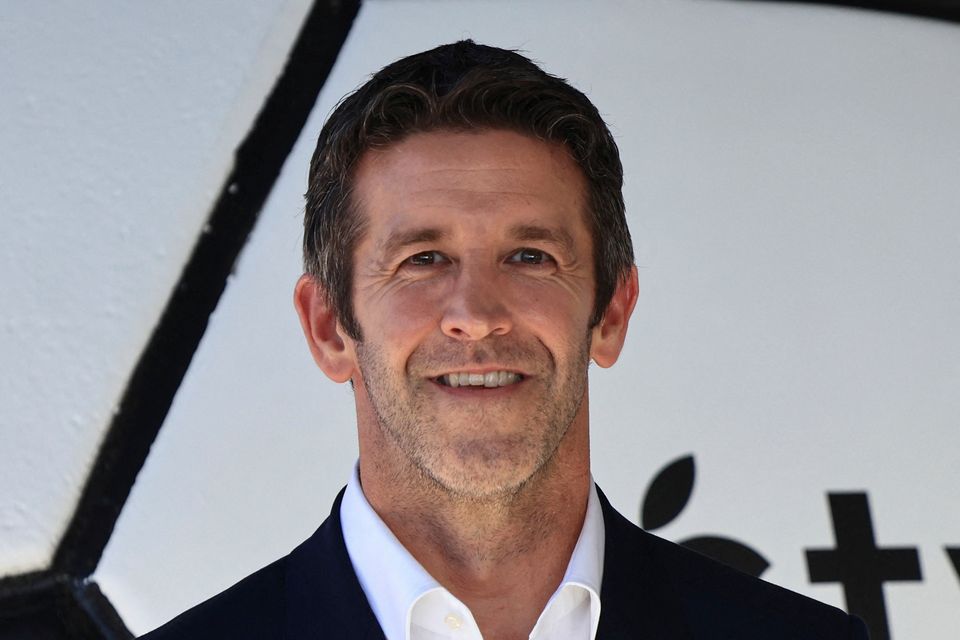
John Ternus, 51, took the keys to a four-trillion-dollar empire this morning. His first product launch is next Wednesday. And the one thing Apple is losing at is the one thing everybody is watching.
SCIENCE & TECH
At some point this morning, in a low-slung glass ring in a Californian suburb, the most valuable company on Earth changed hands — and almost nobody outside the building noticed.
No press conference. No stage. No black turtleneck. Just a calendar flipping over from August 31 to September 1, and a man named John Ternus becoming the chief executive officer of Apple Inc.
Tim Cook, who has run the company for fifteen years and one week, is now executive chairman. He keeps a seat at the table, an office, and a legacy so enormous it is almost impossible to argue with. What he no longer keeps is the job.
And here is the part that should make your palms sweat if you own Apple stock, work for an Apple supplier, or simply own one of the roughly two billion active Apple devices on the planet: Ternus does not get a honeymoon. He does not get a quiet first quarter to move the furniture around. In eight days — Wednesday, September 9, 10 a.m. Pacific — he walks onto a stage in Cupertino for the biggest iPhone launch in a decade, carrying a foldable phone, a rebuilt Siri, and the weight of every headline that has spent two years asking the same question: has Apple already lost artificial intelligence?
Who is John Ternus, and why him?
If you have never heard of him, that is by design. Ternus, 51, is not a showman. He is an engineer's engineer — a man whose public appearances have mostly consisted of standing in front of an exploded diagram of a laptop chassis and explaining, calmly and precisely, why the hinge is better this year.
He joined Apple in 2001, back when the iPod was still a curiosity and the iPhone did not exist. He climbed through the hardware ranks for two decades and became senior vice president of Hardware Engineering in 2021. His teams have had their fingerprints on essentially every physical object Apple sells: iPhone, iPad, Mac, AirPods, Apple Watch. If you have held an Apple product in the last fifteen years, you have held something John Ternus signed off on.
Apple announced the succession back in April, and the board approved it unanimously. The company framed it — accurately, by all accounts — as the endpoint of a long, deliberate planning process rather than a palace coup. Cook stayed on through the summer, working alongside Ternus on the handover. The transition has been about as drama-free as a four-trillion-dollar succession can be.
Which, historically, is not very drama-free at all. Ask anyone who lived through August 2011.
The numbers Cook leaves behind are, frankly, absurd
Let us be blunt about what Ternus is inheriting, because the scale of it is genuinely difficult to hold in your head.
When Tim Cook took over from Steve Jobs on August 24, 2011, Apple was worth just under $350 billion. That was already a staggering sum — enough to make it one of the most valuable companies in the world.
Today it is worth roughly $4 trillion. In July of this year it briefly touched $5 trillion, becoming only the second company in history to do so.
Read that again. Cook grew the company more than tenfold. The stock is up more than twentyfold since he took the chair, an average annual return north of 20 percent before you count a single dividend.
The revenue story is even more vivid. In all of fiscal 2011 — twelve months, every iPhone, iPad, Mac and iPod Apple could build — the company brought in $108 billion. In the third quarter of 2026 alone, Apple reported $109.4 billion. It now earns Steve Jobs's final full year in roughly ninety days.
Fiscal 2025 revenue came in at $416 billion. The services division — the App Store, iCloud, Apple Music, Apple TV, advertising, the whole invisible subscription machine that Cook built almost from nothing — now generates more than $120 billion a year on its own. That single division is bigger than the entire company was when he started.
“Cook was never going to out-Jobs Steve Jobs. He didn't try. He built the machine underneath the magic — and the machine made a trillion dollars.”
That is the ledger. It is close to unimprovable. And it is exactly why Ternus's job is so brutal: when the previous guy went up twentyfold, there is no version of "steady as she goes" that counts as a win.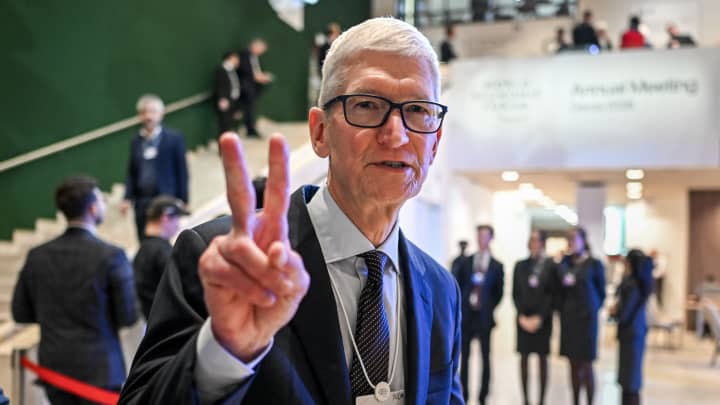
The AI problem that will not go away
Every analyst note, every op-ed, every furious Reddit thread about Apple in 2026 eventually lands on the same four letters: Siri.
Apple invented the mainstream voice assistant. It shipped Siri in 2011 — the same year Cook became CEO — and for a while it was genuinely magic. Then large language models arrived, ChatGPT ate the world, Google rebuilt its entire product line around Gemini, and Siri sat there, in hundreds of millions of pockets, still fumbling requests it had been fumbling since the Obama administration.
Apple promised a rebuilt, genuinely intelligent Siri. Then it slipped. The overhaul that was supposed to arrive in 2024 kept sliding right, the AI division went through a painful leadership shake-up, and the company was forced into the most humbling decision in its recent history: rather than build the foundation itself, Apple has reportedly rebuilt Siri on top of Google's Gemini technology.
Sit with that for a second. The company whose entire brand identity is "we control the whole stack" — silicon, operating system, hardware, retail — has gone to its single biggest search-and-AI rival and licensed the brain.
Defenders will tell you this is pragmatism, and they have a point. Apple has never needed to be first; it has needed to be best-executed. It was not first to the MP3 player, the smartphone, the tablet, the smartwatch, or the wireless earbud, and it ended up owning all five categories. Buying a foundation model and wrapping it in Apple's privacy architecture and on-device silicon may well be the smartest move available.
Critics will tell you something colder: that Apple has just conceded the most important technology platform shift since the smartphone, and rented its way back in. Ternus now owns that argument. All of it.
Eight days: the September 9 test
Apple's invitations went out in late August with the tagline “Surprise and shine” beside a glowing Apple logo. The event runs at 10 a.m. Pacific on Wednesday, September 9, at the Cupertino campus.
Three things are expected to define it.
First, the foldable. After years of watching Samsung, Honor and Huawei iterate through folding handsets — through creased screens, failed hinges and mixed reviews — Apple is expected to unveil its first folding iPhone. This is the classic Apple playbook: arrive late, arrive polished, redefine the category. It is also, in a very literal sense, a hardware problem — hinges, displays, thermals, battery geometry. Which is to say: it is a John Ternus problem, and probably the single product on that stage he understands most intimately.
Second, the new Siri. Apple is expected to debut its large-language-model-powered assistant, capable of actually operating apps on your behalf — reading and sending messages, managing your calendar, chaining tasks together instead of just setting timers and misunderstanding you.
Third, new Apple Watches, and the usual constellation of software and accessory announcements.
A new CEO, a brand-new product category, and a total rebuild of the company's most-mocked software — all converging on a single Wednesday morning. It is not an exaggeration to call it the most consequential Apple event since the original Apple Watch, and arguably since the iPhone itself.
Expert perspective: the in-tray nobody envies
Analysts covering the transition have been notably consistent in their read: Ternus is inheriting a company in phenomenal financial health and severe narrative trouble.
The consensus framing is that Apple's AI position is the single most consequential issue on his desk — not because AI is currently costing Apple money, but because the market has decided AI determines who wins the next decade, and Apple is not currently perceived as winning it. Sentiment, in a company valued at four trillion dollars, is not a soft metric. It is most of the valuation.
Beyond AI, the in-tray is genuinely bulging. Europe's Digital Markets Act continues to force open the App Store and iOS in ways Apple has fought bitterly and repeatedly lost. The cost of AI-capable silicon is climbing across the industry. Supply chains remain hostage to geopolitics in ways Cook — a supply-chain savant, which was always his true genius — managed with extraordinary skill. And Ternus, for all his engineering credibility, has never run a public company, never faced a hostile earnings call, and never had to charm a room full of regulators.
The counter-case is straightforward and not unreasonable: Apple has quietly built one of the best silicon design teams on the planet, has more cash than most nations, has a distribution channel of two billion devices to push AI features through the moment they are ready, and now has a CEO who actually understands the machines. In a moment where AI's bottleneck is increasingly hardware — chips, memory, thermal design, battery life — putting a hardware engineer in the chair may look prescient rather than conservative.
What this means for you
If you own an iPhone: watch September 9 closely, because the Siri rebuilt on modern language-model technology is the biggest functional change to your phone in years — and it is the first Apple product decision that will be judged as Ternus's, fairly or not.
If you own Apple stock, or hold an index fund — and if you have a pension in the Western world, you almost certainly do — this transition matters to your money whether you follow tech or not. Apple is roughly six to seven percent of the S&P 500. A four-trillion-dollar company changing leadership is not a tech story; it is a household-finance story.
If you were thinking of buying a foldable phone: wait eight days. Whatever Apple shows, the entire category will reprice around it — including Samsung's.
And if you simply enjoy watching history turn over: today is one of those days. Fifteen years, one week, and roughly $3.65 trillion in created value ended this morning without a single press conference.
The verdict
Tim Cook did the impossible thing: he followed Steve Jobs and did not fail. He never tried to be the visionary. He was the operator, the logistician, the quiet man who turned a brilliant, chaotic product company into the most efficient profit machine in corporate history.
John Ternus now has to do a different impossible thing. He has to follow the most successful CEO run in modern business — and he has to do it while the entire industry sprints toward a technology his company is widely believed to be losing at.
He has eight days before the world gets its first real look at his answer.
Cupertino has not been this interesting since 2011.



