TECHNOLOGY
In the first quarter of 2026, Zimbabwe’s telecommunications regulator recorded 86,488 active VSAT subscriptions and 86,505 active fibre connections. Seventeen subscriptions separated a technology that has been laid in Zimbabwean trenches for two decades from one that arrived in September 2024. That single data point, buried in a POTRAZ quarterly sector report, is the most consequential fact about Zimbabwe’s digital economy this year — and it reframes almost every other item on the government’s technology agenda.
The quarter satellite caught fibre
VSAT subscriptions grew 28.98 percent quarter on quarter, from 67,057 in the fourth quarter of 2025 to 86,488 in the first quarter of 2026, making satellite the fastest-growing internet access technology in the country by a factor of nearly three over fixed LTE, its closest rival. POTRAZ does not report Starlink as a standalone line item, but the category was negligible before the service launched — it jumped from 3,814 to 23,410 subscriptions in the quarter of entry — which makes VSAT a serviceable proxy. On that basis Zimbabwe added roughly 19,431 satellite users in a single quarter, a scale of growth that took Kenya about twelve months to match.
The structural picture is more interesting than a simple substitution narrative. Zimbabwe’s fixed broadband base grew from 286,271 subscribers in the third quarter of 2024 to 417,892 in the first quarter of 2026, a net addition of 131,621 connections. Satellite accounted for 82,674 of that increase and fixed LTE for 66,951, while fibre added just 7,043 and DSL lost 14,048 outright. Fibre did not shrink; it simply stopped mattering at the margin. What satellite has done is expand the addressable market into areas terrestrial operators could not economically reach, while absorbing the collapse of copper.

Why it happened: reach, then price
The mechanics are unglamorous. Fibre and fixed wireless require capital to be sunk into each community and each premise; satellite requires a terminal and a clear view of the sky. In a country where population density outside Harare and Bulawayo makes trench economics punishing, that difference is decisive. Price sharpened it. At launch in September 2024, Starlink’s standard residential plan was priced at $50 a month for unlimited data with advertised speeds up to 200 Mbps, and the Mini plan at $30 for up to 100 Mbps. At the time TelOne’s top package cost $300 for up to 50 Mbps and Liquid Home’s unlimited fibre package $439. Econet subsequently introduced an unlimited LTE product at $45 for up to 50 Mbps. The gap has narrowed — incumbents cut tariffs in response, which is itself a consumer gain — but the initial combination of price, speed and nationwide availability was not something local operators could answer quickly. POTRAZ licensed the entrant properly rather than fighting it, granting Starlink Zimbabwe a telecommunications network services licence and a national internet service provider licence for a combined $575,000.
The baseline being built on
None of this should be mistaken for saturation. DataReportal’s Digital 2026 report counts 6.54 million internet users in Zimbabwe at the end of 2025, an online penetration rate of 38.4 percent, against 16.2 million cellular mobile connections equivalent to 95.0 percent of the population and just 2.60 million social media user identities, or 15.3 percent. The median fixed download speed was 37.69 Mbps. Roughly ten and a half million Zimbabweans remain offline. The country ranked 149th of 193 in the United Nations 2024 E-Government Development Index with a score of 0.4481 against a global average of 0.6382, and its weakest component was telecommunications infrastructure. Satellite has changed the trajectory of fixed broadband; it has not yet changed the national picture, because 86,000 subscriptions in a population of 17 million is a household-level fix, not a mass-market one.
A satellite of its own
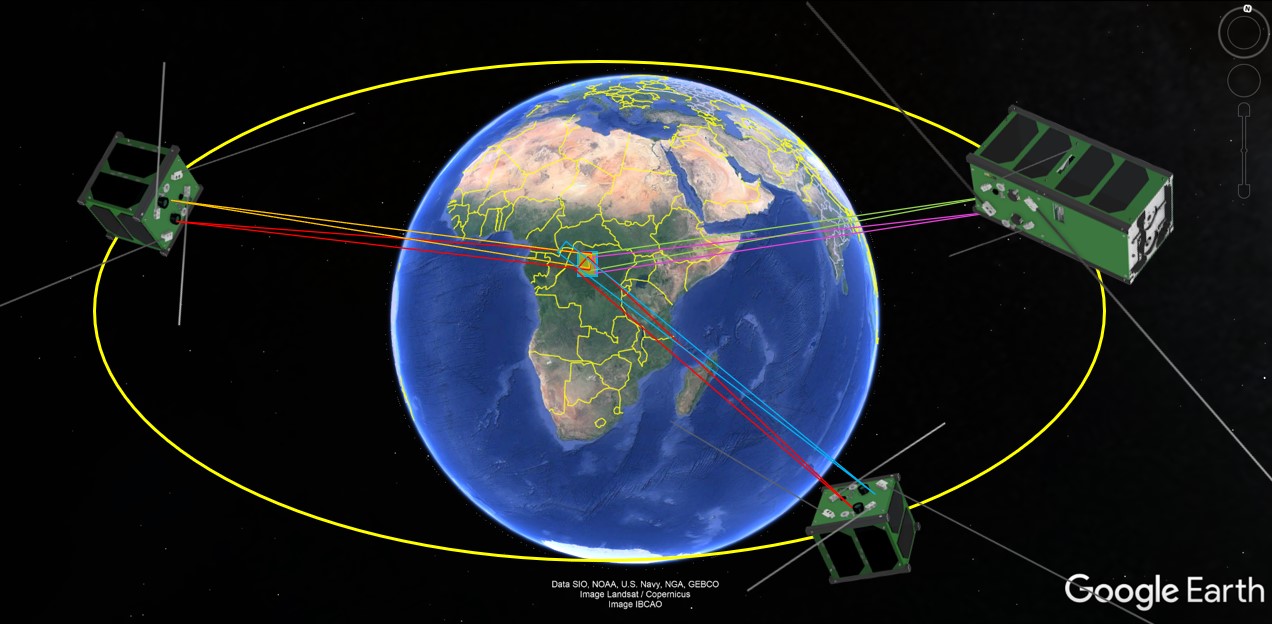
Harare’s response to dependence has been to attempt ownership. On 11 March 2026, speaking at the Zimbabwe Investment and Development Agency’s business and knowledge process outsourcing forum, Finance Minister Mthuli Ncube confirmed the government is raising more than $200 million to finance the launch of a national telecommunications satellite, describing it as part of the country’s digital economy push and conceding candidly that monetising satellites is “a new area for us” requiring a business case to be presented to capital providers.
The ambition is not without foundation. The Zimbabwe National Geospatial and Space Agency, established in 2018 and housed at the University of Zimbabwe, put ZimSat-1 into orbit in November 2022 and ZimSat-2 in November 2024 from Russia’s Vostochny Cosmodrome, and has upgraded the Mazowe ground control station to handle additional frequency bands. A third Earth observation satellite, ZimSat-3, is planned to support mineral exploration, drought forecasting, environmental monitoring and settlement mapping. But an Earth observation cubesat programme and a commercial communications satellite are different orders of undertaking, in cost, in orbital slot and spectrum coordination, and in the operating expertise required. The financing has not closed.
The AI layer arrives before the bandwidth
Zimbabwe approved its National Artificial Intelligence Strategy 2026–2030 in Cabinet in October 2025, and President Emmerson Mnangagwa launched it at the Parliament Building in Harare on 13 March 2026, with development support from UNESCO and its network of AI ethics experts. The strategy rests on six pillars: talent and capacity development; national AI infrastructure and computational sovereignty; adoption and service transformation; governance, ethics and regulation; research and innovation; and international collaboration. Implementation is phased as a 100-day foundation sprint in early 2026, an 18-month build phase, and a scaling phase to 2030, governed by a new National AI Council and an AI Strategy Implementation Office.
The instruments are more specific than most continental AI strategies. Project Pangolin is to provide sovereign compute and national datasets so that local researchers are not wholly dependent on foreign platforms. The Mugove/Umqele/Isabelo Fund is designed to co-invest state capital alongside private investors in certified AI startups. The Innovation Crucible, a regulatory sandbox, is expected to admit a first cohort of five to seven fintech and telecommunications companies. Nzwisiso.ai, a national AI literacy campaign, targets 60 percent of the adult population by 2030. In June 2026 ICT Minister Tatenda Mavetera unpacked the strategy at a Harare event themed “AI for Impact” and launched the AI Grand Challenge, an annual competition whose first round focuses on food security; more than 50 qualified teams registered, with the winning solution expected to reach a quarter of its targeted farmer population, and explicit encouragement for applications built in Shona and Ndebele.
Payments: volume without depth
Zimbabwe’s digital payments ecosystem processed ZiG1.37 trillion in value across 511.1 million transactions in the first half of 2026, figures presented at the Zimswitch Payments Conference in Victoria Falls in July. The Reserve Bank has been actively pushing usage, raising person-to-person, person-to-business and ZIPIT limits in the 2026 Monetary Policy Statement from ZiG8,000 to ZiG13,000 per transaction and lifting the monthly ceiling from ZiG16,000 to ZiG50,000. Yet the central bank’s own officials have warned that adoption is not keeping pace across all segments, framing the challenge as one of trust, affordability, reliability and universal acceptance rather than throughput. High transaction counts in a partly dollarised economy are not the same as displacement of cash.
Turning bandwidth into export revenue
The commercial logic connecting these pieces is business and knowledge process outsourcing. In March 2026 ZIDA and the Ministry of Finance launched a BKPO special economic zone operational framework, offering targeted fiscal incentives against measurable commitments — investment levels, employment creation and foreign currency generation — with ZIDA conducting technical vetting and issuing incentive certificates. The sector already has an anchor in OmniContact, an Econet Wireless subsidiary operating from Harare in partnership with Liquid Intelligent Technologies. Ncube’s satellite pitch was made at a BKPO forum precisely because the two are the same argument: outsourcing revenue requires connectivity that does not fail, and Zimbabwe would rather not rent that reliability indefinitely.
The policy scaffolding
The wider frame was set out on 3 November 2025, when Mavetera presented eight digital policy priorities for 2026–2030 to POTRAZ at a strategy workshop: converting existing community digital centres into innovation hubs, strengthening the National Innovation Acceleration Centre, accelerating the digitisation of public services, hardening data protection and cybersecurity, building digital skills among women, youth, people with disabilities and informal-sector workers, investing in AI, blockchain and 5G, promoting green ICT, and deepening public–private–academic cooperation. These sit under the Smart Zimbabwe 2030 Master Plan and the second National Development Strategy covering 2026 to 2030.
The exposure
The risk in Zimbabwe’s position is straightforward and worth naming plainly. A national AI strategy premised on computational sovereignty, an outsourcing sector premised on service-level reliability, and a digital government programme premised on universal access are all being constructed on a fixed-broadband layer whose fastest-growing component is a single foreign-operated constellation, priced in United States dollars and licensed rather than owned. That is not an argument against Starlink, which has demonstrably widened access and forced incumbent tariffs down. It is an argument for why the $200 million satellite, the Pangolin compute platform and the terrestrial fibre that fibre operators have largely stopped extending all remain live questions. Zimbabwe has bought itself time and reach from orbit. What it does with the interval is the more interesting story.
Published By | Tech Wiz