A new physics study says the best place to hunt for a Dyson sphere isn't a bright sun like ours — it's the dim, dying embers of red and white dwarfs, where an advanced civilization could wrap a power-harvesting shell just a few million kilometers off the surface.
FAYETTEVILLE, Ark
Somewhere out there, according to a new study making waves in astrophysics circles this week, an alien civilization might be running its entire economy off starlight it has completely trapped — leaving behind nothing but a faint, oddly cold glow where a star should be. And for the first time, scientists say they know almost exactly what that glow should look like, and precisely where to point our telescopes to find it.
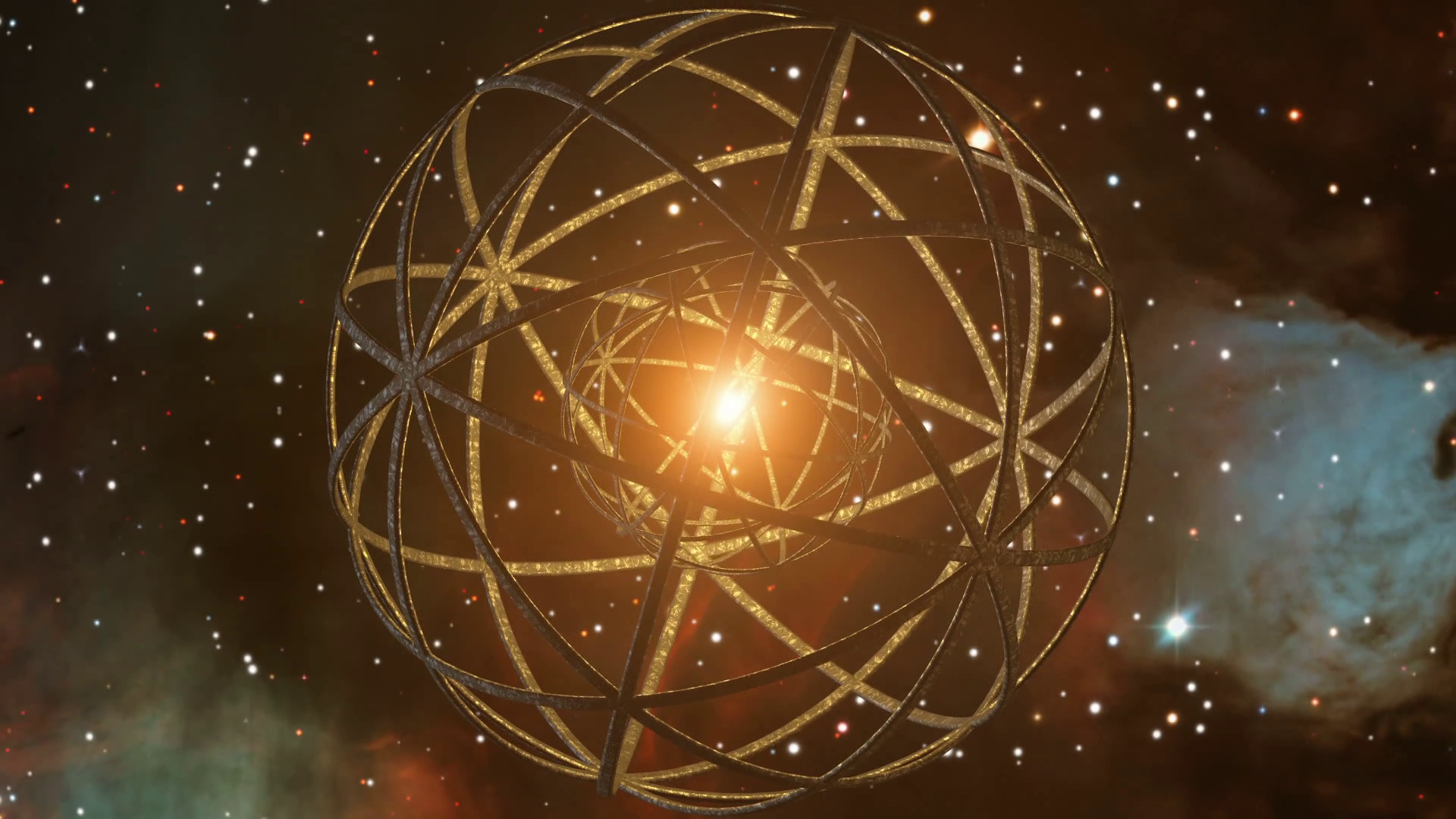
The concept isn't new — physicist Freeman Dyson proposed back in 1960 that any sufficiently advanced civilization would eventually need more energy than a single planet could ever generate, and the logical solution would be to build a colossal shell, or swarm of satellites, around their star to capture nearly all of its light. Science fiction ran with the idea for decades. But a study published this month by physicist Amirnezam Amiri at the University of Arkansas has done something science fiction never bothered with: run the actual numbers on where, in the vast zoo of stars in our galaxy, such a structure would be easiest to build — and easiest for us to spot.
Forget the Sun — Go Small, Cold, and Dead
The intuitive assumption is that a Dyson sphere would most likely be built around a star like our own — a stable, mid-sized yellow sun radiating plenty of energy. Amiri's study, titled "Dyson Spheres on H-R Diagram" and published via the Hertzsprung-Russell diagram framework astronomers use to classify stars by temperature and luminosity, argues the opposite: the most practical, buildable Dyson spheres are far more likely to be found around red dwarfs and white dwarfs — two categories of small, dim, comparatively unglamorous stars.
The logic comes down to brute engineering economics. Red dwarfs (also called M-dwarfs) and white dwarfs are physically tiny compared to Sun-like stars — some white dwarfs are barely larger than Earth despite containing roughly a Sun's worth of mass. That compactness matters enormously for anyone trying to build a megastructure: a Dyson swarm around a white dwarf could orbit just a few million kilometers above the stellar surface, dramatically shrinking the total surface area — and therefore the total amount of exotic construction material — an alien engineering project would need, compared to trying to wrap a structure around a star many times larger.
White dwarfs have another underrated advantage: stability. They are essentially the dense, inert cores left behind after a star like our Sun burns through its fuel and sheds its outer layers. Once formed, they cool at a slow, remarkably predictable rate and release energy steadily for billions of years — making them, in Amiri's framing, a reliable long-term power source rather than a star that might flare, swell, or otherwise complicate a delicate megastructure's engineering tolerances.
How Do You Spot an Alien Power Plant?
The signature a Dyson sphere would leave behind is, physically speaking, elegant: if a shell or swarm of solar collectors intercepts nearly all of a star's visible light and converts it into usable energy, the waste heat from that process has to go somewhere. It gets re-radiated — not as visible light, but as infrared radiation, at a temperature far colder than any naturally occurring star.
Amiri's calculations show that a Dyson sphere radiating as a blackbody at around 300 Kelvin — roughly room temperature here on Earth — would peak in the mid-infrared, at a wavelength near 10 microns. That's squarely within the sensitivity range of existing and active space telescopes, including the James Webb Space Telescope and the WISE (Wide-field Infrared Survey Explorer) mission, both of which are exceptionally good at picking out faint, cold infrared sources against the black backdrop of space.
In other words: a Dyson sphere wouldn't look like a star at all through most instruments. It would look like almost nothing — until you check the infrared band, where it would appear as an object glowing at a temperature that no unshielded, naturally forming star could ever be. Objects that are much colder than physics says a bare star should be, lack the telltale dust signatures of a forming or dying star, and sometimes flicker in irregular, non-stellar ways, are exactly the kind of oddities Amiri's framework flags as worth a second look.

A Six-Decade-Old Idea Finally Gets a Testable Shape
When Freeman Dyson first floated the concept in a 1960 paper in the journal Science, he wasn't writing science fiction — he was making a thermodynamic argument. Any technological civilization, he reasoned, would keep growing its energy demands roughly exponentially, and a planet's surface can only intercept a tiny sliver of the total light its star produces. Eventually, he argued, the logical move for any sufficiently long-lived civilization would be to capture the rest of that starlight directly, rather than settle for the fraction that happens to hit a home planet.
For most of the six decades since, the idea lived almost entirely in the realm of thought experiment and speculative fiction, popularized by novels, video games, and the 2015 mystery surrounding Boyajian's Star (nicknamed "Tabby's Star"), whose bizarre dimming pattern briefly had astronomers seriously entertaining a Dyson swarm explanation before follow-up observations pointed to orbiting dust instead. What Amiri's paper does differently is strip the idea down to hard numbers: exact predicted temperatures, exact predicted wavelengths, and an exact ranking of which stellar types make the best hosts. That shift — from "this is theoretically possible" to "here is precisely what it would look like and here is where to point the telescope" — is what has astronomers taking notice this week.
We've Actually Already Found Some Candidates
This isn't purely theoretical stargazing. Back in May 2024, the Project Hephaistos survey — a systematic search through a catalog of roughly 5 million stars — turned up seven objects with unusual infrared excess consistent with partial Dyson swarms, all of them clustered, notably, around red dwarfs. That's precisely the category of star Amiri's new study argues should be a prime hunting ground.
Follow-up work has since ruled out one of those seven candidates — astronomers determined its unusual signal could be explained by a supermassive black hole perfectly aligned behind it from our vantage point, distorting the light in a way that mimicked a technosignature. That still leaves five Project Hephaistos candidates that haven't been explained away by conventional astrophysics, and which Amiri's new theoretical framework gives researchers a sharper, more quantitative set of tools to re-examine.
Expert Perspective
Researchers in the SETI (Search for Extraterrestrial Intelligence) community have long argued that looking for "technosignatures" — physical evidence of alien engineering, rather than intentional radio broadcasts — represents a more promising search strategy than the traditional approach of listening for deliberate messages. A civilization doesn't have to want to be found for a Dyson sphere to give off a detectable signature; it just has to exist and obey the same laws of thermodynamics that govern every other object in the universe. That's part of what makes this line of research appealing to astronomers: it doesn't require aliens to be trying to communicate with us at all.
What Amiri's paper adds to that broader technosignature effort is specificity — rather than a general "look for weird infrared objects" instruction, the H-R diagram framework gives astronomers a predicted temperature-radius relationship they can test candidate objects against, turning a fuzzy hypothesis into something closer to a checklist. That kind of quantitative rigor is exactly what separates a testable scientific hypothesis from speculation, and it's why the paper is generating buzz well beyond the niche technosignature research community.
What This Means for You
No, nobody is claiming aliens have been found. Every one of the handful of known candidate objects almost certainly has a mundane explanation — background galaxies, unusual dust clouds, faint companion stars, or instrumental quirks — and the history of "maybe it's aliens" astronomical mysteries is littered with objects (Tabby's Star being the most famous modern example) that turned out to have entirely natural causes after years of follow-up study.
What this study does mean is that the search for extraterrestrial civilizations just got measurably more precise. If you've ever been curious about SETI research or wondered why humanity hasn't found any solid evidence of alien life despite the sheer scale of the galaxy, this is a reminder that the search is still evolving methodologically — astronomers are constantly refining exactly what a detectable sign of intelligent life beyond Earth might even look like, rather than simply scanning randomly and hoping for a signal.
It's also a nice case study in how unglamorous-seeming stars can turn out to be scientifically exciting. Red and white dwarfs make up the overwhelming majority of stars in the Milky Way — meaning that if Amiri's reasoning holds, the very stars astronomers have historically paid the least attention to might be exactly where our best shot at answering one of humanity's oldest questions is hiding in plain sight.
Conclusion
For now, the five surviving Project Hephaistos candidates remain just that — candidates, not confirmed alien megastructures. But with Amiri's new theoretical framework in hand, astronomers now have a far sharper set of predictions to test them against, and instruments like JWST already capable of making the exact infrared measurements the theory calls for. Whether the answer turns out to be aliens, or — as it almost always has before — a strange but entirely natural astrophysical phenomenon, the coldest objects in our galaxy just got a lot more interesting to look at.
Published By | Tech Wiz