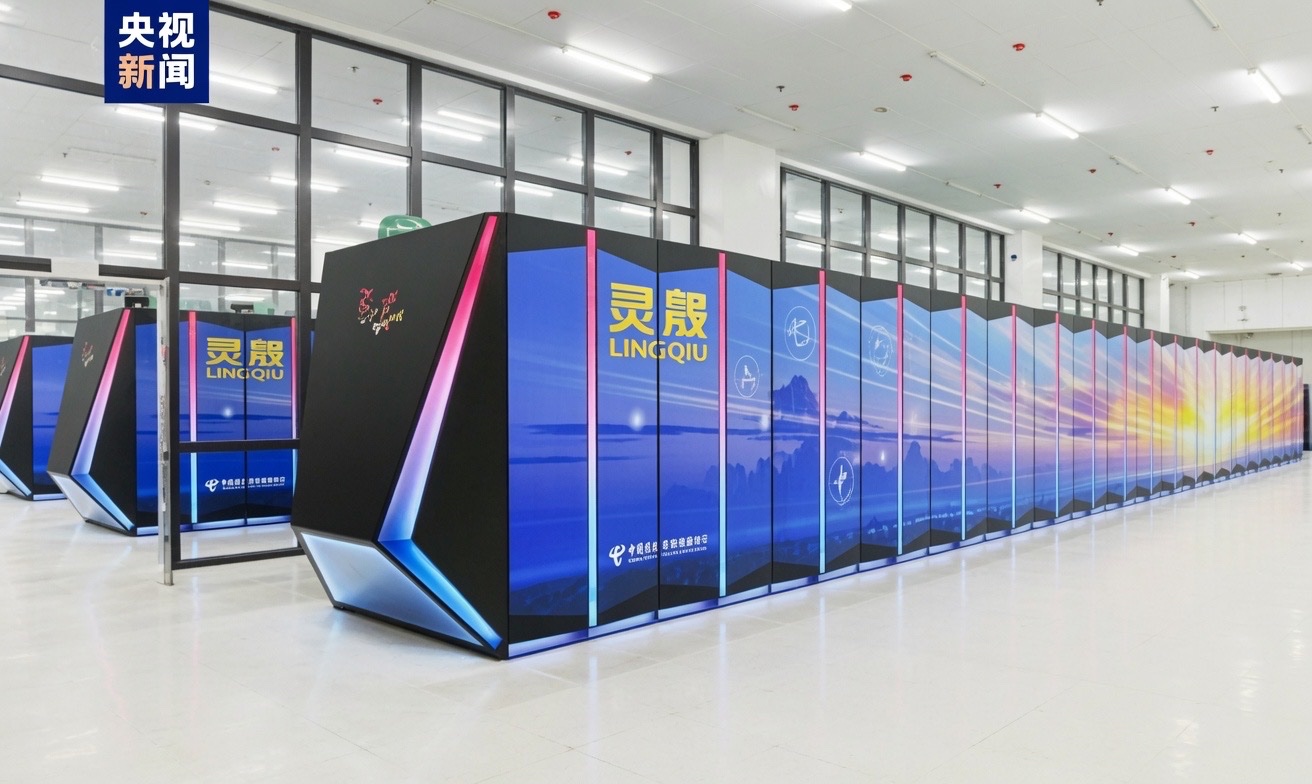
A Chinese machine called LineShine has claimed the title of the world’s fastest supercomputer, achieving 2.198 exaflops using 100% domestically manufactured silicon—proving that years of US export bans haven't halted Beijing's technological advance.
HAMBURG, GERMANY / SHENZHEN, CHINA
For the first time in nine years, the United States has lost the top spot in the bi-annual TOP500 supercomputer rankings. At the ISC 2026 conference in Hamburg, organizers announced that China’s previously unlisted LineShine machine had blown past America’s El Capitan, which had held the No. 1 rank.
LineShine, housed at the National Supercomputing Centre in Shenzhen, sustained 2.198 quintillion calculations per second on the standard benchmark—roughly a 20% lead over its US rival. Even more striking, it achieved this using only central processing units (CPUs), with no GPU accelerators from Nvidia or AMD, making it the first machine to surpass two exaflops on CPUs alone.
The system runs on 13.79 million cores using custom, Chinese-designed 304-core LX2 chips and proprietary high-bandwidth memory, all connected through a homegrown network and operating on the domestic Kylin OS.

The Geopolitical Context
This announcement upends the strategic logic behind US policy. Starting under Trump and escalating under Biden, Washington imposed strict export controls to deny China access to advanced semiconductors and manufacturing tools—specifically targeting the GPUs critical for AI and high-performance computing. For years, this seemed to work; China stopped submitting its best systems to TOP500 after 2023.
LineShine suggests that strategy needs rethinking. By building a "pure CPU" architecture entirely with domestic parts, China sidestepped the most heavily sanctioned hardware categories while still reclaiming the top score.
Expert Perspective
TOP500 organizer Jack Dongarra noted that while the feat proves China "capable of holding its own" despite sanctions, he cautioned that a single benchmark doesn't equate to complete technological leadership. Analyst Addison Snell predicted the news would trigger a "ripple effect" in the US, Europe, and Japan as the AI race intensifies.
However, LineShine has an asterisk: it excels at traditional scientific computing, not AI workloads. On AI-focused benchmarks, it placed fourth due to a lack of advanced accelerator chips. Thus, while China has forged a path to exascale leadership in classic supercomputing, the AI contest remains an ongoing separate battle.

The Bigger Picture
Supercomputers are the engines behind climate modeling, drug discovery, and defense simulations. This achievement challenges the very foundation of US trade policy—the belief that export restrictions could critically slow China's rise. It shows that determined engineering can find a way around hardware bottlenecks.
Conclusion
LineShine’s reign may be brief, as the rankings change every six months. Yet the symbolism is profound: a machine built entirely with Chinese silicon just proved that the US strategy of chip denial has its limits. For the first time in a decade, the leader in raw computing speed is not the country that started the race.
Published By | Tech Wiz