UGANDA TOURISM
At dawn in Uganda's far northeastern corner, the Narus Valley fills with a light that photographers chase across continents — gold pouring over golden grass, acacias throwing long shadows toward the jagged silhouettes of Mount Morungole and the Lonyili range beyond. This is Kidepo Valley National Park, a place so remote that reaching it has always been part of the story, and so wild that Africa’s Big Four still roam its 1,442 square kilometers as if the twentieth century never quite arrived. This year, Kidepo added a new and improbable chapter to that story: after more than four decades of absence, rhinos are once again walking its plains.
A Park Apart
Tucked against the borders of South Sudan and Kenya, Kidepo sits far from Uganda’s more visited southwestern circuit, and that distance has always been its defining feature. Where Bwindi and Queen Elizabeth draw crowds, Kidepo rewards the traveler willing to go further with something increasingly rare on the continent: solitude among wildlife. The park was first protected as a game reserve in 1958 by Uganda’s British colonial administration, largely to control tsetse fly populations and prevent the clearing of its savannah grasslands, before it was formally gazetted as a national park in 1962. Its early decades were golden ones for conservation, but the political turmoil that gripped Uganda through the 1970s and 1980s hit Kidepo especially hard. Poaching surged, security collapsed, and wildlife numbers, including the park’s rhinos, were decimated. The last rhino recorded in Kidepo was seen in 1983.
The recovery that followed was slow and unglamorous, the kind of decades-long institutional patience that rarely makes headlines. It is only now, in 2026, that one of its most symbolic dividends has arrived.
The Rhinos Come Home
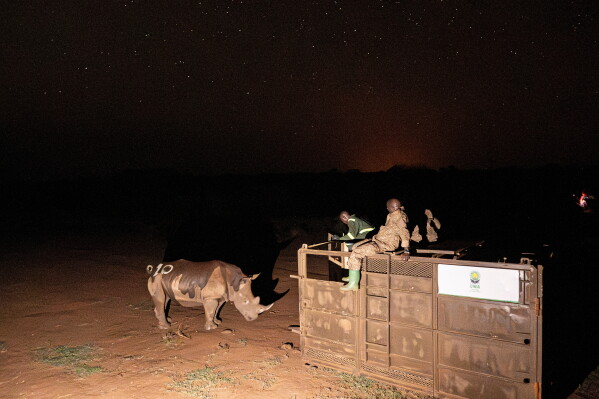
On March 17, 2026, the Uganda Wildlife Authority translocated the first two southern white rhinos from Ziwa Rhino Sanctuary in central Uganda to Kidepo, the opening move in a phased plan to relocate eight animals in total. It is a moment conservationists have worked toward since 2005, when Ziwa was established with just six rhinos after the species was completely eliminated from the wild across Uganda. Under round-the-clock ranger protection and, more recently, an infusion of fresh genetics from South Africa, that founding population has grown into a national herd of 61 animals — enough, finally, to seed a second, wilder home.
The choice of Kidepo is deliberate. As mega-herbivores, rhinos function as ecosystem engineers, and their grazing patterns carve out the short-grass “lawns” that support impala, zebra, and other grazers further down the food chain. Reintroducing them to Kidepo is not simply about restoring a single species; it is about restoring a functioning, complete savannah ecosystem in one of the last places on the continent still wild enough to hold one. It also restores Kidepo’s claim to Africa’s Big Five, a marketing shorthand that undersells a park that already boasts 77 mammal species, including some found nowhere else in Uganda: cheetahs, caracals, striped hyenas, and the beisa oryx among them, alongside elephants, lions, leopards, and buffalo.
Life on the Plains
Kidepo’s two river valleys, Narus and Kidepo, could hardly feel more different, and visitors who can manage a multi-day stay often see both. Narus, greener and more reliable for water, concentrates wildlife in the dry season, when game drives along its tracks can turn up prides of tree-climbing lions draped over sausage trees or long lines of buffalo moving toward a waterhole. The Kidepo Valley itself, to the north, is drier and starker, its wide sand river running dry for much of the year, its horizon interrupted only by borassus palms and the distant blue outline of mountains inside South Sudan. Apoka, the park’s tourism hub, anchors both worlds and offers the widest range of activities: guided game drives, birding walks for a park that hosts more than 475 recorded species, community visits, and, newer to the roster, targeted tracking experiences for golden cats and, now, the returning rhinos.
Just outside the park’s boundaries, the Karamojong bring a cultural dimension that few other Ugandan parks can match. Nilotic pastoralists who trace their migration from Ethiopia to roughly 1600 AD, the Karamojong have preserved a cattle-centered way of life, distinctive beadwork and shukas, and a traditional religion centered on the deity Akuj, even as many have also adopted Christianity. Village visits arranged through Apoka give travelers an unusually candid look at a culture that has resisted homogenization more successfully than almost anywhere else in East Africa.
Getting There, and When
Kidepo’s remoteness is real, and travelers should plan around it rather than against it. The most practical option is the scheduled flight from Entebbe, operated by Aerolink on Wednesdays, Fridays, and Sundays, which covers the distance in well under two hours for around 420 dollars one-way. Driving is an adventure in its own right: four possible routes connect Kampala to the park, ranging from roughly 571 to 792 kilometers and requiring ten to thirteen hours, mostly on tarmac until the final stretch through Karamoja, where a four-wheel-drive vehicle stops being optional. Most visitors treat the drive as a one-way leg, flying out or combining it with stops in Murchison Falls or Kitgum.
Park entry currently runs 40 dollars per day for foreign non-residents, 30 dollars for foreign residents, and about 6 dollars for East African citizens, with ranger-guided game drives available for an additional 25 dollars per half day. The dry seasons, from September to March, offer the best game viewing as animals cluster around the Narus Valley’s permanent water sources, though the park’s isolation means it never feels crowded even at peak times. Accommodation remains deliberately limited, from Apoka Safari Lodge’s upscale tented rooms overlooking the valley to more modest tented camps, which is part of why a Kidepo sunset still feels like a private discovery rather than a shared spectacle.
This Week in Ugandan Tourism
Uganda’s tourism sector spent this week recalibrating how it measures its own success. Speaking on July 7 at the Annual Retreat on Economic and Commercial Diplomacy Implementation in Kampala, Uganda Tourism Board CEO Juliana Kagwa announced that the board will now judge its international marketing campaigns by actual visitor bookings and revenue rather than social media reach, telling delegates that “we need to start measuring our output by number of bookings, not just the leads.” Kagwa also signaled a pivot toward high-value leisure and adventure travelers and more immersive experiences blending wildlife, culture, and community tourism, a strategy that plays directly to parks like Kidepo.
Gorilla trekking economics also shifted this month. As of July 1, standard gorilla permits for foreign non-residents now cost 800 dollars, with foreign residents paying 700 dollars, while the gorilla habituation experience rose from 1,500 to 1,800 dollars. The Uganda Wildlife Authority has softened the increase somewhat by reintroducing green-season discounts of 600 dollars for April, May, and November, though those discounted permits cannot be rescheduled once booked, and since March, permits can no longer be held without immediate full payment.
Elsewhere, the industry gathered in Kampala for the tenth Pearl of Africa Tourism Expo at Speke Resort Munyonyo, bringing together global buyers and investors, while the Uganda Tourism Association used the same venue to launch its 2026–2030 strategic plan, emphasizing sustainability, innovation, and public-private collaboration. At the sector’s recent Ekkula Festival awards, Acacia Wilderness Mweya was named Sustainable New Hotel/Eco Lodge of the Year, underscoring a broader industry push toward eco-conscious development. And in the conservation column, Uganda Wildlife Authority’s confirmation that rhinos have permanently returned to Kidepo after 43 years stands as the year’s most consequential story yet — a reminder that in Uganda’s tourism sector, patient conservation work and headline-grabbing travel news are, increasingly, the same story.
Published By | Features Editor




