TECHNOLOGY
Zambia's economy is still, fundamentally, a copper story — the metal accounts for roughly 70 percent of export earnings and about 22 percent of net tax revenue, and the government's push toward one million tonnes of annual copper output by 2026 dominates headlines about the country's growth, which the IMF and African Development Bank now peg at 5.8 percent for 2025 and an average of around 6.5-6.8 percent across 2026 and 2027. But running underneath that mining narrative is a second, less-covered transformation: Zambia has quietly built one of the more interoperable digital-payment systems in the region, is racing to issue digital national identity cards by the end of 2026, and has struck a strategic partnership with Huawei aimed at pushing government services from basic e-government toward what officials are calling an "intelligent government" model. Whether that digital layer becomes a genuine growth engine in its own right, or stays a support function for a mining economy, is one of the more interesting open questions in Southern African tech policy right now.
A Mobile Money Market That Actually Interoperates
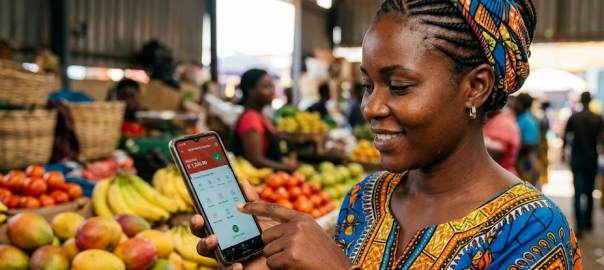
Zambia's mobile money growth over the past decade has been genuinely dramatic. Uptake rose from 14 percent of the population in 2015 to 58.5 percent by 2020, and overall financial inclusion climbed from 59.3 percent to 69.4 percent over the same period. By the 2025 FinScope survey, financial inclusion had reached 80.1 percent nationally, with mobile money usage specifically at 76.2 percent of the population. In raw transaction terms, the value moved through mobile money channels grew from 3.6 billion Zambian kwacha in 2016 to 486.3 billion kwacha in 2024, while active mobile money accounts rose from roughly 521,000 to more than 12.3 million over the same period — a more-than-twentyfold increase in active usage in eight years. Airtel Money and MTN Mobile Money remain the dominant players in that market, competing head-to-head across urban and rural areas alike.
What distinguishes Zambia from many peer markets is that this growth happened on top of a genuinely interoperable payments backbone rather than in walled-off silos. The National Financial Switch, a Bank of Zambia-led project launched in 2013, migrated ATM transactions onto a shared local switch in 2018, brought point-of-sale terminals on board in 2019, and completed full mobile-wallet interoperability in 2020 — meaning a customer on one mobile money network can transact seamlessly with a customer or merchant on another, or move funds directly between a bank account and a mobile wallet. Industry observers describe the resulting architecture, alongside the real-time Zambian Interbank Payment and Settlement System, as a genuinely world-class interoperable payment system, with a level of banking-to-mobile-money integration still rare across the broader region. The Bank of Zambia has continued building on that foundation, publishing a position paper in mid-2026 on open finance in Zambia — an early step toward API-based data-sharing frameworks that would let licensed third parties build new financial products on top of banks' and fintechs' customer data with consent.
The fintech sector riding on top of this infrastructure has scaled accordingly. The number of licensed payment service providers and fintech firms rose from 37 in 2016 to 84 by 2024, and a 2023 UNCDF study counted 57 fintech companies operating locally, more than double the 25 recorded in 2018. Firms such as PAYZ have built consumer and merchant products directly on the switch's interoperability rails, competing for a slice of a payments market that is now processing hundreds of billions of kwacha annually.

Digital Identity: The Homegrown ID Push
Zambia's most consequential digital-infrastructure project of 2026 may be its national digital identity rollout. The government has set an end-of-2026 target for issuing digital identification cards to citizens, a project moving forward under the Digital Zambia Acceleration Project (DZAP), which carries $100 million in financing from the World Bank's International Development Association. DZAP's mandate spans digital ID systems, broader infrastructure development, expanded e-services, and capacity building within government institutions responsible for maintaining the new identity records. Notably, officials have emphasized building a "homegrown" system rather than importing a turnkey foreign platform wholesale, while still seeking international technical expertise to help design and secure the underlying architecture — a balancing act several African governments have wrestled with as they weigh sovereignty concerns against the cost and speed advantages of established vendors.
A functioning national digital ID would plug directly into the financial-inclusion gains already achieved through mobile money, potentially easing know-your-customer requirements for account opening, simplifying access to government social-protection transfers, and providing the identity backbone that open-finance data-sharing frameworks typically require to operate safely at scale.
From E-Government to 'Intelligent Government'
Zambia's state digital-transformation apparatus runs through the Smart Zambia Institute, a division under the Office of the President established in 2016 to coordinate electronic government service delivery. Its current Digital Transformation Change Management Strategy for the Public Service, covering 2023 through 2026 and launched in May 2024, organizes the government's modernization push around four pillars — people, structure, technology, and culture — with an explicit focus on improving government record-keeping and data management as a prerequisite for more advanced digital services. At Africa Public Service Day in June 2026, Smart Zambia presented its digital-transformation milestones to date and reiterated that the effort is meant to make government services more efficient, transparent, and inclusive for citizens, not simply a back-office modernization exercise.
The institute has also moved to deepen its technology partnerships, signing a Strategic Cooperation Memorandum of Understanding with Huawei Technologies Zambia aimed explicitly at shifting the government from a conventional e-government model toward what officials describe as "intelligent government" — language that signals ambitions around AI-assisted service delivery, though the concrete deployment timeline and scope of that partnership remain to be detailed in subsequent announcements. The framing positions Zambia as trying to leapfrog directly from basic digitized services toward automation and AI-enabled public administration, following a path several other African governments are simultaneously exploring with various technology partners.
The Connectivity Gap Behind the Optimism
Zambia's digital ambitions run into a genuine measurement problem, and likely a genuine access problem, when it comes to internet penetration. DataReportal's Digital 2026 report put Zambia's internet penetration at 33.0 percent of the population at the end of 2025, with roughly 7.29 million internet users recorded as of October 2025 — figures based on International Telecommunication Union data and standard international methodology. Zambian government officials, however, have publicly claimed a considerably higher figure, stating internet penetration rose from 56.7 percent in 2021 to 72.1 percent by 2026. That roughly 40-percentage-point gap between independent and official estimates is unusually wide even by the standards of African connectivity data, and it matters directly for policy: a digital-ID and e-government strategy calibrated to 72 percent internet access looks very different from one built around a 33 percent baseline, particularly for rural households furthest from Lusaka and the Copperbelt.
Mobile connections tell a somewhat clearer story: 23.5 million cellular mobile connections were active in Zambia in late 2025, equivalent to 106 percent of the total population (reflecting multiple SIM ownership), giving mobile networks a much broader reach than fixed or even mobile broadband internet access. On the infrastructure side, Liquid Intelligent Technologies — which operates more than 110,000 kilometers of fiber across the African continent — has continued expanding broadband backbone into Zambia, while local operator Fibrecom has published a 2026-2030 strategic plan explicitly aimed at extending digital connectivity to every district in the country, an acknowledgment that district-level coverage gaps remain the binding constraint on translating Lusaka-based digital policy into nationwide reality.

A Startup Ecosystem Still Finding Its Scale
Zambia's homegrown startup scene remains modest relative to regional leaders such as Kenya, Nigeria, or South Africa, but it has an established anchor institution in BongoHive, the country's first technology and innovation hub, which has run incubation programmes, workshops, and investment-readiness support for early-stage founders since its founding in Lusaka. Newer entrants such as Neza Hub have added additional support infrastructure focused specifically on technology and digital-innovation startups, broadening the base of organized support beyond BongoHive alone. The ecosystem's growth has tracked the country's fintech and payments expansion closely — most Zambian startups that have achieved meaningful traction sit somewhere in the payments, agritech, or e-commerce space, building directly on top of the National Financial Switch's interoperability rather than around it.
The Bigger Picture
Zambia's digital transformation is a story of strong foundations in one layer — interoperable payments — paired with ambitious but still-unproven bets in two others: a homegrown national digital ID racing toward an end-of-2026 deadline, and an AI-inflected "intelligent government" partnership whose real-world shape is still emerging. The connectivity data gap between official claims and independent measurement is worth watching closely, because it will determine whether these digital-government ambitions can actually reach the roughly two-thirds of Zambians that international estimates suggest remain offline. For a country whose economic identity is still built primarily around copper, the payments and identity infrastructure now taking shape could ultimately matter as much to ordinary Zambians' daily lives as the mining sector that dominates the country's export statistics.
Published By | Tech Wiz