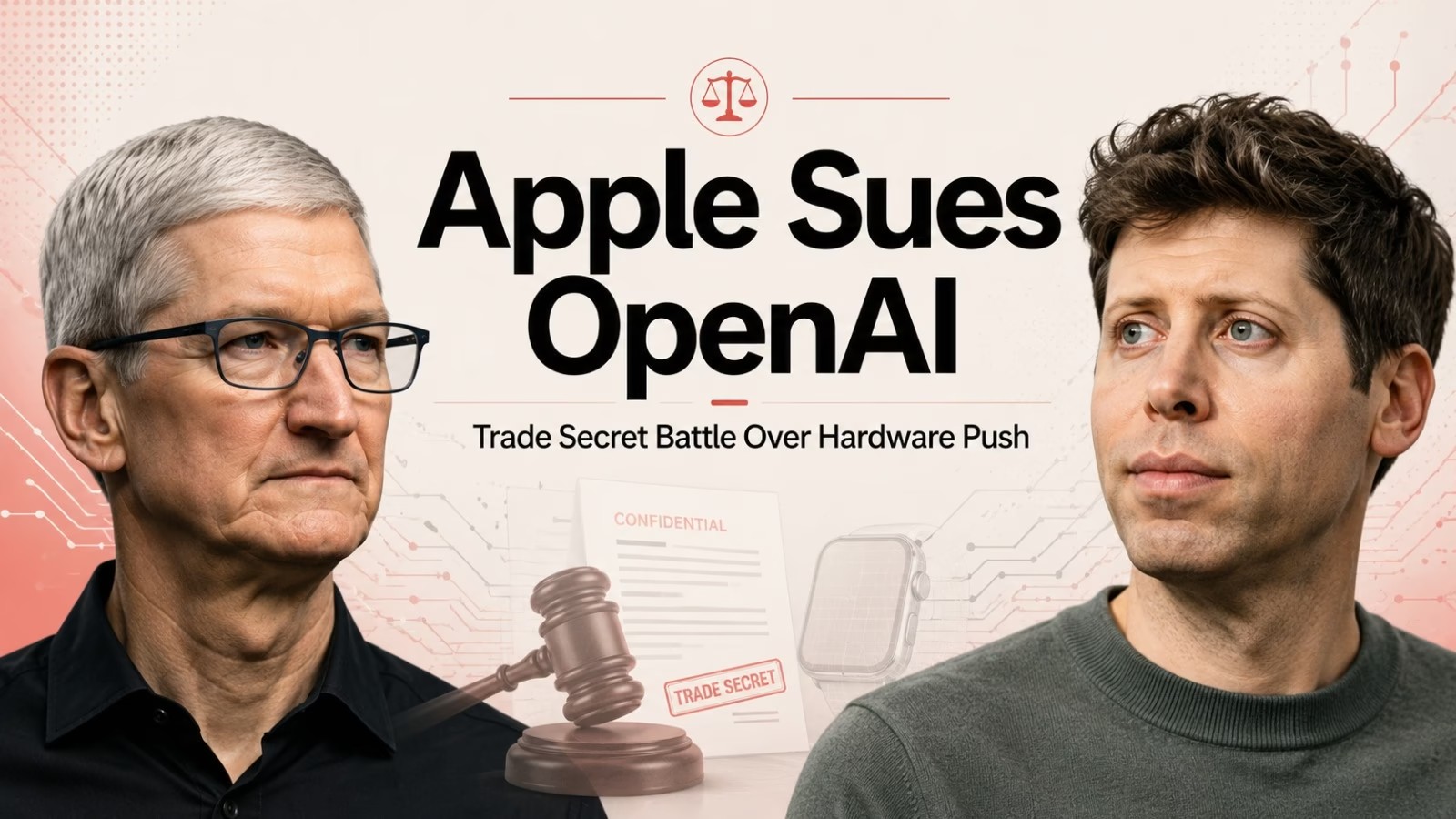
Court filings accuse ChatGPT's maker and its Apple-defector hardware chief of turning job interviews into intelligence-gathering sessions — with candidates allegedly told to smuggle in actual iPhone parts for "show and tell."
CUPERTINO, Calif.
It reads less like a Silicon Valley HR complaint and more like the opening scene of a corporate espionage thriller: job candidates, still drawing an Apple paycheck, allegedly walked into interviews at a rival company clutching actual, physical iPhone components pulled from Cupertino's most guarded labs. According to a blockbuster lawsuit Apple filed Friday in the U.S. District Court for the Northern District of California, that rival wasn't a scrappy startup or a foreign competitor. It was OpenAI — the company that makes ChatGPT, and until recently, one of Apple's most talked-about AI partners.
The 2026 partnership era is over. In its place is a legal filing dripping with words like "scheme," "coordinated," and "at every level." Apple's lawyers allege that OpenAI's recruiting apparatus, driven by its chief hardware officer and staffed with dozens of ex-Apple engineers, became a pipeline for stealing the secrets behind the iPhone and Apple Watch — precisely as OpenAI races to build its own consumer hardware.
The Allegations: Codenames, Confidential Parts, and a Missing Laptop
At the center of the complaint is Tang Tan, OpenAI's chief hardware officer, who spent 24 years at Apple before decamping for the AI lab. Most recently he served as Apple's vice president of product design for the iPhone and Apple Watch — meaning he sat inside the very rooms where Apple's next several years of hardware roadmaps were mapped out, discussed, and prototyped.
Apple's filing claims Tan didn't leave that knowledge at the door. The company alleges he directed job candidates who were still employed at Apple to bring "actual parts" from unreleased or confidential Apple products to their OpenAI interviews, ostensibly for "show and tell" sessions where he and his team could "elicit still more Apple confidential information." The lawsuit further claims Tan used Apple's own internal project codenames during OpenAI's recruiting pitches — a level of specificity, Apple argues, that could only come from someone who still had access to material he was contractually obligated to keep secret.
The complaint doesn't stop with hiring pitches. It also names Chang Liu, a former senior systems electrical engineer who spent eight years at Apple before joining OpenAI earlier this year. Apple alleges Liu failed to return his Apple-issued laptop after resigning — and, worse, used that laptop to download confidential Apple technical documents before handing in his notice. If true, it's the kind of detail that turns a civil dispute over competitive hiring into something that starts to resemble a criminal referral.
Taken together, Apple's narrative is not of a few rogue employees taking liberties on their way out the door, but of a company-wide effort. "At every level, from members of its Technical Staff to its Chief Hardware Officer, and in coordination with business partners, OpenAI has been stealing Apple's trade secrets and confidential information," the filing states bluntly.
From Partners to Adversaries: How We Got Here
It's a stunning reversal. Apple and OpenAI entered a headline-grabbing partnership in 2024, integrating ChatGPT into Siri and Apple's operating systems as the iPhone maker scrambled to catch up in the generative-AI race. For a while, the two companies were held up as evidence that Apple's slow-and-steady approach to AI could coexist with OpenAI's move-fast ethos.
That warmth curdled the moment OpenAI decided it didn't just want to power devices — it wanted to build them. Last year, OpenAI acquired io Products, the hardware startup founded by legendary former Apple design chief Jony Ive, in a deal reportedly worth $6.4 billion. Ive himself is notably not named as a defendant in Apple's lawsuit, but the acquisition marked OpenAI's unmistakable pivot toward building its own AI-native consumer devices — putting it on a collision course with the company that invented the modern smartphone category.
Since then, Apple says, more than 400 of its former employees have landed at OpenAI. That number alone would be notable in any industry; in the tightly-guarded world of Apple's hardware division, where NDAs are practically a second employment contract, it has apparently set off alarm bells inside Cupertino's legal department.
OpenAI Pushes Back
OpenAI, for its part, is not conceding an inch. In a statement to Fortune, the company said: "We have no interest in other companies' trade secrets. We remain focused on building innovative technology that empowers people everywhere." Notably, the statement doesn't directly rebut the specific allegations about Tan's interview practices or Liu's laptop — a gap that trade-secret litigators say is common in the early, high-stakes days of a lawsuit like this, before a company's legal team has finished internally auditing exactly what happened.
Neither Tan nor Liu has issued a public statement responding to the specific claims made against them personally. OpenAI has also not indicated whether either executive still holds their current role at the company, though as of this reporting both remain listed as OpenAI personnel.
Why This Case Is Different From the Usual Silicon Valley Talent War
Poaching talent between tech giants is nothing new — Apple itself has spent two decades hiring away engineers from Google, Samsung, and countless smaller rivals. What makes this case unusual, legal analysts say, is the specificity and audacity of the alleged conduct. Asking a job candidate to bring physical, confidential hardware into an interview isn't garden-variety competitive recruiting; if proven, it would represent a deliberate, systematic effort to extract protected information under the guise of a hiring process.
Trade secret law in California is notoriously friendly to employee mobility — the state famously bans most non-compete agreements, meaning Apple can't simply argue that its former employees shouldn't be allowed to work for OpenAI. Instead, Apple's legal strategy has to prove something narrower and harder: that specific, identifiable confidential information was misappropriated, not just that talented people with institutional knowledge in their heads moved to a competitor. That's why the filing leans so heavily on granular details — the codenames, the laptop, the alleged "show and tell" sessions — rather than a vaguer claim about brain drain.
If Apple can establish those specifics in discovery, it could seek both damages and injunctive relief barring OpenAI from using any hardware designs or processes that trace back to misappropriated Apple material — a outcome that could meaningfully slow down OpenAI's hardware ambitions at a moment when the company is widely reported to be racing toward its first consumer device launch.
Expert Perspective
Employment and IP attorneys who have followed the case note that its outcome will hinge heavily on what Apple can produce in discovery, versus what remains circumstantial. Allegations about codenames and interview conduct are dramatic, but courts generally require documentary or testimonial proof — internal OpenAI emails, interview notes, forwarded files — rather than pattern-of-behavior arguments alone. Several legal commentators covering the filing have pointed out that the case echoes a wave of similar hardware-startup trade secret suits in the electric vehicle and chip industries over the past decade, most of which settled quietly before reaching trial, often with the departing employees agreeing to purge and certify deletion of any retained files.
At the same time, analysts covering the AI hardware race note the timing is politically loaded: this suit lands just as competition for AI-native hardware — glasses, pins, voice-first companions, and whatever OpenAI's io-designed device turns out to be — is intensifying across the industry, with Meta, Google, and a wave of startups all chasing the "post-smartphone" device category Apple has dominated for nearly two decades.
What This Means for You
If you're an Apple or OpenAI customer, the immediate, practical impact is minimal — no product is being pulled from shelves, and Siri's ChatGPT integration isn't going anywhere overnight because of a lawsuit that will likely take months or years to resolve. But the case is a preview of a much bigger fight to come over whatever hardware OpenAI is building with Ive's design team. If Apple wins meaningful restrictions on what OpenAI can build, it could delay or reshape the AI company's long-rumored device, which multiple reports have suggested aims to be a screen-free, ambient AI companion.
For tech workers, especially in hardware and chip design, the case is a pointed reminder that California's employee-friendly mobility laws don't grant blanket immunity — bringing physical materials, internal documents, or specific proprietary processes to a new employer, even informally or under interview pressure, can create serious personal legal exposure alongside corporate liability.
And for anyone watching the AI industry's increasingly personal, bare-knuckle rivalries — this is simply the latest sign that the era of AI companies as tidy, cooperative ecosystem partners is giving way to something that looks a lot more like the smartphone wars of the early 2010s: aggressive, litigious, and very personal.
Conclusion
Apple v. OpenAI is still in its opening act. No trial date has been set, and both companies have powerful incentives — reputational and financial — to eventually settle rather than air years of internal communications in open court. But for now, the filing has done what lawsuits rarely do: it has put a very human, very specific face on the abstract idea of "AI disruption," turning a boardroom rivalry into a story about job interviews, smuggled hardware, and a laptop that never came back. Expect discovery fights, expect more denials, and expect this case to become the reference point for how trade secret law adapts to an industry where yesterday's partner is today's most dangerous competitor.
Published By | Tech Wiz