SCIENCE & TECH
For a hundred years, one of the most-watched stars in the night sky has been keeping a secret.
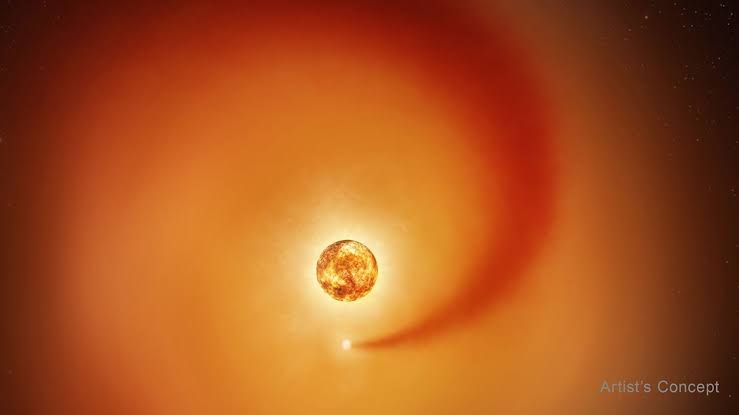
Betelgeuse — the shoulder of Orion the Hunter, the reddish, twinkling beacon visible to the naked eye from nearly anywhere on Earth — has flickered and dimmed in ways astronomers couldn't fully explain for a century. Now, using one of the most powerful telescopes on the planet, a team of European astronomers says they've finally caught the culprit red-handed: a hidden companion star, smaller and fainter than Betelgeuse but considerably heavier than anyone expected, quietly orbiting the doomed supergiant.
"This is the conclusion of a century-long quest," said Miguel Montargès, the French astronomer at the Observatoire de Paris who led the team. "We have shown that Betelgeuse is not single, it is accompanied by a faint stellar companion."
And the moment he saw the confirmation come through in the data, Montargès didn't play it cool. "I jumped from my chair when I saw the processed images," he admitted.

THE STAR EVERYONE'S BEEN WATCHING
Betelgeuse needs no introduction to skywatchers. Sitting roughly 650 to 700 light-years from Earth, it's one of the largest and brightest stars visible in the night sky, a red supergiant so enormous that if it replaced our sun, its outer edge would swallow the orbits of Mercury, Venus, Mars and possibly Jupiter. It's also living on borrowed time, cosmically speaking — a star so massive and so far along in its life cycle that astronomers agree it will one day explode as a supernova, a blast so bright it could be visible in broad daylight from Earth. The only real debate is when: anywhere from tomorrow to 100,000 years from now.
That combination — visible to the naked eye, famously unstable, and destined for a spectacular death — has made Betelgeuse one of the most obsessively studied stars in the galaxy. And for decades, that obsessive study kept turning up something odd: The star's brightness rises and falls in ways that a single, isolated star shouldn't. Astronomers first floated the idea of a hidden companion star roughly 100 years ago as a possible explanation, but the theory stayed unconfirmed for generations. A star that close to something as blindingly bright and turbulent as Betelgeuse is notoriously difficult to see directly — like trying to spot a lit match standing next to a wildfire.
THE HUNT THAT ALMOST CAME UP EMPTY
The breakthrough traces back to two scientific papers published in 2024, which used mathematical modeling of Betelgeuse's brightness patterns to make a bold and testable prediction: if a companion star existed, it should reach its greatest apparent separation from Betelgeuse — its best possible viewing window — in December of that year.
Montargès and his team pointed the European Southern Observatory's Very Large Telescope (VLT), based high in Chile's Atacama Desert, at Betelgeuse during that window, using an instrument called SPHERE that's specially built to block out the blinding glare of a bright star in order to detect faint objects sitting right next to it — the same basic technique astronomers use to hunt for exoplanets around distant suns.
Then came months of patient, painstaking data processing. And going in, Montargès wasn't optimistic.
"Honestly, I thought we did not have the sensitivity to detect Betelgeuse B as it was predicted," he said.
He was wrong — in the best possible way. When the fully processed images came back, there it was: a faint point of light, exactly where the models said a companion should be. And the reason the team could see it at all turned out to be the twist in the story. The companion wasn't the lightweight, sun-sized star everyone had assumed. It was a genuine heavyweight.
"Because it is more massive than predicted, we see it!" Montargès said.
A SURPRISINGLY BEEFY NEIGHBOR
Initial estimates had pegged the hypothetical companion, now dubbed Betelgeuse B, at roughly the mass of our sun — modest, by stellar standards. The new VLT observations instead suggest Betelgeuse B carries somewhere between two and three times the sun's mass, a far more substantial and luminous star than the one scientists had spent a century searching for.
That's a significant enough surprise that Montargès and his co-authors are treating it as one of the more startling findings of their careers. "The fact that we can still discover a nearby companion, more massive and brighter than the Sun, around such a well-studied star is remarkable," Montargès said. "These are among the best moments in science: seeing something new, unexpected."
Co-author Anthony Boccaletti, also of the Observatoire de Paris, noted the broader significance of the imaging technique itself. "It is remarkable to see how SPHERE and advanced post-processing techniques, originally developed to find exoplanets, also excel at detecting a companion around a massive, evolved star like Betelgeuse," he said.
Earlier hints had already pointed toward something orbiting the star. A possible direct detection using the Gemini North Telescope in Hawaii, reported in 2025, offered the first tantalizing clues. NASA researchers had separately announced evidence for the companion's existence in mid-2025, and a Hubble Space Telescope study released in early 2026 spotted what looked like a visible "wake" — a disturbance carved through Betelgeuse's outer atmosphere, consistent with something smaller and denser plowing through it on a tight orbit. But the new VLT image, made public this week and published in the journal Astronomy & Astrophysics, is described by the team as the clearest, most direct look yet at the object itself — actual captured light from the companion star, not just its side effects.

NOT QUITE A SLAM DUNK — YET
For all the excitement, Montargès and his colleagues are keeping one foot planted firmly in scientific caution. Despite the strength of the new evidence, the discovery isn't being called fully "confirmed" just yet. The gold-standard test in astronomy is repeatability — seeing the same object again, in a different position, exactly where orbital mechanics predict it should be.
"To be certain that the companion is really there, we still need to observe it in one year on the other side of the star, but there is very little space left for doubt," Montargès said.
If the follow-up observation, expected around late 2027, catches Betelgeuse B on the opposite side of its orbit as predicted, it would essentially close the case on a mystery that has outlived generations of astronomers.
WHY THIS ISN'T JUST A PRETTY PICTURE
It would be easy to file this away as a nice astrophotography story and move on — a fuzzy dot next to a famous star. But scientists say the discovery could reshape how we understand not just Betelgeuse's past, but its future.
Betelgeuse made global headlines a few years back when it dimmed dramatically and unexpectedly, an event so pronounced that some astronomers and a fair number of very online amateur skywatchers speculated it might be the star's death rattle — an imminent supernova. That turned out to be a false alarm; follow-up VLT observations, also led by Montargès, traced the dimming to a cloud of dust the star had belched out, temporarily blocking part of its light, like smoke obscuring a lighthouse.
Now, the discovery of Betelgeuse B adds a genuinely new variable to the equation. A massive companion star tugging on Betelgeuse in a tight orbit could influence the giant's structure, its mass loss, and potentially the dynamics of its eventual death. Some researchers have floated more dramatic scenarios still: if Betelgeuse B's orbit decays over time, models suggest the two stars could eventually merge — a collision that, in some simulations, could hurl several solar masses of hydrogen gas into space and set the stage for an unusually bright, "interaction-powered" supernova, potentially rivaling a quarter of the full Moon's brightness in Earth's sky when Betelgeuse finally does go.
"The question is truly opened whether this companion is going to have an impact on the evolution of the red supergiant," Montargès said.
WHAT THIS MEANS FOR YOU
You don't need a telescope, or even a physics degree, to appreciate why this matters. Betelgeuse is one of the only stars most non-astronomers could actually pick out of the night sky — visible with the naked eye across most of the inhabited world, a fixture of the winter constellation Orion that humans have stared up at and told stories about for thousands of years. Discovering that it's secretly not traveling alone, and that its silent companion may be quietly steering its fate toward a more violent and spectacular ending, adds a genuinely new chapter to a story humanity has been reading for millennia.
It's also a reminder of how much modern astronomy can still surprise us. Betelgeuse is arguably the most closely studied star in the sky outside our own sun — and it still took a century, a purpose-built prediction, an extreme adaptive-optics instrument, and a healthy dose of luck (the companion turning out to be heavier, and therefore brighter, than expected) to finally catch it on camera. If a star this famous, this close, and this obsessively observed could hide a companion for a hundred years, it's a humbling hint at how much else might still be lurking in plain sight across the rest of the galaxy.
And for anyone who steps outside on a clear night this winter and looks up at Orion's shoulder, there's now a small, strange thrill in knowing: that reddish twinkle isn't traveling solo. It never was.
CONCLUSION
Scientists caution that the case won't be fully closed until that follow-up observation in 2027 confirms Betelgeuse B is exactly where physics says it should be. But for a mystery that has outlasted the careers of the astronomers who first proposed it a century ago, the current evidence — a real, imaged point of light exactly where predicted, exactly when predicted — is about as close to a smoking gun as the field of stellar astronomy gets. As Montargès put it, there's "very little space left for doubt." Betelgeuse, it turns out, has spent all of recorded human history keeping company we simply couldn't see.
Published By | Tech Wiz