NUUK, Greenland
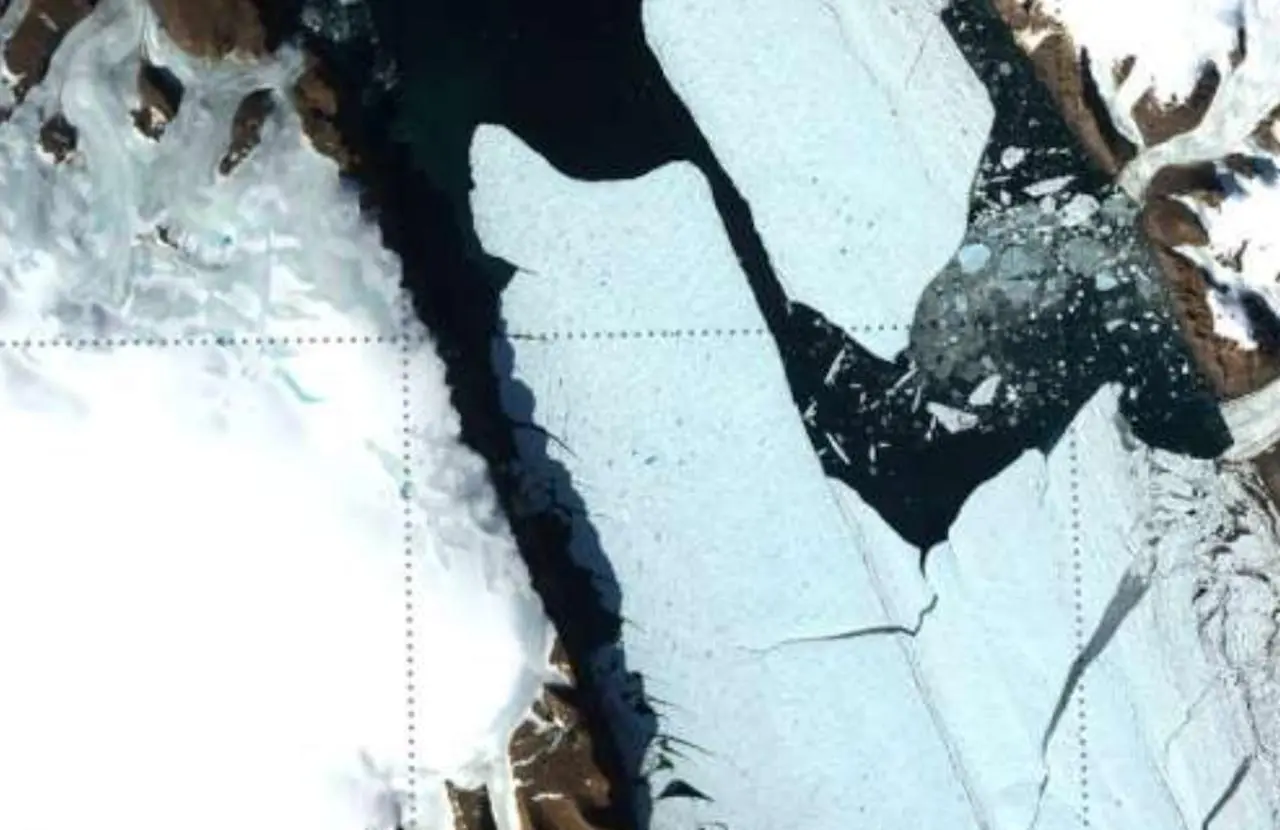
It took less than 24 hours for a piece of Greenland nearly the size of the island of Manhattan to tear itself away from the Arctic mainland and drift out to sea — and the whole violent breakup was caught on satellite camera.
On August 4, 2026, a 76-square-kilometer slab of the Petermann Glacier's floating ice tongue in far northwest Greenland cracked off and became what scientists call a "tabular iceberg," or ice island. It is up to 150 meters thick — roughly the height of a 50-story skyscraper — and it now represents the glacier's largest loss of floating ice since 2012, and the single biggest calving event recorded anywhere in the Arctic since 2020.
Europe's Copernicus Sentinel-1 satellite mission watched it happen in near-real time. Radar images taken on August 3 showed a jagged line of deterioration spreading along the centerline of the ice tongue. By the next day, the entire eastern section had ripped free and was floating independently in the fjord, on its way toward the open ocean.
And according to the scientists who have obsessively tracked this glacier for years, the newly born ice island is very likely not the last. Two more slabs — estimated at roughly 97 and 87 square kilometers, both larger than the piece that just broke off — are still attached to Petermann by spreading rifts, and could detach at any time.
“Petermann Glacier has long been one of Greenland's largest remaining ice tongues,” said Adam Garbo, a PhD student at the University of Ottawa who has been part of the monitoring team. “We've anticipated this break for years, and seeing it finally happen is remarkable. It's a powerful reminder of how quickly these systems can change.”

The Glacier That Won't Stop Shedding
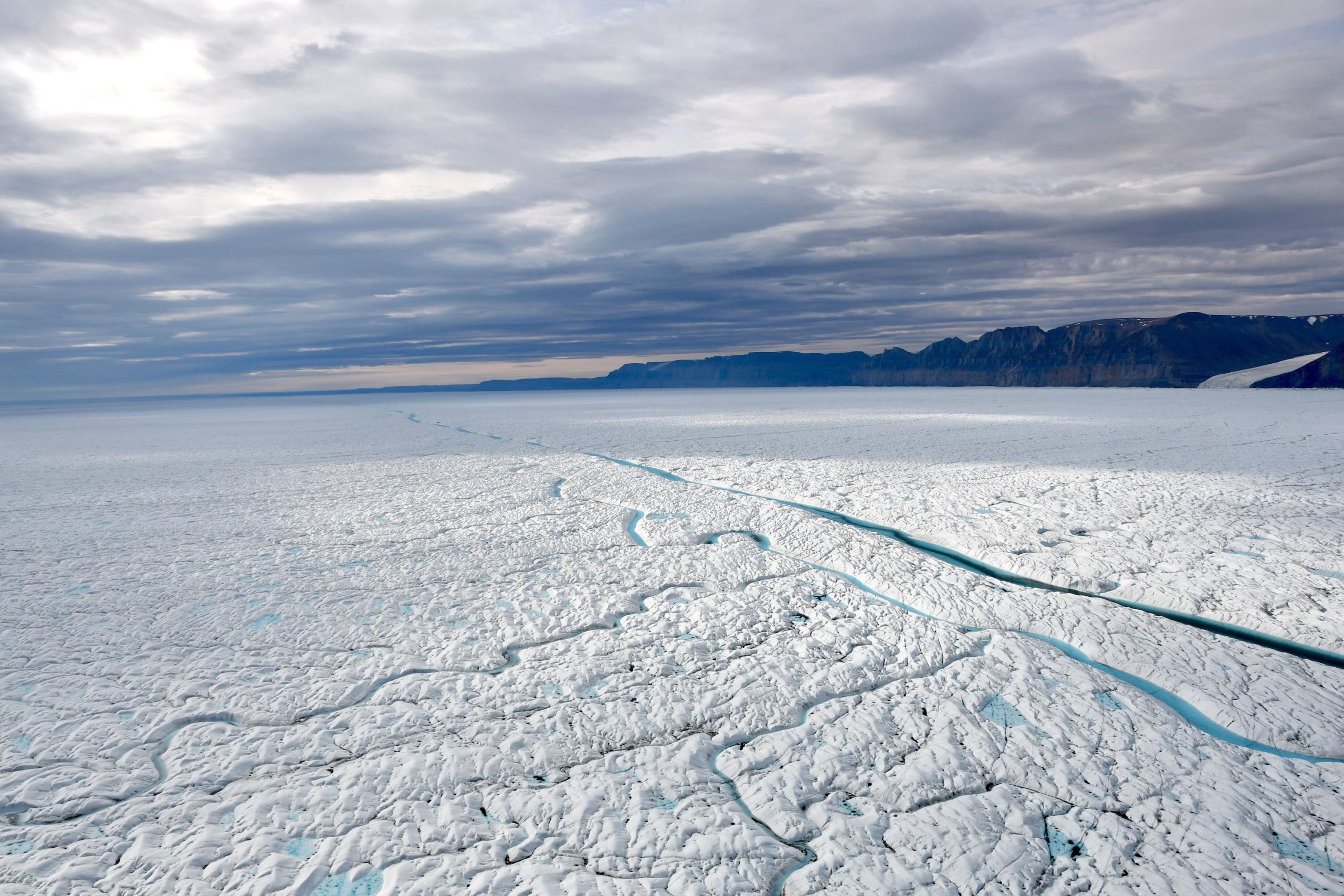
Petermann isn't just any glacier. It's one of the largest glaciers draining the Greenland ice sheet into the ocean, and by itself it holds enough ice to raise global sea levels by 38 centimeters — about 15 inches — if it were ever to fully melt or collapse. It sits at the head of a long fjord in northwest Greenland, where its floating "ice tongue" — a shelf of ice that extends out over the ocean, still attached to the glacier on land — has acted like a cork, buttressing the much larger mass of ice grounded behind it.
That ice tongue has a dramatic and well-documented history of falling apart. Huge sections calved off in 2008, 2010 and 2012, with the 2010 event alone producing an iceberg roughly four times the size of Manhattan. Those back-to-back breaks in 2010 and 2012 shrank the ice tongue's length by 30 to 40 percent, cutting it down to a stretch shorter than anything recorded since the British Arctic Expedition first mapped it in 1875-76.
After that flurry of activity, Petermann went comparatively quiet. For roughly 14 years, aside from a handful of smaller calving events, the ice tongue held together. That is, until this month.
Researchers had seen it coming. An international team — including scientists from the University of Ottawa, the Universities of Stirling, Lancaster and Leeds in the U.K., and Environment and Climate Change Canada's Canadian Ice Service — has monitored Petermann using satellite radar since 2019 as part of the European Space Agency's FutureEO ARCTEX project. Interferometric radar images taken back in April had already picked up deformation and fracturing rippling through the ice tongue, months before the final break.
Then, in early August, everything accelerated. Thanks to a rare "tandem phase" of ESA's newly launched Sentinel-1D satellite flying in formation with Sentinel-1C, the team was able to capture radar images of the same patch of ice just one day apart — an unusually tight observation window that let them watch cracks propagate almost in real time.
“The changes we observed on Petermann Glacier were occurring very rapidly in the lead-up to the iceberg calving event, so it was incredibly exciting to monitor the crack propagation with interferometry in near-real time,” said Molly Hammond, a University of Leeds PhD student who processed the radar data. “This has demonstrated the incredible value of one-day repeat synthetic aperture data.”
Why Arctic Icebergs Are Different
If you're picturing the towering, table-flat icebergs you've seen in documentaries about Antarctica, you're on the right track — but those are actually rare up north. Enormous tabular icebergs are almost routine in the Southern Ocean, where Antarctica's ice shelves regularly shed slabs the size of small countries. In the Arctic, they're a genuine rarity, which is exactly why scientists are so eager to study this one closely.
“While large, tabular icebergs are relatively common in the Southern Ocean around Antarctica, Arctic ice islands are far rarer,” said Anna Crawford of the University of Stirling, one of the researchers on the monitoring team. “By studying Arctic ice islands, we will gain knowledge that can be transferred across polar regions. This is critical for understanding how the calving and deterioration of ice islands impact glacier dynamics, sea-level rise and the ocean environment.”
Martin Wearing, an Earth scientist with the European Space Agency, echoed that sense of scientific opportunity mixed with urgency. “This type of large tabular iceberg is relatively rare in the Arctic, making this calving event a unique opportunity to study how such a vast ice mass drifts, evolves and eventually breaks apart,” Wearing said. “Satellite missions such as Sentinel-1 provide the systematic, long-term observations needed to track these changes, helping scientists better understand the processes driving calving and the wider impacts on the polar environment, and ultimately the Earth system as a whole.”
The mechanism behind the thinning is fairly well understood at this point: warmer Atlantic Ocean water has increasingly been finding its way into Petermann Fjord, eating away at the underside of the ice tongue from below even as the surface looks intact. That's a pattern being repeated across Greenland's other major marine-terminating glaciers, though Petermann had, until now, been something of a holdout — unusually stable compared to its more volatile neighbors.
Where Does a Manhattan-Sized Iceberg Even Go?
The newly freed ice island isn't going to just melt quietly in place. Environment and Climate Change Canada is now actively tracking its drift path and assessing the risk it poses to shipping lanes and offshore infrastructure in the region. Ice masses of this scale can persist in the ocean for years before they finally break down, and as they fragment into smaller — but still dangerous — chunks, they become progressively harder for ships and monitoring agencies to track and avoid.
That's not a hypothetical concern. The waters off northwest Greenland and into Baffin Bay see increasing vessel traffic as Arctic sea ice recedes and shipping companies eye faster polar routes. A rogue iceberg fragment, invisible on a foggy night or lost in radar clutter, is precisely the kind of hazard that sank the Titanic more than a century ago — except this one weighs many times more and could calve off "growlers" (smaller ice chunks) for years as it drifts and disintegrates.
Researchers say they'll keep watching both the parent glacier and its newly detached offspring using a combination of satellite imagery, aerial surveys and ocean-tracking buoys, hoping to build a fuller picture of how these rare Arctic giants move, break apart and ultimately melt into the sea.
Expert Perspective
The scientific consensus forming around this event isn't really in dispute: this is unusual, it's big, and it's the kind of event that offers researchers a "natural experiment" they can't easily replicate. What's less settled is exactly how much of the credit — or blame — belongs to long-term climate warming versus Petermann's own internal, decades-long cycle of stress buildup and release.
What is clear is the broader trend line. Petermann's near-total quiet since 2012 had led some scientists to treat it as a relatively "stable" glacier compared to flashier, faster-collapsing systems elsewhere in Greenland and Antarctica. This event punctures that assumption. As Garbo put it, the glacier's behavior is "a powerful reminder of how quickly these systems can change" — a sentence that could apply to nearly every major ice system currently being watched by climate scientists worldwide, from West Antarctica's Thwaites Glacier to Greenland's own Jakobshavn Glacier.
What This Means For You
You don't have to live near a fjord in northwest Greenland to have a stake in what just happened. Petermann alone holds enough ice to add over a foot to global sea levels if it were ever to fully discharge into the ocean — and while nobody is suggesting that's happening overnight, every major calving event chips away at the "buttressing" effect that holds back the much larger ice sheet sitting on land behind it. Less buttressing generally means glaciers can flow and thin faster, which in turn means more ice reaching the ocean and contributing to sea-level rise that affects coastlines from Miami to Mumbai.
There's also a more immediate, practical angle: shipping and fishing industries operating in Arctic and sub-Arctic waters now have a slow-motion iceberg the size of a major city to track for years to come, a reminder that a warming Arctic isn't just a distant abstraction — it's actively reshaping the geography and hazards of one of the planet's fastest-changing regions.
And for anyone who follows climate science, this is a textbook example of why long-term satellite monitoring matters. Without years of Sentinel-1 radar data patiently documenting Petermann's slow-building cracks, this event would have looked like a sudden, inexplicable shock. Instead, scientists watched it coming for months, even if they couldn't say exactly which week it would finally give way.
Conclusion
For now, the newly minted ice island — a slab of ancient, compacted glacial ice roughly the footprint of Manhattan and the height of a skyscraper — is adrift in the waters off northwest Greenland, its journey just beginning. Scientists expect it to fragment gradually over months and years, breaking into smaller and smaller pieces as ocean currents, tides and warming waters do their slow work.
Behind it, Petermann Glacier remains cracked and unstable, with two even larger sections still hanging by their rifts. Whether they let go next month, next year, or hold on for another decade the way the glacier did after 2012, is anyone's guess. But researchers say one thing is certain: they'll be watching, satellite pass after satellite pass, for whatever Petermann does next.
Published By | Tech Wiz