KAMPALA
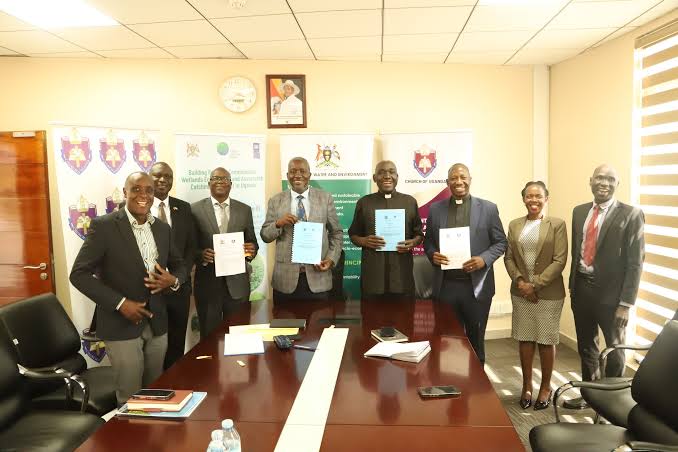
On July 23, in a quiet ceremony at the Ministry of Water and Environment's headquarters in Luzira, the Church of Uganda and the government signed a memorandum of understanding that will run for the next twelve years — an agreement that hands one of the country's most trusted institutions a direct role in one of its most stubborn environmental problems: the destruction of Uganda's wetlands.
The MOU, signed by Permanent Secretary Dr. Alfred Okot Okidi on behalf of the government and Provincial Secretary Rev. Canon William Ongeng on behalf of the Church's Registered Trustees, commits the Ministry to installing and operating fish-feed pelleting machines at Church premises across 24 project districts. In return, the Church will provide housing for the equipment and help manage and implement the programme on the ground. The initiative also promises technical training, start-up capital, market linkages and operational support to cooperative groups formed to run the fish-feed enterprises.
“Church of Uganda has an extensive presence within communities across the country. This partnership will help bring climate-smart livelihood interventions closer to the people while promoting sustainable management of wetlands and associated catchments,” Okot Okidi said at the signing. Ongeng described the arrangement as “a practical demonstration of the Church's holistic ministry that addresses both spiritual and socio-economic transformation,” adding: “By hosting these fish feed production facilities, we are creating opportunities for employment, household income generation and food security while supporting environmental conservation. This is holistic ministry.”
Uganda's first Green Climate Fund project, scaled up
The new MOU formalises and expands a partnership that has already been quietly running for months. It sits inside “Building Resilient Communities, Wetland Ecosystems and Associated Catchments in Uganda,” a $45 million programme — $24.9 million from the Green Climate Fund and $20.1 million from the Ugandan government and UNDP — that was Uganda's first Green Climate Fund-financed climate adaptation project. The programme aims to restore roughly 760 square kilometres of degraded wetlands and catchments while directly improving the lives of up to 800,000 people across 20 to 24 districts in Eastern and South Western Uganda, largely through three interventions: wetland and forest restoration, improved farming practices and alternative livelihoods in catchment areas, and better access to climate and early-warning information for farmers.
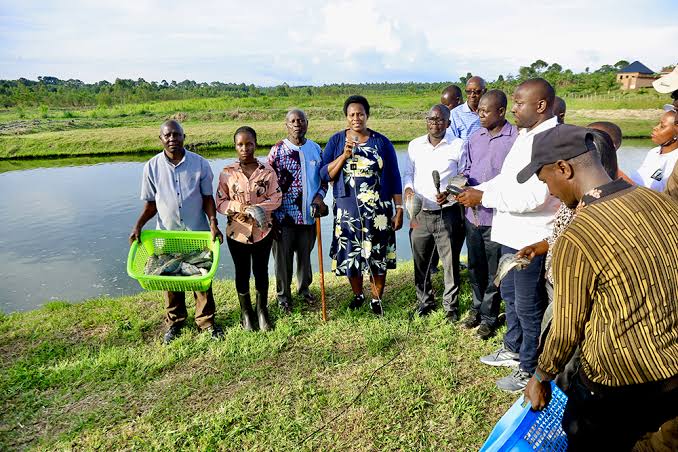
Fish farming was chosen as the flagship “alternative livelihood” because it rewards, rather than punishes, communities for leaving wetlands wet. Draining a swamp to plant crops or graze cattle has long been the default economic use of wetland fringes in Uganda; a fish pond or cage inside an intact wetland offers an income stream that depends on the wetland staying functional. The missing piece, officials say, has been the cost of feed — commercial fish feed is expensive and often has to be trucked in from urban mills, eating into the thin margins of small-scale fish farmers.
A Ministry official put it plainly at an earlier handover event: “Fish farming is one of the most environmentally friendly and economically viable ventures for communities living around wetlands. By supporting local production of high-quality fish feeds, we lower the cost of entry for farmers and help them grow income in a sustainable way.”
A model already tested in Bushenyi
The Church-government model was piloted last year in the Diocese of West Ankole, one of ten dioceses initially selected from the Church of Uganda's 39 dioceses nationwide. In November 2025, the diocese received five fish-feed processing machines, supplied under the joint programme with support from the Green Climate Fund, government and UNDP, and distributed across archdeaconries in Buhweju, Mitooma, Sheema, Bushenyi and Rubirizi districts — the Greater Bushenyi area.
The machines were placed under the central management of the Bishop's office to ensure equitable access, and run on what the diocese describes as a non-profit model designed to benefit youth and women in particular. “Our goal is to support farmers with affordable, quality feeds. These machines will operate on a non-profit model so that communities, especially youth and women, can fully benefit,” said Diocesan Secretary Rev. Joseph Mweyungye at the handover. Bishop Johnson Twinomujuni, in remarks delivered through representatives, framed the initiative in explicitly moral terms, urging Christians to “rise, work hard, and use the resources God has placed in our hands” rather than “wait for miracles we can create through commitment and hard work.”
That pilot is now the template for the 24-district rollout formalised this week — a significant scale-up that, if it follows the Bushenyi pattern, will see cooperative groups, rather than individual entrepreneurs, running the machines, with proceeds and access managed collectively under diocesan oversight.
Why it matters for Uganda's wetlands — and its fish
The stakes for wetland conservation are real. Uganda's wetland cover, once whittled down to under 9 percent of total land area by decades of drainage for farmland and settlement, has recovered to about 13.9 percent by 2025, according to the National Environment Management Authority — a rebound the agency credits to tighter enforcement and restoration programmes and one that now sits above both African and global averages. But encroachment pressure has not disappeared; population growth, informal settlement and agricultural expansion continue to threaten wetland fringes in urban and peri-urban areas in particular, and government officials, including President Museveni, have repeatedly urged citizens to “take the lead” in protecting the remaining swamps rather than draining them for short-term gain.
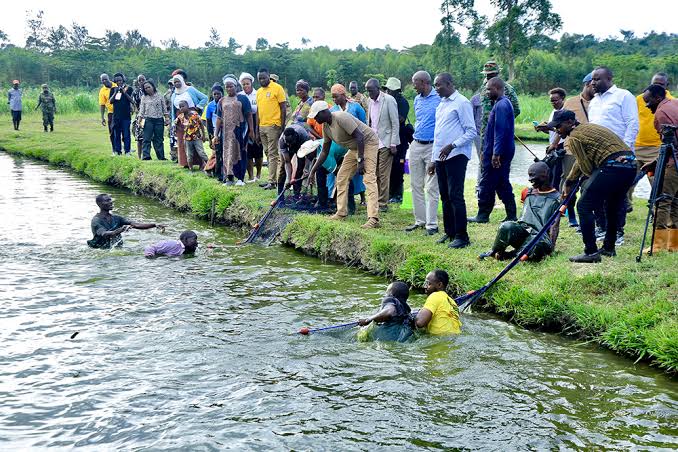
The economics of fish farming give the Church-government partnership a genuine incentive structure to work with. Uganda's aquaculture sector already generates an estimated $100 million to $150 million a year and accounts for roughly 12 percent of agricultural GDP, supporting more than 20,000 active fish farmers and some 500 hatcheries nationwide. The sector received a significant boost in January 2026 when the European Union authorised Uganda to export up to 4,000 metric tonnes of farmed fish annually, opening a premium market for tilapia and other species and drawing fresh interest in processing and cold-chain investment. Government has set a target of scaling national aquaculture production to 1.3 million metric tonnes by 2029 — a goal that will be unreachable without solving the feed-cost bottleneck the Church partnership is designed to address.
There are open questions the partnership will have to answer as it scales past a single pilot diocese to two dozen districts. Centralised, diocese-run management worked at the scale of five machines in one diocese; whether the same governance model holds up to consistent quality control, fair access and financial transparency across many more dioceses and cooperative groups is untested. The programme also currently reaches only a subset of Uganda's roughly 146 districts, meaning wetland communities outside the 24 target areas — including many in the drought-stressed north and northeast — will see none of its benefits unless it is extended further.
Still, the partnership represents an unusual and potentially durable model for rural development in Uganda: pairing a state climate-finance programme with the country's most extensive non-state distribution network. The Church of Uganda counts congregations in nearly every corner of the country, giving the government a delivery mechanism for climate-adaptation livelihoods that reaches deeper into rural life than most ministry field offices can manage alone. If the Bushenyi pilot's early framing — “holistic ministry” blending faith, livelihoods and conservation — proves durable at scale, it could become a template other government climate programmes look to replicate with other faith or civil-society networks.
Published By | Features Editor