Agriculture Desk
Uganda has been officially free of Ebola for more than two weeks. The last patient was discharged in mid-June, a mandatory 42-day surveillance period passed without a single new infection, and on July 28 the Ministry of Health formally declared the outbreak over. By every epidemiological measure, the crisis that gripped the country's western border districts from mid-May has ended.
Yet the markets that sit astride Uganda's border with the Democratic Republic of Congo remain closed. On Wednesday, August 12, that contradiction landed squarely in Parliament, when Arua City Woman MP Hon. Mourine Osoru pressed the Minister of Health, Dr Chris Baryomunsi, to explain why cross-border markets had not reopened weeks after the all-clear was sounded. His answer was blunt: the danger has not passed, it has simply moved to the other side of the line.
"I can assure you, if we declared the market open today, within a few days, you would have reported cases of Ebola," Baryomunsi told the House, sitting under Deputy Speaker Thomas Tayebwa. The minister said Uganda had recorded 20 confirmed cases during its own outbreak — most of them, 15, involving Congolese nationals who had crossed into the country — and that the source of the threat, an unusually severe and untreatable strain known as Bundibugyo ebolavirus, was still spreading unchecked across the border. In the DRC, he said, "the opposite is happening. They have since registered 4,380 positive cases and over 2,000 deaths, and the infections are on the rise." A meeting of the National Ebola Task Force, chaired by Vice President Jessica Alupo, is scheduled to review the restrictions next week — the clearest signal yet of when, or whether, a reopening might be imminent.
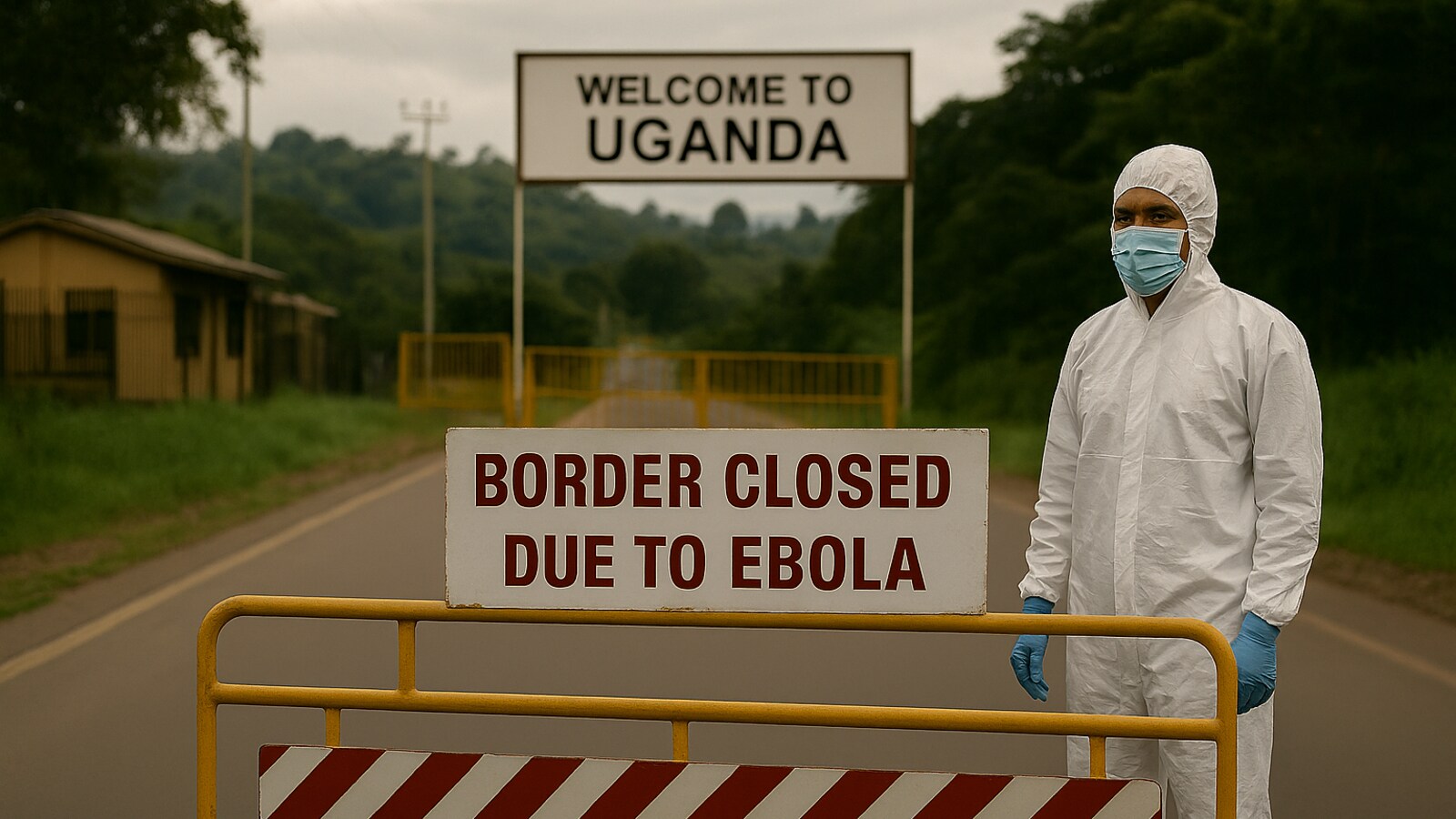
For the farmers, traders and transporters who depend on that trade, "next week" is the latest in a string of postponed deadlines that stretches back to late May, when the government first shut border crossings such as Mpondwe-Lhubiriha in Kasese District as part of its containment response. Nearly three months on, the economic toll is now arguably rivalling the public health emergency that triggered it.

A trade corridor worth hundreds of millions, frozen
Mpondwe is not a minor crossing. It is Uganda's single busiest border post for informal cross-border trade, channeling an estimated $131 million worth of goods a year according to earlier trade data — much of it agricultural produce, food items and household goods carried by small-scale traders, many of them women, moving daily between Kasese, Bundibugyo, Kisoro and the DRC's Ituri and North Kivu provinces. When the border shut in late May, that flow did not slow down; it stopped.
Traders who spoke to reporters in the weeks after the closure described watching their incomes "disappear almost overnight." Districts like Kasese, Kisoro and Bundibugyo have functioned for years as extensions of the eastern Congolese market — farmers there grow specifically for Congolese buyers, and Congolese wholesalers cross daily to stock up on Ugandan bananas, beans, maize, fish and household goods. With the border closed, perishable produce that once moved within hours of harvest has instead been left to rot at collection points, or diverted at a loss to already-saturated domestic markets. Transporters, wholesalers and small exporters whose businesses run on same-day cross-border turnover have faced what analysts describe as acute cash-flow pressure, with no compensation mechanism in place to cushion the loss.
This is the second time in three years that Ebola has forced Uganda to choose between public health caution and cross-border livelihoods along this frontier, and farmers on both sides of the line are, once again, absorbing the cost of a decision made in Kampala and Kinshasa.
Why the government is holding the line
Baryomunsi's reasoning reflects genuine epidemiological uncertainty rather than bureaucratic inertia. The Bundibugyo strain that triggered this year's outbreak is a rarer variant than the more commonly encountered Zaire ebolavirus, and existing vaccines and therapeutics — developed and stockpiled against Zaire strains — offer little to no protection against it. That leaves border screening, quarantine and movement restriction as almost the only tools available to prevent reimportation, at a time when the outbreak in the DRC is, by the minister's own account, still accelerating rather than winding down.
Uganda has not been a passive bystander in the meantime. As part of a joint response with Kinshasa, the two governments signed a memorandum of understanding to run a cross-border Ebola response, and Uganda helped establish two mobile laboratories and an 80-bed treatment unit inside DRC territory, in Aru and Kasenyi, aimed at containing the outbreak closer to its source rather than waiting for it to arrive at Uganda's doorstep. That investment is significant, but it has done little to change the calculus facing traders staring at another indefinite closure.
The agriculture angle policymakers can't ignore
What makes this story an agricultural one, and not simply a public-health footnote, is the sheer weight of farm produce that moves through these crossings. West Nile and Rwenzori-region farmers have spent years building supply relationships with Congolese buyers precisely because the DRC's own agricultural production has been hollowed out by decades of conflict — meaning Uganda effectively functions as eastern Congo's breadbasket. Bananas, beans, fresh vegetables, dried fish, live animals and processed foods normally flow across in volumes that dwarf formal trade statistics, because so much of it moves informally, carried by headload, bicycle and pickup truck rather than through customs declarations.
The same MPs debate that produced Baryomunsi's remarks also aired broader frustrations about the state of rural agricultural support — restocking programme inequities in Acholi sub-region, delayed coffee-seedling deliveries in Otuke, and flooding damage to farms in Terego's Imvepi refugee settlement were all raised in the same sitting, underscoring how thinly stretched government attention is across simultaneous agricultural crises. Against that backdrop, a border trade freeze that specifically strangles some of the country's most commercially active farming districts risks compounding losses that farmers elsewhere are only beginning to recover from after a punishing dry spell earlier this year.
What happens next
The Ebola Task Force's review next week will be watched closely in Kasese, Bundibugyo, Kisoro and Arua, where district leaders and traders' associations have repeatedly petitioned for a phased reopening — potentially with enhanced screening, temperature checks and controlled market days — rather than an indefinite blanket closure. Public health officials will be weighing that pressure against a still-worsening outbreak across the border, where case counts and deaths continue to climb.
For now, the government's position is that Uganda's own Ebola-free status is necessary but not sufficient grounds for reopening; as long as the DRC's outbreak trajectory keeps rising, the risk calculus resets closer to zero tolerance. Whether next week's task force review shifts that calculus, or simply extends the closure again, will determine how much longer border communities have to wait before trade — and the agricultural livelihoods built on it — can resume.
Published By | Features Editor