Written By | Staff Writer
According to the article, Busoga is home to about 4.3 million people, most farming small rain-fed plots
A fresh analysis of fieldwork in Jinja and Buyende argues the hunger spreading through Uganda's sugar belt is less about how much cane farmers grow than about who signs the contract, who receives the cheque and who is left to feed the family.
Agriculture
A paradox on the Busoga landscape
Drive through Busoga and the paradox is hard to miss. Cane stands tall to the edge of homesteads, factory chimneys mark the horizon, yet households report going whole days without food. A new analysis published this week by The Conversation Africa and republished by AllAfrica on 14 October, based on doctoral research by Dr James Kintu of the University of Massachusetts Boston, offers a pointed explanation: the problem is not simply that farmers plant too much sugarcane, but how the contracts that govern cane are written and who they leave out.
Kintu, who spent more than 20 years in Uganda's civil service, draws on 27 interviews with officials, local leaders and farmer representatives, plus four farmer focus groups, in Jinja and Buyende districts. By his own account, the evidence is qualitative and comes from two districts, so it illuminates mechanisms rather than measuring prevalence. Even so, it lands in a region where the numbers are alarming.
The scale of the boom
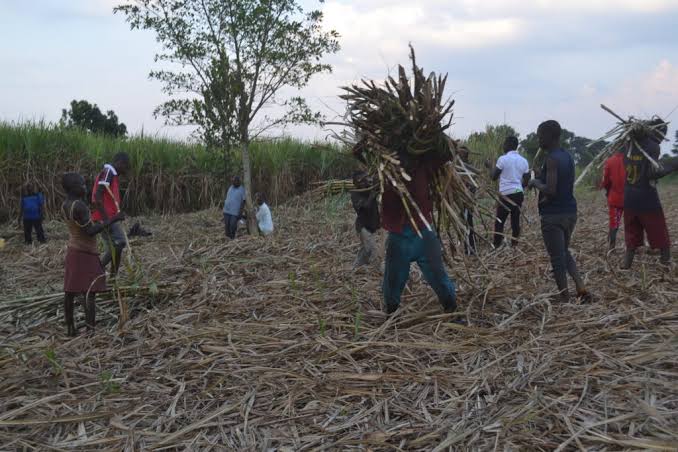
According to the article, Busoga is home to about 4.3 million people, most farming small rain-fed plots. In Uganda's 2024 census, about a third of Busoga households reported going entire days without food. Commercial cane has been grown in the region since the 1920s, and private investment accelerated after the industry opened up in 1991. Seven mills now operate in and around Busoga, and cane planting roughly tripled between 2000 and 2024. In Jinja and Buyende, Kintu reports that up to 80 percent of family farmland is under cane, leaving roughly 20 percent for food crops.
An earlier piece by Kintu for New Security Beat, published in August, put the cane area serving the seven mills at about 110,000 hectares, nearly four times the 2000 level, and found more than half of residents in his study districts living with moderate-to-severe food insecurity. These figures echo local reporting. The Monitor's Tausi Nakato reported in June from Wankole Sub-county in Kamuli, where the sub-county chairperson George Wankona blamed land fragmentation and large-scale cane growing, and the district environment officer Samuel Bakaki linked expansion to food insecurity, deforestation and biodiversity loss.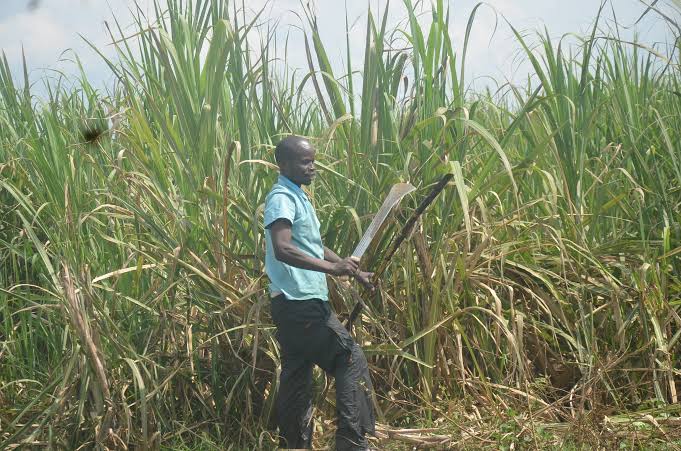
Who signs, who eats
The new analysis's central claim is about gender and contract design. Mills, Kintu finds, sign outgrower contracts mostly with men. The signatory makes decisions about the land and receives payment, usually as a lump sum at harvest. Women, who in most households carry the responsibility for feeding the family, often have no say and little land left for food crops. In one focus group, wives said their husbands had signed multi-year contracts covering the whole family's land without consulting them. Some men, Kintu notes, do not spend the money on food.
The legal framework, on paper, offers protection. Under the Land Act, family land cannot be sold, leased or mortgaged without a spouse's written consent. But cane agreements rarely pass through district land offices, so consent is seldom checked. The result, in Kintu's phrase, is a gap between holding a right and being able to use it. Extension officers reinforce the pattern, he says, by visiting only registered contract holders, not their wives.
Widows are most exposed. Although the constitution recognises women's inheritance rights, contracts typically remain in a deceased husband's name, and recruitment agents, clan meetings or banks may block a widow's access to the contract, the land or credit. Kintu says this occurs despite being illegal, and that no mechanism exists to stop it.
Land leases and the missing food plot
Leasing compounds the squeeze. The Monitor reported in late June, in a piece on Busoga's malnutrition crisis based on a parliamentary alliance investigation, that five-year leases for cane were going for between Shs800,000 and Shs1.5 million per acre, after which families often had too little land to feed themselves. The same report cited Ministry of Health figures showing 23.8 percent of Busoga children under five stunted and 57.5 percent anaemic, and an estimated 47 percent of households food secure, with 39 percent food stressed and 14 percent in crisis. Jacqueline Namusalisi of the Sasakawa Africa Association told the paper: "We see sugarcane grown right up to people's homes, yet the same families are complaining of hunger."
The industry's counterargument deserves space. David Christopher Mombwe, chairperson of the Busoga Sugarcane Growers Association, told the Monitor he disputes that sugarcane alone causes shortages, and proposed that millers supply organic fertiliser while growers intercrop with maize, beans and groundnuts. A 2024 study by the Economic Policy Research Centre, covering 1,771 households in Buganda, Busoga and Bunyoro, found that cane-growing households overall had lower food insecurity than non-growers once other factors were controlled for, though it also found Busoga and Bunyoro households worse off than those in Buganda, and recommended that intensive cane growers keep one to two acres for food. The evidence, in other words, is mixed on whether cane per se harms food security. What the new research adds is a mechanism for why household outcomes can diverge: who controls the land and the cash.
Rules that exist but are not enforced
Kintu's August analysis argued that Uganda does not lack rules so much as enforcement. A so-called 30/70 standard, under which outgrower households should keep 30 percent of their land in food crops, was a recommendation in the 2010 National Sugar Policy and was never enacted as binding law, he writes. Recruitment agents have no contractual duty to explain it. District officials told him less than one percent of their budgets goes to climate adaptation, and a single National Environment Management Authority officer covers all of Buyende district, without a vehicle or a water-testing budget.
Labour enforcement is similarly thin. The latest piece cites a policy brief indicating Uganda has 83 labour officers against an estimated need of 1,344. A technical officer in Buyende told Kintu that most daily cane cutters and loaders are children, and some young men who sell inherited land end up as wage labourers in the same fields.
What the reforms would look like
Kintu's recommendations are specific. Mills should contract with women farmers and automatically transfer a deceased husband's contract to his widow. The Sugar Industry Stakeholders Council, the regulator created under the 2025 Sugarcane (Amendment) Act, should refuse approvals for contracts lacking both spouses' signatures and consider guaranteeing widows a share of food crops from each farm. District land offices should register cane agreements so the spousal-consent rule bites, and the labour ministry should fund more inspectors in cane areas. Separately, he urges making the 30/70 standard a binding licensing condition.
He singles out Kidera Sugar, a Buyende mill that opened in 2026 and is still setting its outgrower rules, as an early opportunity to build women's inclusion into contracts before practices harden. The regulator's licensing decisions have already been politically contested elsewhere in the sector, as our coverage of the Namayingo licence dispute earlier this month showed, which suggests that conditioning licences on social standards will not be uncontroversial.
Implications for farmers, millers and the economy
For farmers, especially women, the proposals would shift bargaining power and make household food a contractual consideration. For millers, joint contracts and food-crop clauses could raise administrative costs and complicate cane supply at a time of expansion, though the New Security Beat piece argues the changes require political will rather than complex new law. For the wider economy, the stakes are large: sugar is among Uganda's more visible agro-industrial success stories, and stunting and anaemia in a region of more than four million people carry long-term costs in schooling and productivity.
There are limits to what the research can show. The sample is small, the districts are two among many, and the claims about child labour and contract practice are drawn from interviews rather than audits. The mills have not, in the sources reviewed here, responded to the specific findings, and a fuller picture would need their account of how contracts are drawn up and whether wives are consulted in practice.
The bottom line
Busoga's hunger is often described as a land problem, a price problem or a climate problem. The new analysis adds a fourth lens: a contract problem. If the person who signs for the land is not the person who feeds the household, even a record cane harvest can leave the kitchen bare. Whether the regulator, the mills and district governments act on that insight, starting with a new mill that has yet to settle its practices, will be a test of whether Uganda's sugar boom can be made to feed the people who grow it.



