Written By | Agriculture Expert
A recent government report found that 97.2 percent of the country's parishes rely on rainfall for farming, leaving agriculture almost entirely at the mercy of the seasons.
Uganda Agriculture Desk
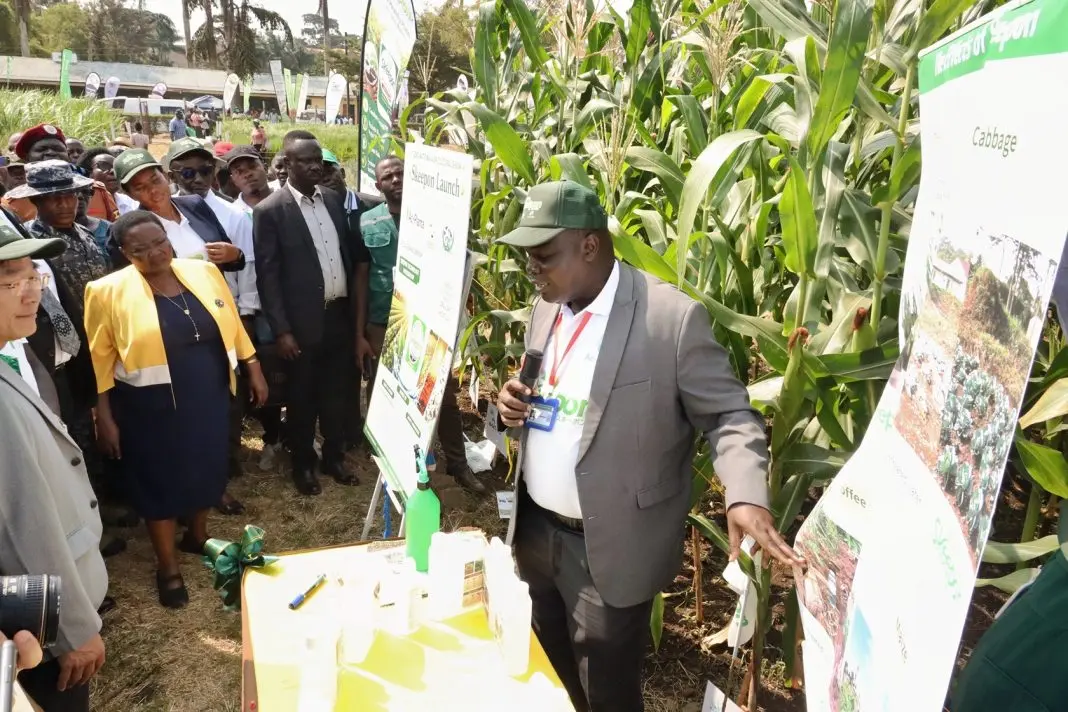
On June 30, at the 2026 National Agricultural Show in Jinja, Prime Minister Robinah Nabbanja unveiled a product that its backers hope can help rewrite the terms of Uganda's relationship with the weather. Called Skeepon Technology, or SKP, it is not a new seed, a fertiliser or an irrigation scheme but a plant bio-stimulant — a treatment designed to switch on crops' own natural defences against drought and heat. Its national launch comes at a moment when official data suggest the country's overwhelmingly rain-fed farming system is growing more vulnerable, and it offers a window into how Uganda is trying to adapt to a climate that no longer behaves the way farmers expect.
A farming system exposed to the sky
The scale of Uganda's exposure is stark. A recent government report found that 97.2 percent of the country's parishes rely on rainfall for farming, leaving agriculture almost entirely at the mercy of the seasons. The same findings show that 75.7 percent of parishes now experience irregular rainfall seasons, making planting decisions less predictable and raising the risk of crop failure. More than 94 percent of parishes report problems in crop farming such as diseases, limited land and a shortage of improved seeds, while in livestock farming 93.1 percent report animal theft and 92.5 percent face pests and diseases.
These are not abstract statistics. For a country where agriculture employs the majority of the workforce and anchors rural incomes, unreliable rain translates directly into hunger, lost earnings and slower economic growth. Prolonged dry spells, rising temperatures and unpredictable rainfall — the hallmarks of a shifting climate — have become recurring threats to food security and household stability. It is against this backdrop that the government has been searching for tools that can make crops more forgiving of a harsh and erratic environment, and Skeepon is the latest and most prominent of them.
How the technology works — and what the trials showed
Skeepon is described as a bio-stimulant that activates a plant's own drought and heat tolerance mechanisms, enabling crops to keep growing under water stress and high temperatures for up to three months. Rather than adding nutrients in the manner of a conventional fertiliser, it is designed to prime the plant's internal stress responses so that it can better withstand periods when rain fails to arrive. The approach is attractive in the Ugandan context because it does not require the capital investment of irrigation infrastructure, which remains out of reach for most smallholders.
The claims rest on field work conducted by the National Agricultural Research Organisation, or NARO. In efficacy studies run over two cropping seasons, researchers recorded more than 30 percent higher maize yields and over 45 percent higher vegetable yields in treated crops compared with untreated ones. They also reported faster crop growth, improved plant vigour and markedly greater tolerance to drought and heat stress. For maize — a staple that doubles as both a food security crop and a cash earner across much of the country — a yield gain of that magnitude, if it holds up at scale on ordinary farms, would be significant.
The product arrives through an international partnership. Skeepon was introduced by a consortium bringing together the Ministry of Agriculture, Animal Industry and Fisheries, NARO, the Office of the Prime Minister, and Ac-Planta Inc., a Japanese agricultural biotechnology company. Distribution is to be handled by NARO Holdings Limited, the commercial arm of the research body, which plans to roll the technology out nationwide through partnerships with government agencies, farmer organisations and private-sector players using what officials describe as farmer-friendly delivery models.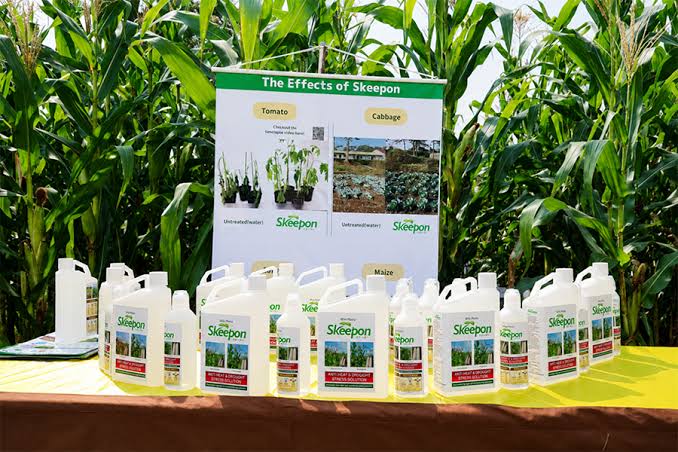
Promise, and the questions that follow
The launch fits a broader pattern in Ugandan agricultural policy, which has increasingly leaned on science and technology to close the gap between the country's farming potential and its actual output. It sits alongside programmes such as the Uganda Climate Smart Agricultural Transformation Project and continued investment by NARO in greenhouses, screen houses and improved varieties. The appeal of a bio-stimulant is that it can, in principle, be layered on top of a farmer's existing practices without demanding new land, new machinery or a new irrigation system — the kinds of changes that are hardest for a smallholder to make.
Yet a launch is not the same as adoption, and several questions will determine whether Skeepon delivers on its billing. The first is price and access: for a treatment to matter to the smallholder majority, it must be affordable and physically available in rural trading centres, not just demonstrated at a national show. The second is whether the impressive results from controlled NARO trials translate to the messy reality of thousands of individual farms with varying soils, seed quality and management. The third is knowledge: technologies of this kind live or die by the strength of agricultural extension, and Uganda's extension services have long been stretched thin, a gap the same government report on climate vulnerability implicitly highlights when it notes the widespread shortage of improved inputs and know-how.
There is also a strategic dimension. A bio-stimulant that buys crops a few months of tolerance to dry conditions is a powerful stopgap, but it is not a substitute for the deeper investments that agronomists say Uganda ultimately needs: water harvesting and small-scale irrigation to reduce dependence on rainfall in the first place, resilient and disease-resistant seed varieties, better storage to cut post-harvest losses, and stronger market links so that the extra output a farmer manages to grow can actually be sold at a fair price. Skeepon can help a plant survive a dry spell; it cannot, on its own, fix a system in which nearly all farming still depends on rain that arrives less and less on schedule.
For now, the technology represents a considered bet by the government and its partners that biology can be enlisted to help Ugandan agriculture ride out a more hostile climate. If the roll-out reaches ordinary farmers, keeps its price within their means, and is matched by the extension support needed to use it well, the maize and vegetable yield gains recorded in NARO's trials could translate into real resilience for millions of rural households. If it remains a showpiece launched to applause in Jinja but never fully delivered to the village, it will join a long list of promising interventions that looked transformative on stage and thin on the ground. Which of those futures materialises will be one of the more revealing tests of Uganda's climate adaptation strategy in the seasons ahead.
Torch Media Africa



