SCIENCE & TECH
Two thousand two hundred kilometers beneath your feet — roughly 1,367 miles, deeper than any drill has ever gone or ever will — a river of molten iron the size of an ocean has been quietly doing something scientists say they've never documented before. Sometime around 2010, a massive current of liquid metal swirling beneath the equatorial Pacific stopped drifting weakly westward, as it had for as long as anyone had been able to measure, and swung hard in the opposite direction, roaring eastward instead.
Nobody planned for this. Nobody predicted it. And sixteen years later, the team of scientists who finally pieced together what happened, using nearly three decades of satellite and ground-based magnetic data, still can't tell you why it happened. What they can tell you is that it's real, it's been sitting in the data the whole time, and it's forcing a rewrite of textbook assumptions about the most inaccessible, most consequential layer of our planet: the outer core, the churning ocean of liquid iron that generates Earth's magnetic field and, by extension, protects every living thing on the surface from the raw radiation of space.
THE DISCOVERY
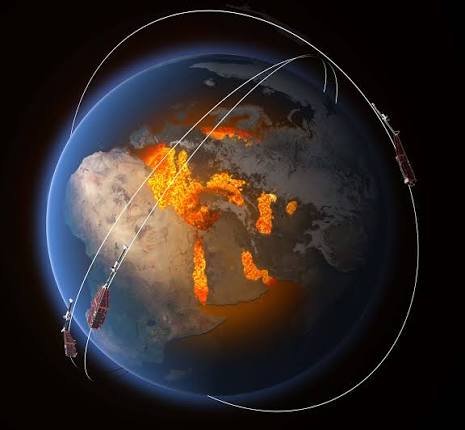
The findings, published in the peer-reviewed Journal of Studies of Earth's Deep Interior by researchers Frederik Dahl Madsen, Isobel Howard, William Brown and Kathryn Whaler, drew on an unusually long and rich dataset: ground-based magnetic observatory records combined with nearly three decades of satellite measurements, spanning 1997 to 2025. That includes data from the European Space Agency's Swarm mission, a trio of satellites launched in 2013 specifically to map tiny fluctuations in Earth's magnetic field with a precision no ground station could match on its own.
By feeding that data into models of core-surface flow — essentially, computer reconstructions of how molten iron is moving thousands of kilometers below the crust, inferred indirectly from how the magnetic field it generates is changing — the team found something startling sitting in the record: a broad region of core flow beneath the Pacific had reversed direction in 2010, flipping from a weak westward drift to a powerful eastward surge, and the eastward flow had then been gradually weakening again since around 2020.
"This study shows that regional changes can emerge rapidly within just a decade," said Elisabetta Iorfida, ESA's Swarm mission scientist, in comments about the findings. The reversal, she noted, challenges the long-standing assumption that the outer core beneath this stretch of ocean is dominated by stable, predictable westward circulation — the kind of steady, dynamo-like motion that has generally been treated as a safe baseline in models of how Earth's magnetic field behaves.
WHAT'S ACTUALLY DOWN THERE
To understand why a flow reversal 2,200 kilometers underground matters to anyone standing on the surface, it helps to understand what the outer core actually is and does.
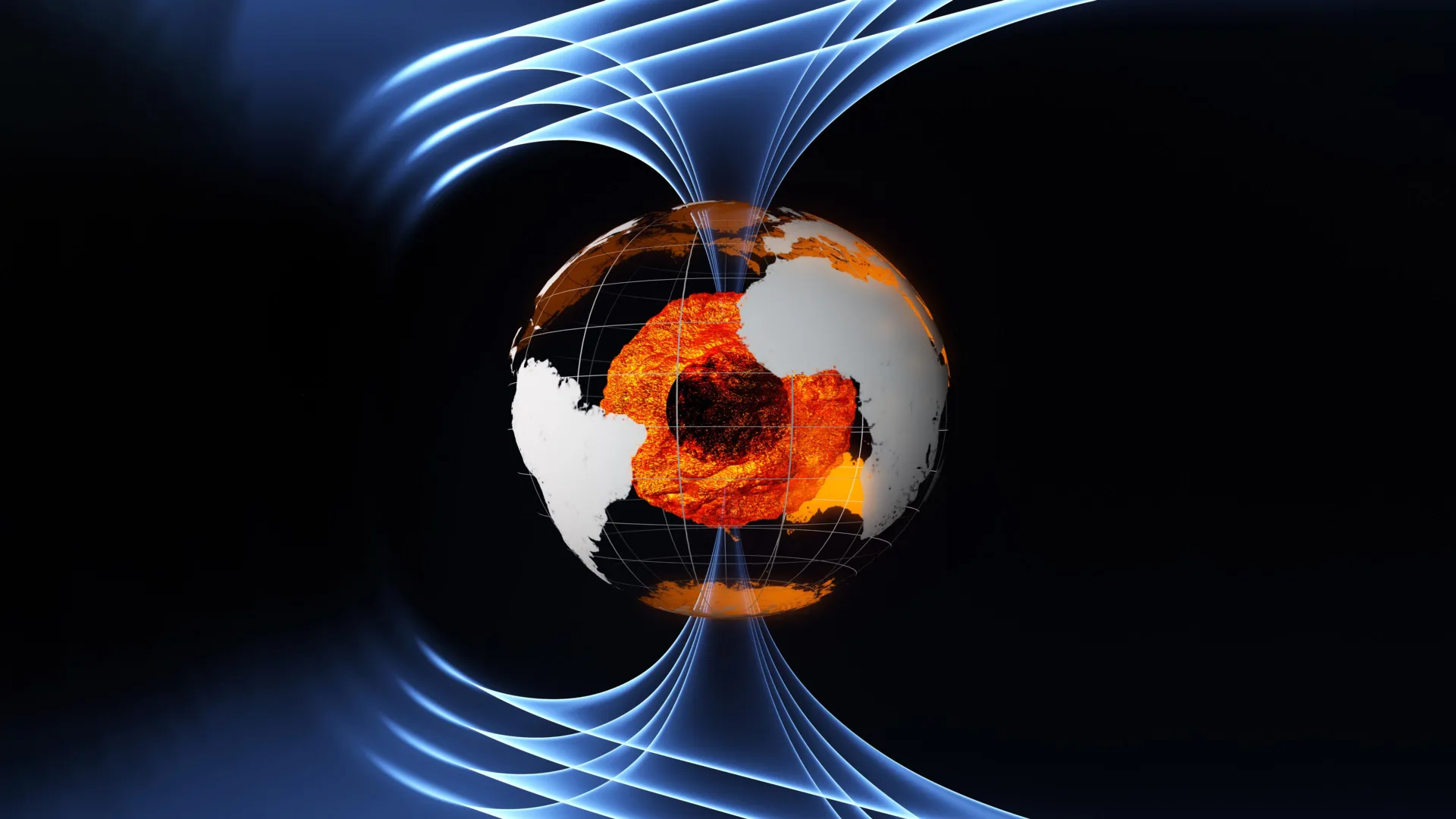
Earth is built like a set of nested shells. There's the thin crust we live on, the thick rocky mantle beneath it, and then, starting a little under 3,000 kilometers down, the outer core: a layer of liquid iron and nickel, superheated to temperatures rivaling the surface of the sun, under crushing pressure, and in constant, churning motion. At the very center sits the solid inner core, a ball of iron roughly the size of the Moon, slowly crystallizing as the whole planet cools over geological time.
That churning liquid iron in the outer core is not just moving randomly. As it flows, it drags Earth's rotation and internal heat with it, generating electric currents the same way spinning a conductor inside a magnet generates electricity in a bicycle dynamo. Those currents, in turn, generate Earth's magnetic field — the invisible shield that deflects the solar wind, protects the atmosphere from being stripped away the way Mars's was billions of years ago, and, as a very convenient side effect, makes compasses point roughly north.
This process is called the geodynamo, and scientists have spent more than a century building models of how it behaves based on the assumption that, on human timescales, the broad patterns of core flow change slowly and predictably. Finding a region that flipped its entire direction within roughly a decade — and that this flip correlates suspiciously well with a known, sudden shift in the magnetic field itself called the 2017 "geomagnetic jerk" — suggests the core can behave far more dynamically, and far less predictably, than the textbooks assumed.
Researchers also flagged something else in the timing: the onset of the strong eastward flow beneath the Pacific occurred around the same time as changes in the behavior of the solid inner core inferred separately from seismology and geodesy — the study of the Earth's precise shape and rotation. That's led to a working hypothesis, still unconfirmed, that something happening deeper still, at the boundary between the liquid outer core and the solid inner core, may have triggered the reversal at the surface of the core that researchers were able to detect.
A DETECTIVE STORY WITH NO ENDING YET
What makes this discovery unusual isn't just the reversal itself — it's that scientists caught it entirely by accident, hiding in data they already had. Nobody set out in 2026 to find a core reversal; the signal had been sitting, unrecognized, across nearly thirty years of magnetic observations until this team went back and applied new statistical techniques — principal component analysis, a method for teasing distinct patterns out of noisy, overlapping data — to isolate what had actually happened at the Pacific site specifically.
That's also why the mystery remains wide open. The team's model suggests the eastward surge has been losing strength since 2020, but they can't yet say whether that means the flow is settling back toward its old westward pattern, whether it's part of some longer oscillating cycle nobody has previously identified, or whether it's evolving toward some entirely new, as-yet-unknown stable state. Confirming any of those possibilities will require years more data, and potentially entirely new satellite missions purpose-built to keep watching the same patch of core.
It's worth being clear about what this is not. This is not evidence of an imminent magnetic pole reversal — the dramatic, complete flip of Earth's north and south magnetic poles that happens on average every few hundred thousand years and has fueled a small industry of doomsday speculation. Nothing in this study suggests that process is underway. What the researchers found is a regional change in flow direction within the core, not a global collapse or inversion of the magnetic field itself. It's a significant and genuinely surprising finding about how dynamic the core can be — not a sign the planet's magnetic shield is failing.
WHY SCIENTISTS ARE EXCITED, NOT ALARMED
For geophysicists, this discovery is less a warning sign and more a rare, precious data point — a real-world example of the core doing something unexpected that they can now use to stress-test and improve their models. Understanding how quickly and dramatically regional core flow can shift matters for a surprisingly practical set of reasons.
Airline navigation systems, satellite communications, and models used to forecast space weather all lean on accurate, up-to-date maps of Earth's magnetic field. That field isn't static — it drifts constantly, which is why magnetic north has been slowly wandering across the Canadian Arctic for decades, forcing periodic updates to the World Magnetic Model that underpins GPS-linked compass systems in everything from smartphones to commercial aircraft. A discovery that regional core flow can reverse within a decade, rather than shifting gradually over centuries, means the models used to predict those changes may need to account for much faster, more localized variability than previously built in.
There's also a deeper scientific payoff. The core is, by definition, a place no instrument will ever physically visit — the pressures and temperatures involved make direct sampling essentially impossible with any foreseeable technology. Almost everything scientists know about it is inferred indirectly, through exactly this kind of magnetic field detective work. Every anomaly like the Pacific reversal is effectively a rare, unplanned experiment that the planet is running for free, and each one sharpens the tools researchers use to peer into a region that will otherwise remain permanently out of reach.
WHAT THIS MEANS FOR YOU
You will not feel this. There's no tremor, no visible sign, nothing that changes about daily life on the surface because a current 2,200 kilometers down changed direction. But the slow, cumulative effects of core dynamics do eventually surface in ways that touch ordinary technology: the magnetic declination your phone's compass app quietly corrects for, the periodic recalibrations of GPS-linked navigation systems, and the space weather forecasts that airlines use to reroute polar flights during solar storms all depend, ultimately, on scientists' evolving understanding of exactly this kind of core behavior.
It's also, more simply, one of those stories that's worth sitting with for what it says about how much remains unknown about the planet under our feet. We have mapped the surface of Mars in finer detail than we have mapped the top of Earth's own core. A discovery like this is a reminder that "settled science" about our own planet is sometimes anything but, and that the ground truth — quite literally — can still surprise us.
THE BOTTOM LINE
Somewhere beneath the Pacific, a mass of molten iron bigger than any ocean on the surface reversed course sometime around 2010, kept flowing that way for roughly a decade, and has been quietly losing steam since 2020 — and the scientists who found it, buried in data they'd had all along, still don't know what triggered it or where it's headed next. It's not a doomsday signal. It's something rarer and, in its own way, more exciting: proof that the deepest, most hidden part of our planet is far more restless than we thought, and that thirty years of patient satellite data can still turn up secrets nobody knew to look for.
Researchers say the next step is watching closely to see whether the weakening eastward flow keeps fading, stabilizes, or does something nobody's predicted yet. Given the track record so far, betting on "nobody's predicted yet" might be the safest call.
Published By | Tech Wiz