TECH
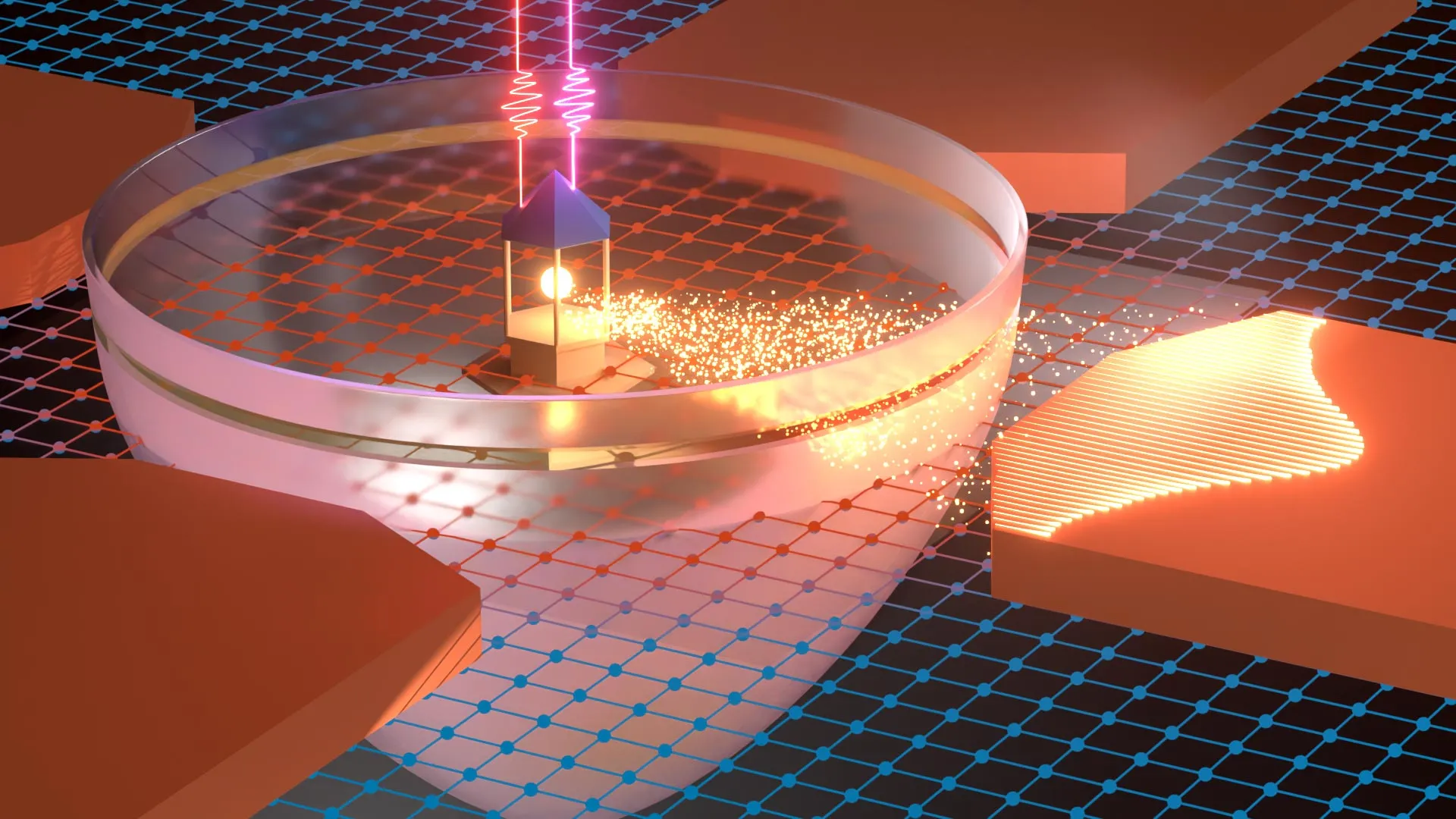
Picture a lighthouse: a single lamp, spinning slowly inside a lens, throwing a rotating beam of light out across dark water. Now imagine the beam isn't light at all — it's electrons, the fundamental particles that carry every electric current on Earth, and instead of a mechanical lamp turning on a spindle, the thing doing the sweeping is nothing more than the angle of polarization in a pair of overlapping laser pulses.
That is, almost unbelievably, what a team of physicists at the University of Michigan has actually built. In a new paper published in Physical Review Letters, researchers led by Steven Cundiff describe a semiconductor device that generates a directional beam of electrons using only laser light — no battery, no applied voltage, no electric field of any kind pushing the current along. Change the color relationship between two laser pulses, or rotate their polarization, and the electron beam swivels to point in a new direction inside the material, exactly like a lighthouse rotating its lamp.
"The light no longer merely switches the current on; it also aims it," Cundiff said of the discovery — a distinction that sounds subtle until you understand just how strange it is by the standards of ordinary electronics.
HOW YOU NORMALLY MOVE ELECTRONS (AND WHY THIS IS DIFFERENT)
In virtually every electronic device on the planet — your phone, your laptop, the router humming in the corner of your living room — electrons move because something is pushing them: a voltage difference, an electric field, a battery terminal offering electrons a lower-energy place to go. Current follows the field. That's rule number one of basically all conventional electronics, and it's been rule number one since Thomas Edison and Nikola Tesla were arguing about which kind of current was better.
The Michigan team's device breaks that rule entirely. There is no applied electric field directing the current. Instead, the direction and character of the electron flow are dictated purely by quantum mechanical interference between two colors of laser light hitting the semiconductor at the same time.
Here's the trick, as best it can be explained without a physics doctorate: when two different colors (frequencies) of coherent laser light strike a semiconductor together, they can each drive electrons from a low-energy state up into the same final high-energy state, but by different quantum-mechanical paths — one color might excite an electron using a single high-energy photon, the other using two lower-energy photons whose combined effect lands the electron in the identical state. Because both paths lead to the same destination, quantum mechanics allows them to interfere with each other, the same way two ripples on a pond can either reinforce or cancel each other depending on how their peaks and troughs line up.
Crucially, that interference isn't the same in every direction. For electrons trying to move one way through the crystal, the two quantum paths reinforce each other, boosting the odds that an electron actually launches in that direction. For electrons trying to move a different way, the paths cancel out, suppressing that motion almost entirely. The net result is a "ballistic" current — meaning the electrons shoot off along a specific trajectory determined by their initial launch velocity, like a thrown ball rather than a river of charge oozing along a wire — and that trajectory can be steered simply by adjusting the relative phase and polarization of the two laser colors.
Rotate the polarization of the two coherent optical fields, and the whole electron beam rotates with it — sweeping through the material exactly like a lighthouse beam sweeping across open water, hence the name that's stuck to the discovery.
WHO'S BEHIND IT
The paper, titled "Directional Photocurrent Generated by Quantum Interference Control," lists Cundiff alongside University of Michigan researchers Yiming Gong and Kai Wang. Cundiff, a physicist known for his work on quantum coherence and ultrafast optics, has spent years studying how light and matter trade energy and information on timescales measured in femtoseconds — millionths of a billionth of a second. This latest result extends that line of work from merely observing quantum interference effects to actually harnessing them as a functional steering mechanism, arguably the more difficult and more useful half of the equation.
The underlying phenomenon of quantum-interference-controlled photocurrents isn't itself brand new to physics — researchers have chased "coherent control" of currents in semiconductors for years, in pursuit of ways to manipulate matter using nothing but carefully shaped light pulses. What's new here is the demonstration of genuine directional steering: not just switching a current on or off with light, or biasing it slightly one way, but actively pointing it, continuously, across a range of directions, purely through polarization control of the driving lasers.
WHY PHYSICISTS ARE EXCITED
The appeal isn't abstract. Modern electronics are bumping up against physical limits imposed by wires, contacts, and the sheer speed at which conventional circuitry can be switched on and off. Optical processes, by contrast, can happen on femtosecond timescales — orders of magnitude faster than the nanosecond switching speeds of today's fastest transistors. A device that lets light directly control the direction of an electron current, without needing a physical electrode or applied field to do the steering, opens the door to hybrid opto-electronic components that could, in principle, operate far faster and with far less energy overhead than devices that rely on charging and discharging capacitors and gates the old-fashioned way.
Researchers covering the work have pointed to a cluster of plausible applications: optical sensors that respond directly to the color and polarization of incoming light without intervening conversion steps; new approaches to high-speed communications, where information could be encoded directly into the direction of a photocurrent rather than its mere on/off state; advanced imaging systems; and novel forms of information storage that exploit directional control at the quantum level rather than conventional magnetic or charge-based storage.
None of this is a product yet. It's a laboratory demonstration in a research semiconductor sample, not a chip you'll find in next year's smartphone. But foundational discoveries in semiconductor physics have a long, well-documented history of taking a decade or two to migrate from "we made this work once, carefully, in a lab" to "this is inside the phone in your pocket." The transistor itself took years to go from a benchtop curiosity to mass manufacturing; the quantum-interference-based directional photocurrent is, right now, roughly at that same benchtop-curiosity stage — except with a head start, because decades of semiconductor fabrication infrastructure and expertise already exist to eventually build on.
EXPERT PERSPECTIVE
Physicists outside the immediate research group who study ultrafast optics and semiconductor devices have generally described the "electron lighthouse" concept as an elegant, clever piece of coherent-control physics — a textbook demonstration of how quantum interference, often treated as an abstract or even nuisance effect in physics classrooms, can be turned into a genuinely functional engineering tool. The core idea — using the relative phase between two colors of light to control which quantum pathway "wins" — has deep roots in coherent control theory, a field that's spent decades trying to use tailored light pulses to steer chemical reactions and electronic processes with a precision electric fields alone can't match. What makes this result notable is the demonstrated continuous directional control: not a binary switch, but something closer to a dial you can turn.
Laser Focus World and other trade outlets covering the Physical Review Letters paper have framed it as part of a broader push toward "photonic" or "opto-electronic" computing architectures — systems that blend the speed of light-based signaling with the familiar architecture of semiconductor devices, rather than trying to replace electronics with pure photonics wholesale. The electron lighthouse fits that mold precisely: it doesn't throw out semiconductors, it just changes what's doing the steering inside them.
WHAT THIS MEANS FOR YOU
It's fair to ask why a laboratory curiosity in Ann Arbor should matter to anyone who isn't a condensed-matter physicist. The honest answer is that it probably won't matter directly, not this year and likely not this decade — but the category of technology it points toward absolutely will. Every leap in how fast and how efficiently we can move and control electrons eventually shows up in consumer technology: faster phones, more efficient data centers, better fiber-optic communications, sharper cameras and sensors. The specific mechanism demonstrated here — using light's polarization and color to steer current with no applied field — is exactly the kind of fundamental building block that shows up, decades later, inside a component nobody outside the industry has ever heard of but that makes some later device faster or cheaper or cooler-running than it otherwise would be.
There's also a broader pattern worth noticing: some of the most consequential technology stories of 2026 aren't the flashy AI product launches or trillion-dollar data center deals dominating headlines, but quieter benchtop results like this one, which quietly rewrite what's considered physically possible. The transistor, the laser, the LED — all of them started as a strange, narrow laboratory result that took years to explain and decades to commercialize.
CONCLUSION
For now, the "electron lighthouse" remains exactly that: a laboratory device, a sliver of semiconductor illuminated by two carefully tuned laser colors, its beam of electrons sweeping obediently in whatever direction the polarization dial commands. But in demonstrating that light alone — no wires, no batteries, no electric field — can not just switch a current on but actively steer it, Cundiff's team has handed the wider field of opto-electronics a new tool, and quietly nudged forward the decades-long project of building computing and sensing technology that runs on light as much as on electricity. Keep an eye on this one; the lighthouse metaphor might prove more literal than anyone expects, guiding a whole generation of devices still years from being built.
Published By | Tech Wiz