HOUSTON, TEXAS
For sixty years, watching humans fly into deep space has meant grainy black-and-white footage, garbled radio static, and a many-second delay between "go" and knowing whether it actually worked. That is about to change forever. NASA just announced that when four astronauts blast toward the Moon aboard Orion in the Artemis III mission, targeted for late 2027, the world won't just hear about their most dangerous maneuver — it will watch it live, in ultra-high-definition, as it happens.
The space agency confirmed on July 16 that it has selected SpaceX to install two Starlink "mini" laser communication terminals on the outside of the Orion capsule. The terminals will use focused beams of infrared light — not radio waves — to blast 4K video and imagery back to Mission Control at Johnson Space Center in Houston in something close to real time. NASA and SpaceX both describe it as a first: never before has a crewed NASA spacecraft streamed live footage of a ship-to-ship docking in orbit in high definition.
It is a small piece of hardware carrying an enormous amount of symbolism. It marks the moment America's human deep-space program stops relying on the same government-built relay architecture that has shuttled voice and low-resolution telemetry since the days of Mercury and Apollo, and instead plugs directly into the commercial internet backbone already crisscrossing low Earth orbit.

A Test Flight Unlike Any Other
Artemis III was originally billed as the mission that would put boots back on the lunar surface for the first time since Apollo 17 in 1972. That's no longer exactly the plan for this particular flight. According to NASA's revised mission architecture detailed in mid-July, Artemis III will not attempt a lunar landing at all. Instead, it has been reengineered into a high-stakes orbital dress rehearsal: a circularized low-Earth-orbit demonstration at a baseline altitude of roughly 460 kilometers, where Orion will practice rendezvous and docking maneuvers with not one but two competing commercial lunar landers.
That detail alone makes this one of the most closely watched missions NASA has flown in years. For the first time, the agency will integrate hardware and software interfaces from both of its Human Landing System providers — SpaceX's Starship and Blue Origin's Blue Moon — during a single flight. Four astronauts will guide Orion through a delicate ballet of approach, station-keeping, and docking with test versions of both vehicles, verifying that the systems that are supposed to ferry humans down to the lunar surface in 2028 actually work as advertised before NASA bets real lives on them.
It is, in other words, a dress rehearsal with the whole world potentially watching over the astronauts' shoulders — literally, through the two Starlink laser terminals bolted to Orion's hull.
How A Beam Of Light Replaces Decades Of Static
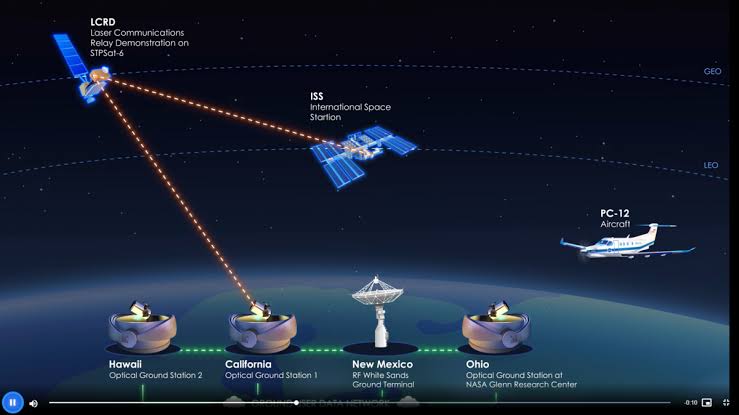
The technology at the center of all this is deceptively simple in concept and staggeringly complex in execution. Traditional deep-space communication relies on radio frequency signals bounced between spacecraft and NASA's Deep Space Network or Near Space Network — a system of giant dish antennas that has to be shared across every active NASA mission, from Mars rovers to solar probes to the International Space Station. Radio frequency communication is reliable, but it is bandwidth-starved. Squeezing 4K video through it is like trying to pour a swimming pool through a garden hose.
Laser, or optical, communication throws out the radio hose entirely. Instead, it encodes data onto a tightly focused beam of infrared light — invisible to the naked eye — and points it directly at a receiving terminal. Because light waves oscillate far more rapidly than radio waves, a laser link can carry vastly more information through the same size aperture. NASA has been quietly testing pieces of this technology for years, but the Artemis III arrangement represents its first operational use on a crewed deep-space capsule.
Critically, the terminals NASA is bolting onto Orion aren't bespoke, one-off government hardware. They are adapted "mini" versions of the same laser terminals SpaceX already uses to link more than 25,000 Starlink satellites to each other in orbit, forming the invisible laser mesh that delivers broadband internet to hundreds of thousands of customers on Earth, from rural farmhouses to Ukrainian trenches to cruise ships. NASA is essentially borrowing off-the-shelf commercial infrastructure — hardware SpaceX has already mass-produced, flight-proven, and iterated on at a scale no government contractor could match — and repurposing it to solve one of human spaceflight's oldest bottlenecks: getting good pictures home fast.
The two terminals will be mounted on the exterior of the Orion capsule and will downlink imagery and live video directly to Mission Control, skipping layers of relay infrastructure that have traditionally introduced delay, compression, and — during the most dramatic moments of past missions — long stretches of silence.
From "The Eagle Has Landed" To 4K Streaming
It's worth pausing on how dramatically this upends nearly the entire history of crewed spaceflight coverage. When Neil Armstrong and Buzz Aldrin landed on the Moon in 1969, roughly 600 million people watched flickering, low-resolution television footage relayed through a chain of ground stations and satellites, with noticeable transmission lag and a picture quality that today would look worse than a decade-old flip phone camera. Space Shuttle missions in the 1980s and '90s improved on this only incrementally. Even the International Space Station, which has hosted a nearly continuous human presence for more than two decades, has historically relied on NASA's aging Tracking and Data Relay Satellite System for its video downlinks — serviceable, but nowhere near broadband quality, and entirely unavailable during certain orbital blackout windows.
Artemis III's laser terminals blow past all of that. Real-time 4K video from a quarter-million miles closer to the Moon than the ISS orbits Earth means viewers on the ground could, for the first time, watch a genuinely uncertain, high-stakes docking maneuver unfold with television-quality clarity as astronauts' lives literally hang on split-second navigation between Orion and two different experimental landers. One trade publication covering the announcement summed up the shift bluntly, describing it as the moment the "government relay era ends" for NASA's most important missions.
Why This Matters Beyond The Spectacle
Beyond the sheer novelty of watching astronauts dock near the Moon the way you'd watch a football game, the stakes here are engineering ones as much as entertainment ones. Live, high-bandwidth video isn't just a nice-to-have for public relations — it is a genuine safety and operational upgrade. Flight controllers and engineers on the ground will be able to visually monitor docking hardware, spacecraft exteriors, and crew activity in real time rather than waiting for delayed or compressed data dumps. If something looks wrong on an antenna, a docking ring, or a thermal panel, engineers could potentially spot it and react within seconds rather than minutes or hours.
That matters enormously given what's actually being tested. This isn't a routine supply run to the ISS. It's the first time NASA will attempt to validate, in a single mission, whether two independently built commercial landers — one from SpaceX, one from Blue Origin — can each safely interface with the Orion capsule that will eventually carry astronauts down to a landing on the lunar surface. Any anomaly during those docking attempts needs to be understood immediately, not reconstructed after the fact from a stack of telemetry logs.
There's also a quieter policy story behind the headline. For decades, NASA's most important human spaceflight communications have depended on infrastructure built, owned, and operated by the government — the Deep Space Network, the Tracking and Data Relay Satellite System — systems that are aging, oversubscribed, and expensive to modernize. By leaning on Starlink's already-operational commercial laser mesh, NASA is effectively outsourcing a piece of mission-critical crewed spaceflight communications to private industry for the first time at this level of importance. It's a bet that commercial space infrastructure, built at a scale and cadence no government program could match, can be trusted with the literal safety of astronauts' lives near the Moon.
What This Means For You
You don't need a NASA badge or a television deal to watch this unfold. If the plan holds, anyone with an internet connection could plausibly watch astronauts thread the needle between two competing lunar landers hundreds of miles above Earth, in crisp high definition, as it happens — not hours later in an edited highlight reel. It's the closest an ordinary person on Earth has ever gotten to riding along inside a real deep-space mission.
It also previews what's coming for the actual Moon landing attempts later this decade. If this orbital dress rehearsal goes well, the same laser-relay approach could plausibly carry live video from the lunar surface itself when astronauts finally step down again — turning what was once a scratchy, delayed broadcast into something closer to a live sports event, beamed from the Moon.
The Bigger Picture
Artemis III's redefinition — from lunar landing attempt to orbital docking gauntlet between two rival landers — reflects just how complicated and schedule-strained NASA's return to the Moon has become. Both SpaceX's Starship and Blue Origin's Blue Moon landers have faced repeated delays, and NASA's decision to test both simultaneously, rather than picking a single winner outright, shows an agency hedging its bets after years of slipped deadlines. The mission is now aimed at 2027, feeding into an eventual crewed lunar landing NASA still hopes to achieve by 2028 — itself already pushed back multiple times from the original mid-2020s target first announced under the Artemis program.
Whether that 2028 target holds remains an open question given the program's track record. But for the first time, the public won't have to simply trust NASA's word about how a critical test went. They'll be able to watch it, in real time, in 4K, streamed to Earth on a beam of laser light — a fitting, almost poetic upgrade for a space agency trying to prove, after decades of budget battles and schedule slips, that it can still pull off something genuinely new.
Conclusion
Six decades after grainy black-and-white footage of the first Moonwalk mesmerized the world, NASA is preparing to give the public something it has never had: a front-row, broadcast-quality seat to the exact moment human spaceflight's biggest risks are actually unfolding. Two small laser terminals, borrowed from a commercial internet satellite network, are about to do what billions of dollars of government relay infrastructure never quite managed — make deep space feel close, immediate, and utterly real. When Orion approaches those two lunar landers sometime in 2027, the whole world may finally get to watch humanity's next giant leap the moment it actually happens, not the moment someone gets around to telling us about it.
Published By | Tech Wiz