Written By | Staff Writer
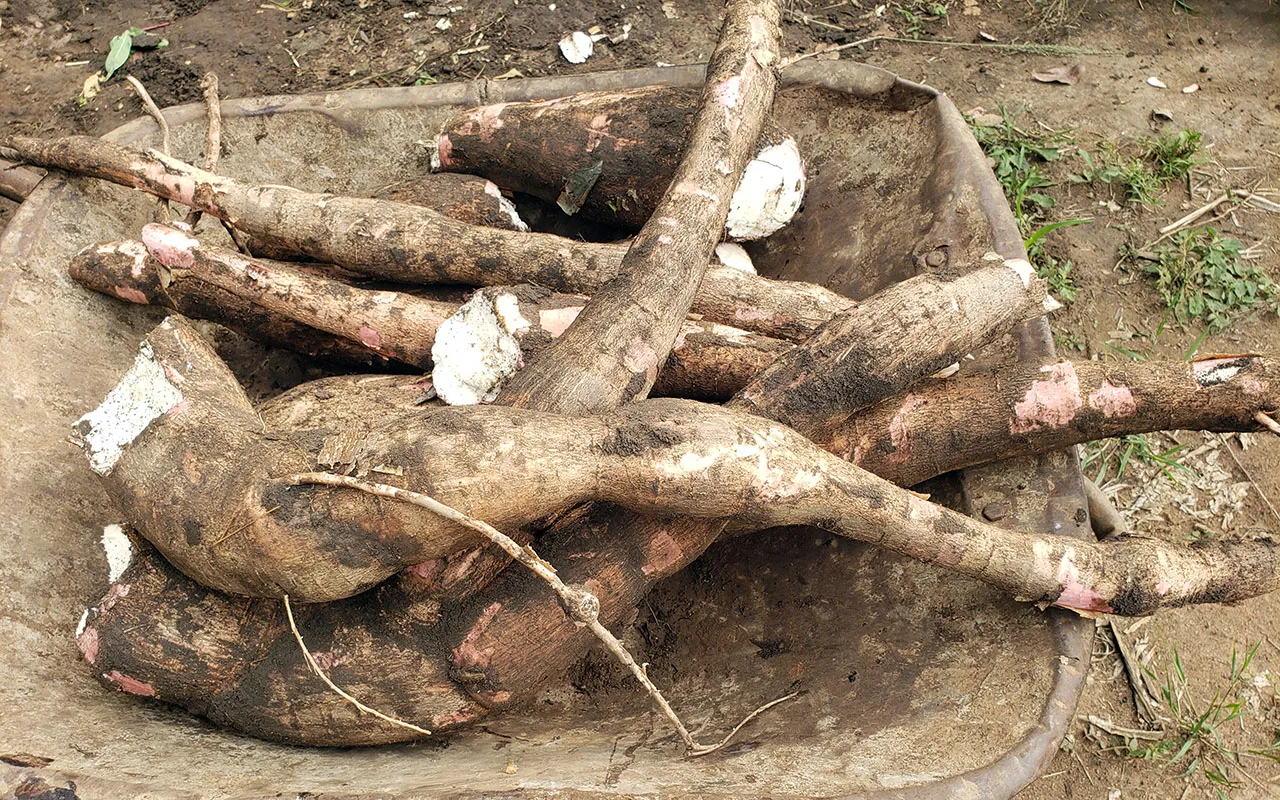
Farmers in Akwac Cell say their roots are rotting in the soil after a drought-then-deluge season.
Agriculture
For a crop that farmers often call the "insurance plant" because it survives where maize and beans fail, cassava is behaving badly in Oyam. Farmers in Akwac Cell, Oyam Town Council, say tubers are rotting underground before they can be harvested, and that gardens inspected this week by local leaders and residents showed whitefly infestation and other signs of disease. Some were severely damaged before harvest, according to local radio reports from the area on 22 October and Nile Post reporting on 23 October.
What makes the Akwac report notable is not only what is happening to the roots but what has not yet happened: nobody with the authority to confirm it has said what the disease is. Reports note that experts still need to establish whether the symptoms stem from cassava brown streak disease, cassava mosaic disease, whitefly damage itself, or something else, before recommending controls. In the meantime, a household food staple in one of northern Uganda's most food-stressed sub-regions is quietly failing.
What farmers are seeing
Susan Onguu, a farmer in Akwac, told reporters that changing weather is making crops harder to protect. "They are destroying our cassava, and if we do not act fast, we risk losing our harvest and our food supply," she said. Farmers link the problem to a pattern familiar across Uganda this year: prolonged dry spells followed by heavy rain, which stress the plants and invite whiteflies.
Belmos Alango, the LC1 chairperson of Akwac Cell, framed it as a convergence of causes. "This is not just a pest problem; it is a weather problem that has become a farming problem," he said, urging farmers to report unusual symptoms early and calling for a coordinated community response.
Underground rot is especially cruel because it is invisible. A farmer can tend a garden for most of a year, see healthy-looking foliage, and discover the loss only at digging time. That is a different risk profile from a cereal crop where failure shows in the field weeks earlier and replanting remains possible.
Not a new problem, but an unresolved one
The Akwac reports are the latest chapter in a longer story. In March 2025, Oyam's District Production Officer reported a persistent cassava disease, active since 2023, that had spread across all sub-counties and town councils and destroyed hundreds of acres. Symptoms then included yellowing leaves, drying stems and rotting roots, with crops deteriorating within two to three weeks of infection. One farmer in Abok Sub-county lost an entire two-acre garden.
The market registered the damage quickly. A sack of cassava at Oyam Main Market was reported to be selling for about Shs50,000 in early 2025, compared with Shs95,000 to Shs100,000 the previous year. Prices that fall that sharply in a staple crop are usually a sign of distress selling and shrinking quality rather than abundance.
Officials at the time advised farmers to consult extension workers and plant disease-tolerant varieties such as NAROCASS 1. They also flagged repeated planting of the same varieties without crop rotation as a possible factor in how long the problem has persisted. Earlier reports identified Lango districts, Oyam among them, as areas with whitefly infestation and cassava brown streak disease.
Why whiteflies matter
Whiteflies are more than a nuisance. A 2024 study linked to NARO, as cited in the reporting, said whitefly damage alone can cause yield losses of up to 50 per cent, while a 2025 review put losses at 70 to 100 per cent under severe pressure. Crucially, whiteflies can transmit both cassava brown streak disease and cassava mosaic disease. Brown streak is particularly feared because it can leave leaves looking acceptable while the roots develop a corky, brown rot, which makes the harvest unfit to eat or sell.
This is why diagnosis is not an academic nicety. If the Akwac problem is brown streak or mosaic, the response involves clean planting material, removal of infected plants and variety selection. If it is primarily whitefly build-up after erratic weather, the response leans toward pest management and field hygiene. And if it is a rot driven by waterlogging after drought, as some farmers suspect, advice on drainage, planting on mounds and harvest timing would matter more. Getting this wrong wastes a planting season, which farmers in Lango cannot afford.
A region with little room for error
The stakes are heightened by who is exposed. The most recent Integrated Food Security Phase Classification (IPC) analysis, covering April 2025 to February 2026, estimated that 273,300 people, about 16 per cent of the analysed population in the Lango sub-region, faced high levels of acute food insecurity. Oyam was classified in Phase 2 (Stressed), while Kole and Alebtong were in Phase 3 (Crisis). The drivers named included dry spells, erratic rainfall, floods, hailstorms, and pests and diseases, which are exactly the stack of shocks now visible in Akwac.
The weather backdrop has not helped. Separate Nile Post reporting this week from a visit by Japanese officials to Lira City quoted Ajuri County MP Fred Jalameso saying harvests in two seasons this year fell below 20 per cent of normal in his area. He added that hiring a tractor costs Shs120,000 to Shs150,000 per acre, which many farmers cannot afford. Those are one legislator's figures rather than a survey, but they are consistent with a sub-region where households have thin buffers and few ways to replace a failed staple.
Seasonal forecasts add another layer. The El Niño-linked rains expected to peak from late October through mid-November, as covered in earlier reporting, raise the risk of further waterlogging in fields where roots are already compromised. Whitefly populations also tend to respond to shifts in temperature and moisture, so a wet spell after a dry one may not bring relief.
What the official pipeline offers
Government's main answer sits in a proposal rather than in the field. The proposed Integrated Cassava Industry Development Project would build processing facilities in Lira and Gulu, support drying and processing in the Acholi and Lango sub-regions, distribute at least 142,400 bags of certified clean stem cuttings every year, and target at least 242,080 metric tonnes of fresh roots annually.
On paper that addresses the two weakest links, clean planting material and a reliable buyer. In practice the project is described as proposed, and the reporting available does not give a start date or budget. Farmers in Akwac need answers in the next planting window, not the next financial year. Their requests are modest: intensified field inspections, laboratory identification of the cause, pest-management guidance, and access to clean, disease-tolerant cuttings.
There is also a structural question about how fast Uganda's extension and diagnostic system can move. Cassava is propagated from stem cuttings, which means that infected planting material can carry disease from one season to the next. When farmers replant from their own gardens, as most do, a problem that begins in one cell can spread quietly. Clean seed systems, based on certified multiplication sites, are the long-term fix, but they depend on sustained funding and farmer awareness.
Implications for farmers, markets and the economy
For farmers, the immediate message is practical: report unusual symptoms to the sub-county production office, avoid moving cuttings from affected gardens, and ask extension staff about tolerant varieties such as NAROCASS 1 before replanting. Rotating with legumes or cereals, where land allows, breaks some of the build-up that officials have linked to repeat planting.
For markets, cassava price swings in Lango matter well beyond Oyam. Cassava flour is a cheaper dietary base than maize flour for many northern households, and when supply tightens, pressure shifts to other staples. Uganda is also already experiencing elevated food inflation, with food crops prices rising faster than overall inflation in recent national data, so a localised cassava failure is an unwelcome addition rather than an isolated event.
For the wider economy, cassava is a test case for whether Uganda can protect smallholder staples against a climate pattern that appears to be producing more extremes. The country has invested heavily in coffee, tea and export horticulture, but the food security of northern households rests on crops like cassava, sorghum and millet. A diagnosis that comes in weeks rather than months, followed by a visible supply of clean cuttings, would signal that the system can respond at the speed the weather now demands.
For now, the roots in Akwac keep rotting while the question of why remains open. The next step is simple to state and hard to deliver: send samples to a laboratory, tell farmers what the disease is, and put clean planting material in their hands before the next season is lost.



