DESIGN
At Guarulhos International Airport, the new Pedra Preta Lounge greets travellers with a winding timber installation modelled on the Juruá River, inside a 1,400-square-metre space built on Brazilian stone, art and food.
Airport lounges tend to look alike: grey carpet, a buffet, a wall of windows and a soundtrack of boarding calls. The new Pedra Preta Lounge in Terminal 3 of São Paulo's Guarulhos International Airport, which designboom calls "Latin America's busiest transit hub," takes a different approach. It starts with a river.
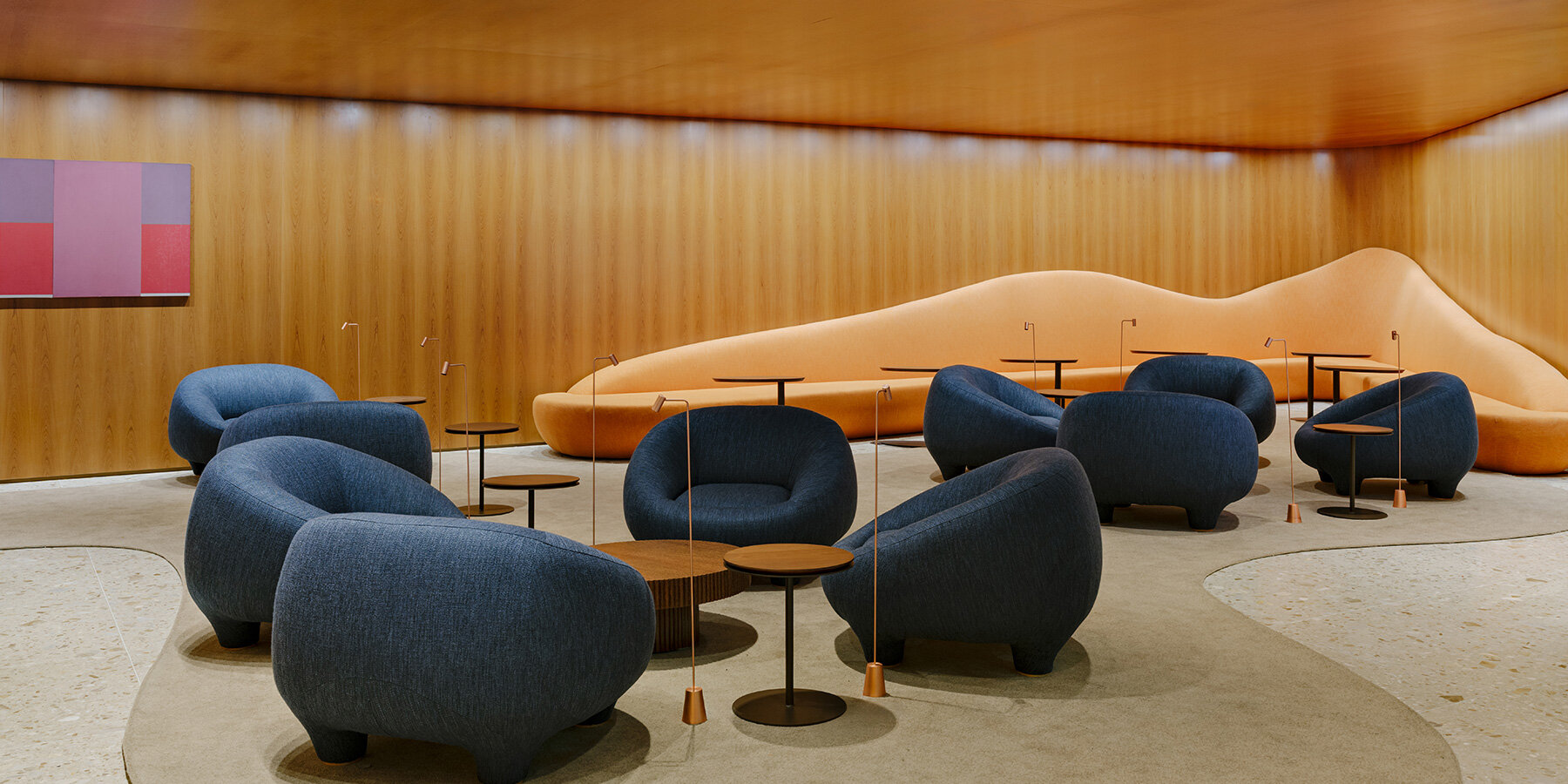
Designed by Perkins&Will São Paulo with Estúdio Campana for Itaú Personnalité and Itaú Private, the private-banking arms of Brazil's Itaú, the 1,400-square-metre lounge was featured by designboom on Nov. 19, 2026. Its centrepiece is at the entrance: a curved timber installation by Estúdio Campana, "modeled on the meandering curves of the Amazon's Juruá River."
The threshold
The Juruá is one of the Amazon's most winding tributaries, looping in tight curves through western Brazil. At Guarulhos, those curves become a wall of warm natural wood that, in designboom's words, "wraps the reception area to form a physical and acoustic threshold from the surrounding terminal."
That double role is what makes it more than decoration. Airports are loud, harsh environments, and the first thing a lounge needs to do is block that out. Instead of a glass door and a reception desk, the Campana installation uses a curved wall of wood that absorbs noise and signals that you've arrived somewhere calmer. The design idea is that you feel the change in sound and texture before you consciously notice it.
The commission suits the studio. Founded by brothers Humberto and Fernando Campana, Estúdio Campana built an international reputation by turning humble and natural materials into collectible design. Fernando died in 2022, and Humberto has continued the practice. Here, that approach is scaled up to architecture.
A sequence, not a hall
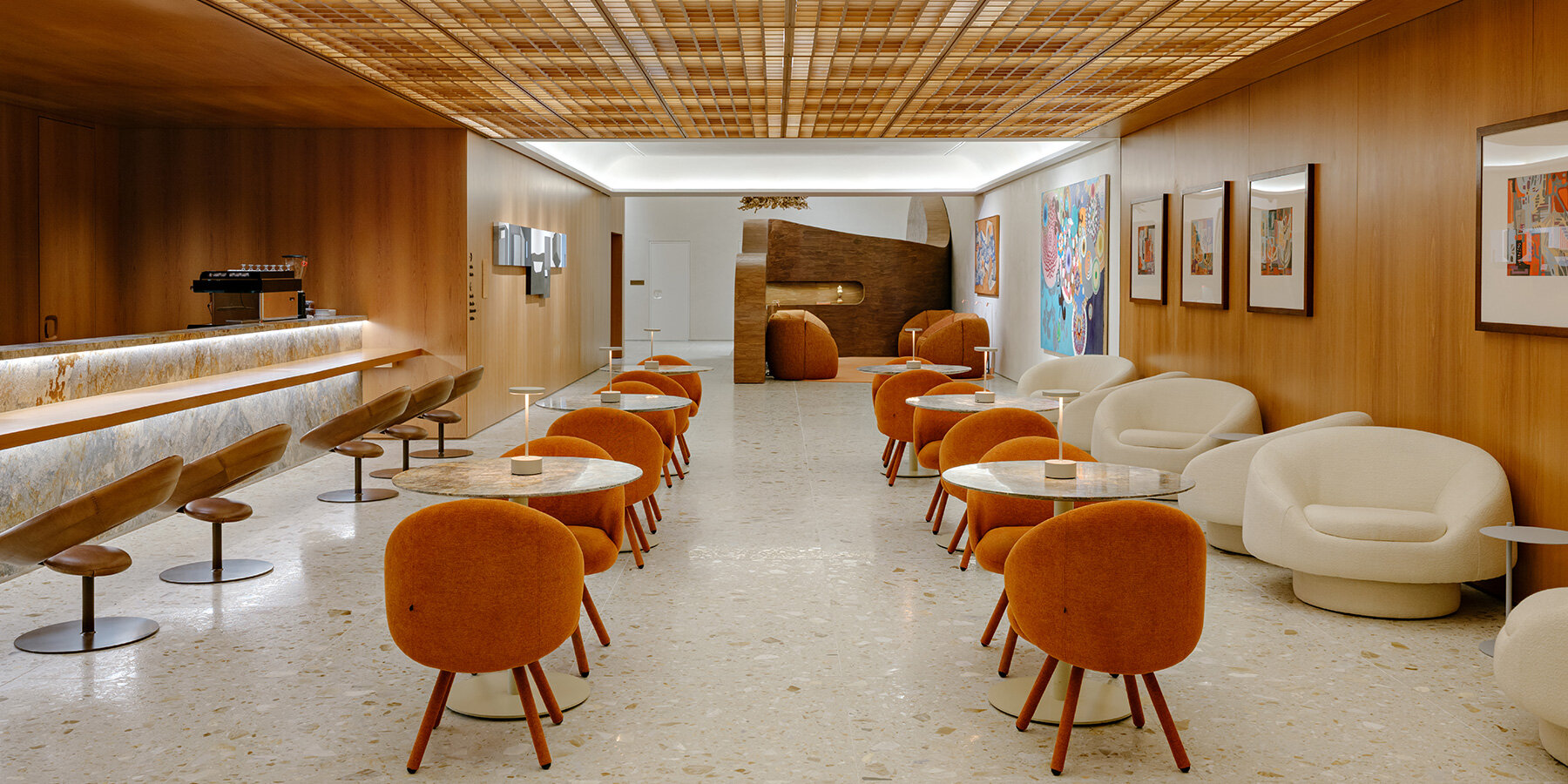
Inside, Perkins&Will avoided the open-plan waiting hall common to most lounges. Designboom says the plan is "divided into a sequence of interconnected zones calibrated for varying levels of privacy and activity," with areas for dining, work, rest, meetings, entertainment and wellbeing. Image captions also show a bar, a quiet lounge, a mezzanine staircase and an "ultra premium room."
The architects use "curved transitions, layered lighting, and framed sightlines" to separate these areas "while maintaining orientation toward departure gates." In practice, the curves of the entrance continue through the interior, so you move from one area to the next without a corridor of doors, and you can still keep an eye on the outside world before your flight.
The materials stay local. The palette pairs "natural stone quarried in Espírito Santo" with "warm timber, textured wall finishes," and "custom-designed furnishings that integrate built-in architecture with furniture." Photographs by Fran Parente show warm orange seating, leather armchairs, a long curved green sofa, round tables and planted greenery. Gold and dark marble light fixtures provide accents, giving the space a mid-century Brazilian feel rather than generic corporate polish.
Art on the way to the gate
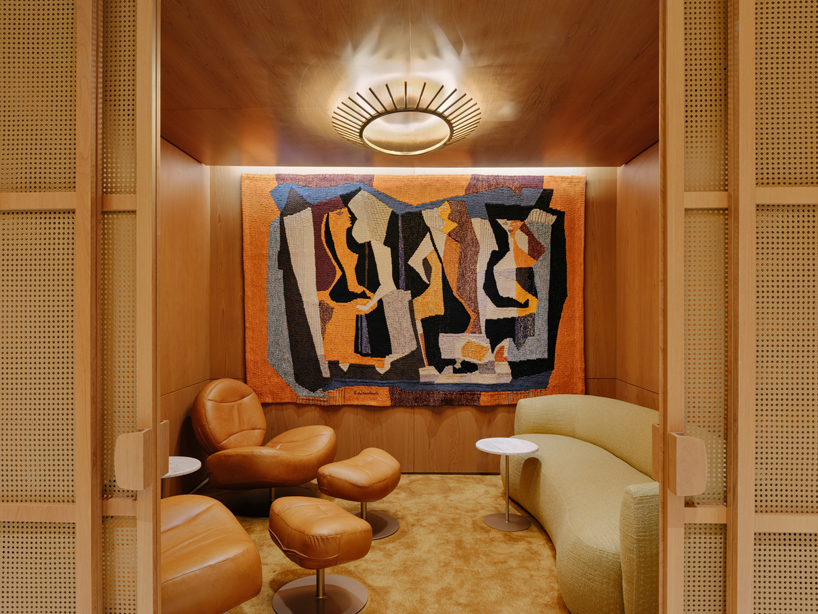
The lounge also displays "a curated selection of Brazilian modern and contemporary artworks," which designboom says are "embedded throughout the circulation path rather than isolated in gallery displays." Patterned works hang on wood-panelled walls and a large abstract tapestry adds texture. The works are part of the route through the lounge, so you see them on the way to your seat rather than in a separate gallery.
Food gets the same attention. Menus are by chef Luiz Filipe Souza, with wine pairings curated by sommelier Juliana Carani. Taken together, the lounge presents Brazil through materials, art and food before passengers leave the country.
Why it matters
Pedra Preta reflects a wider change in lounge design. As banks, credit-card issuers and airlines compete for frequent flyers, lounges have become brand showcases, and the strongest ones now look less like waiting rooms and more like boutique hotels or galleries. Bringing in a collectible-design studio to shape the most visible element, and drawing on a specific Amazon river instead of a generic "nature" theme, ties the space to its location in a way most airport interiors don't attempt.
It also shows that regional identity doesn't require kitsch. There are no toucans or tropical-print wallpaper here. The Amazon is represented as a form, the river's curve, and the rest of Brazil through stone from Espírito Santo, Brazilian art and the food on the menu.
The project also shows how much the brief has grown. A lounge was once judged on comfortable seating, reliable Wi-Fi and a decent coffee machine. Clients now expect acoustics, varied lighting, a range of moods for different travellers and a clear sense of place, all in a space where people stay perhaps two hours. Pairing an international architecture firm, which handles the planning, with a design studio that creates the memorable entrance is likely to become a common model.
What this means for you
If you travel through Guarulhos and hold Itaú Personnalité or Itaú Private relationships, this is worth arriving early for. Everyone else can still take away a few ideas. A curved, textured surface near an entrance does more to soften noise than a flat painted wall. Dividing one big room into smaller zones makes it feel calmer. Art placed along everyday routes gets more attention than art hung in a single feature spot. All three ideas work in a hallway at home as well as in a terminal.
The bottom line
In a building designed to move people through as quickly as possible, Pedra Preta encourages them to slow down. Its winding timber entrance, inspired by one of the Amazon's most twisting rivers, is a good example of how design can make a brief stopover feel memorable.
Published By | FASHION & DESIGN EDITOR