DESIGN
Kashef Chowdhury/URBANA's Friendship Centre in rural Bangladesh is the first winner of the $200,000 Ambasz-MoMA Annual Prize for nature-reconciled architecture, and half the money will plant a forest in Argentina.
The Museum of Modern Art has named its first winner of a prize designed to reward buildings that make peace with nature, and it went not to a glossy skyscraper or a celebrity-architect museum, but to a quiet, earth-roofed training centre in the farmlands of northern Bangladesh.
On Nov. 16, MoMA announced that Dhaka-based Kashef Chowdhury/URBANA has won the inaugural Ambasz-MoMA Annual Prize for the Friendship Centre in Gaibandha. Worth a total of $200,000, the award is described by MoMA as the largest for a single architectural project. Its structure is as unusual as its size: $100,000 goes to the architect, and the other $100,000 goes to a nonprofit that plants trees in honor of the building's client.
A Building That Expects the Water
Completed in 2011 and designed between 2008 and 2010, the Friendship Centre sits in a rural, agricultural area near the Jamuna River, on land prone to flooding and with weak soil. It was commissioned by Friendship, a Bangladeshi NGO, as a place for training and meetings.
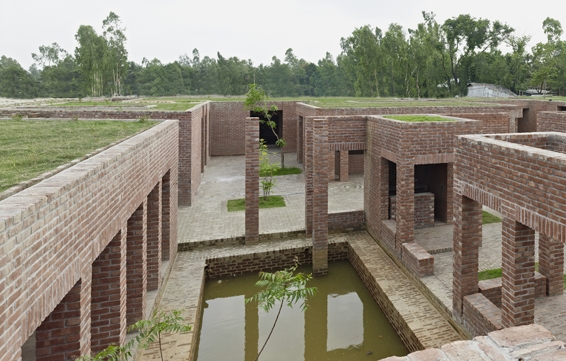
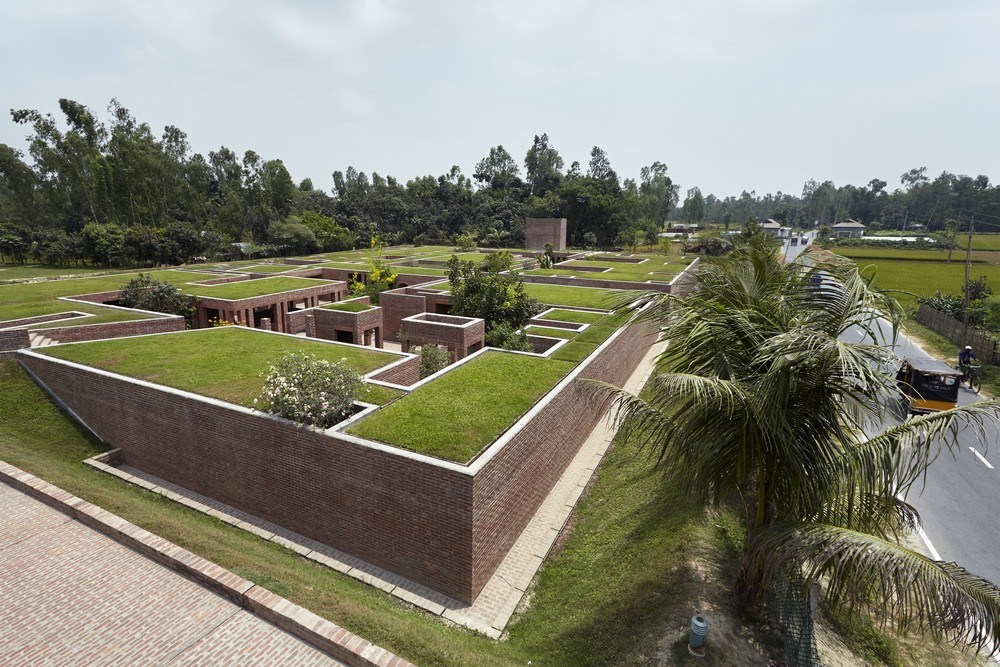
Rather than fighting the site, Chowdhury designed for it. According to the Aga Khan Development Network, the complex is protected by an embankment and a water run-off pumping system, with large rainwater tanks set between its two building blocks. Built mainly from local handmade bricks, with reinforced concrete, timber and stone, the centre stays cool through courtyards, pools and earth-covered green roofs, so that from a distance it reads less as a building than as a gently terraced landscape.
The programme is modest and practical. One block holds offices, a library, reception, four training classrooms, a prayer space and a small tea shop; the other contains dormitories, a dining pavilion and staff quarters. The centre can train 80 people at a time and is rented out for meetings to generate income. Its austere, introspective character was inspired by the ruins of Mahasthangarh, one of Bangladesh's earliest known urban archaeological sites, dating to the third century BC. The project previously received an Aga Khan Award for Architecture in the 2014-2016 cycle.
Trees in the Client's Name
The prize's second half is its most distinctive feature. Friendship, as the client, receives recognition rather than cash; the $100,000 instead goes to Fundación Gran Chaco in Formosa, Argentina, which will fund reforestation in the Gran Chaco forest in the NGO's honor. The idea is that every winning building should be answered by new growth somewhere else on the planet.
The award is funded by the Legacy Emilio Ambasz Foundation (LEAF) and organised by MoMA's Emilio Ambasz Institute for the Joint Study of the Built and the Natural Environment, founded in late 2020. Eligible projects must have been completed anywhere in the world within the past 30 years. The jury includes Martino Stierli, MoMA's Philip Johnson Chief Curator of Architecture and Design, curators from his department, the institute's director and two rotating external members.
The timing matters. Architecture's best-known honours, such as the Pritzker, typically celebrate a body of work by an individual. By focusing on a single built project, and by asking how that project relates to its ecosystem, the Ambasz-MoMA Prize puts the building itself, and its performance in the real world, at the centre of the conversation. Choosing a 15-year-old project also sends a message: the prize is interested in buildings that have proven themselves over time, not just renderings or freshly opened landmarks.
The Philosophy Behind the Prize
The Argentine architect Emilio Ambasz, long a pioneer of what he calls "green architecture," frames the award in moral terms. "Every building is an intrusion into the vegetal realm and a challenge to nature," he said. The prize, he argues, is "an ethical obligation: to demonstrate that another future is possible." On this year's selection, he called it "a choice of great significance," adding a line that could serve as the award's motto: "If an architectural work does not touch the heart, it is just another building."
Stierli called the award "one of the most generous in the field." It is also built to last. MoMA and LEAF announced a renewable ten-year agreement on April 23, 2026. The prize will be worth $200,000 a year for its first five years and rise to $250,000 a year for years six through ten. A companion Ambasz-MoMA Annual Lecture on "Architecture as Poetry" will begin in spring 2028 and run for nine years, and LEAF is funding two new full-time roles to run the programmes.

What This Means for You
For architecture lovers, the choice is a clear statement of values. Instead of rewarding novelty or scale, MoMA's first pick celebrates a building that uses local materials, passive cooling and a deep reading of its landscape to serve a community facing climate risk. Those are lessons that apply as much to a suburban house or a school renovation as to a training centre in Bangladesh: build with the climate, not against it.
For visitors to New York, MoMA plans a public ceremony each autumn with remarks from curators and winners, a chance to hear directly from the people shaping this conversation.
The Bottom Line
In choosing the Friendship Centre, MoMA has set the tone for a prize that could become one of architecture's most influential. It honours a building that is humble in materials, generous in spirit and fully prepared for the floods it knows will come, and it answers that building with a forest on another continent. As climate pressures reshape how and where we build, that pairing of architecture and ecology may be the most persuasive design idea of the year.
Published By | Features Editor