Written By | International News Agencies
The strike, carried out Sunday, Nov. 22, is the most dramatic sign yet that Libya's 15-year division has made it a staging ground for rival foreign powers
BENGHAZI, Libya
Ukrainian President Volodymyr Zelenskyy said Monday that Ukrainian naval drones sank the Russian corvette Merkury at the Benghazi naval base in eastern Libya, an attack roughly 2,400 kilometers from the front line in Ukraine that turned a Libyan port into a battlefield of the Russia-Ukraine war.
The strike, carried out Sunday, Nov. 22, is the most dramatic sign yet that Libya's 15-year division has made it a staging ground for rival foreign powers. Russia's military footprint runs through territory controlled by eastern commander Khalifa Haftar, while Libyan officials say Ukrainian drone specialists operate from bases in the west under the internationally recognized government in Tripoli. Both Libyan governments reacted with alarm, and the United Nations warned that the country "must not become a battleground for foreign conflicts."
What happened in Benghazi
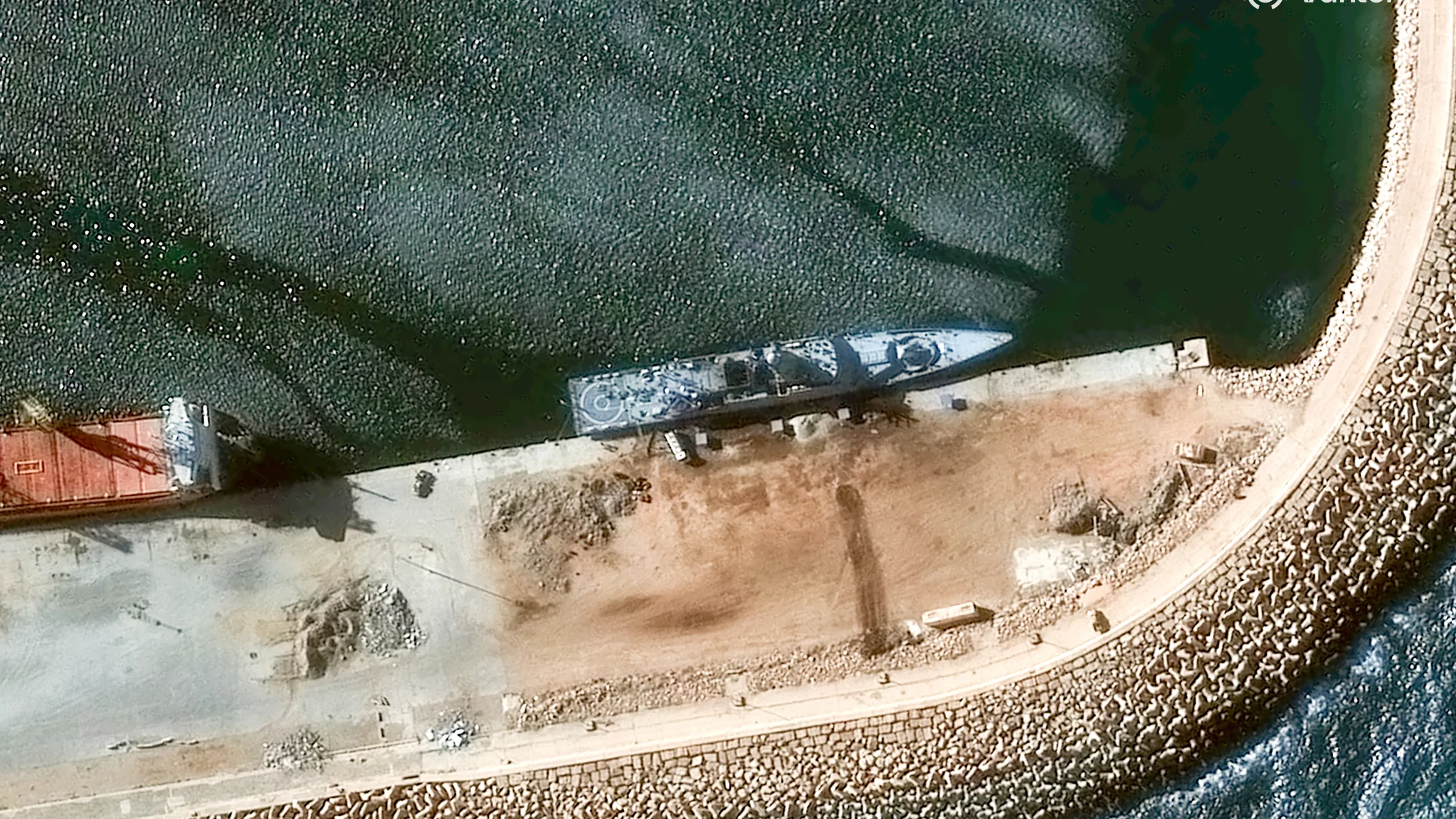
The Merkury, a Project 20380 Steregushchiy-class corvette commissioned in 2023, was docked at the Benghazi naval base when it was hit by several explosions, according to ABC News. Satellite imagery from Vantor showed the vessel capsized and largely submerged.
Zelenskyy confirmed Ukraine's responsibility in a post on X. "Our warriors deployed seven Ukrainian-made naval drones," he wrote. "Despite all the enemy's efforts to counter the attack, the Russian corvette Merkury was sunk." He called it "an exemplary Ukrainian operation" and added, "We continue our operations in designated waters."
The Security Service of Ukraine, or SBU, said it coordinated the operation with the military and described the seven unmanned boats as "launched from a 'mother ship'" near the target. It said Russian forces tried to intercept them with air, sea and land defenses. The SBU said the Merkury regularly escorted Russian naval convoys, including the dry cargo ship MV Angara, which it accused Moscow of using to move military equipment. "Both vessels were legitimate military targets for Ukraine, as they directly contributed to Russia's war capabilities," the agency said.
Zelenskyy said the Angara was also hit and that a Russian Ka-27 helicopter was destroyed. Neither claim has been independently confirmed.
Libyan accounts add detail but differ in parts. Two military officials affiliated with Haftar's self-styled Libyan National Army told The Associated Press that the drones were launched from a base run by Ukrainian forces in western Libya, that at least four were intercepted and destroyed, and that two struck the warship, severely damaging it and igniting a fire. The eastern authorities said the fire was later extinguished. A Libyan official told Middle East Eye that at least 10 people, including Libyan and Russian nationals, were wounded. Local outlet Almasar TV reported that at least 12 other sea drones were destroyed off the city and that a separate drone hit a commercial vessel off Benghazi that evening. Casualty figures and the number of drones that reached their targets have not been independently verified.
Moscow's muted response
The Kremlin did not confirm the sinking. "We have taken note of Zelenski's words on this matter," Kremlin spokesman Dmitry Peskov said Monday, referring questions to the Defense Ministry, which had not issued a statement by Monday afternoon.
The silence fits a pattern. Russia has rarely acknowledged naval losses in the Black Sea, where Ukrainian sea drones have struck the Black Sea Fleet repeatedly since 2022. The Benghazi attack shows that Ukraine can now reach Russian warships across the Mediterranean, an escalation the SBU framed as proof that Russia's navy and logistics have no safe routes beyond the Black Sea.
Two governments, two responses
Libya has been split since the 2011 NATO-backed uprising that toppled Muammar Gaddafi. The internationally recognized Government of National Unity, led by Prime Minister Abdul Hamid Dbeibah, sits in Tripoli. A rival Government of National Stability, led by Osama Hammad and backed by Haftar's forces, governs from Benghazi and controls the east and much of the south.
The eastern government said the Merkury had docked to refuel and resupply on its way back to Russia under a cooperation agreement between Moscow and the Benghazi administration. It said it had opened a joint investigation with Russia "to uncover the circumstances of the attack, its source, and the party behind it," and condemned the strike as a violation of Libyan sovereignty. Hammad asked for an international investigation through the U.N. General Assembly and Security Council, including into whether the drones were launched from western Libya and whether Ukrainian specialists were involved.
That request carries an accusation aimed at Tripoli. The Tripoli government, for its part, expressed concern about "dragging Libyan ports and civilian facilities into external conflicts." "The government reaffirms its categorical rejection of turning Libya into an arena for international conflicts," it said, according to the AP.
The U.N. Support Mission in Libya expressed "serious concern" about the attacks at Benghazi port and off the city's coast. "Libya cannot afford, and must not become a battleground for foreign conflicts," the mission said, calling for an "immediate, independent and transparent investigation" and urging all parties to show restraint.
Russia's Libyan footprint
The Merkury's presence in Benghazi was no accident. Haftar's forces have maintained close ties with Moscow for years, and Russia has expanded its presence in eastern and southern Libya since the fall of Syrian President Bashar al-Assad in December 2024 disrupted its Mediterranean logistics.
An August report by ADF magazine, drawing on the U.S. National Geospatial-Intelligence Agency's Tearline Project, described Russia as planning, funding, building and staffing infrastructure at six Libyan bases. They include Al-Khadim, about 100 kilometers east of Benghazi, which has reportedly served as an arms-supply hub including for deliveries to Sudan's Rapid Support Forces; Al-Jufra, used by Russian paramilitary forces since 2019; and Maaten al-Sarra near the Chad and Sudan borders, which Russia reactivated in December 2024. At Brak al-Shati, Tearline reported, the number of Russian personnel rose from 300 to 450 after December 2024. Russia also reportedly plans to invest in Tobruk's port and air base. Many of those details come from satellite and open-source analysis, and several are hedged.
Russia uses that network as a corridor to its operations in the Sahel and Central Africa through the Africa Corps, the Defense Ministry-controlled successor to the Wagner Group. An attack on a Russian warship in a Haftar-controlled port strikes at the logic of that partnership: that Haftar's territory offers Moscow a secure southern flank.
Ukraine's western Libyan connection
Sunday's strike was not the first time Libya has been linked to Ukrainian operations. On March 3, the Russian-flagged LNG carrier Arctic Metagaz, carrying 61,000 tons of liquefied natural gas, was damaged in a suspected sea drone attack near Maltese waters; all 30 crew members were rescued, the AP reported. Two Libyan officials later told the AP that Ukrainian forces, mostly drone experts, operate in western Libya, mainly at an air base in Misrata and also at facilities in Tripoli and Zawiya, and one said the tanker strike was launched from a military facility in Tripoli. The officials described the deployment as part of a "covert deal" between Kyiv and Dbeibah's government that Western countries, including the United States, reportedly backed. Kyiv did not publicly claim the tanker attack, and the Tripoli government did not respond to requests for comment at the time.
If the eastern government's investigation concludes the Benghazi drones came from western Libya, the episode could inflame relations between Libya's two camps at a delicate moment. U.S. adviser Massad Boulos has reportedly drafted a power-sharing proposal that would keep Dbeibah as prime minister and name Haftar's son Saddam head of the Presidential Council, according to the AP.
Analysis: a proxy fault line hardens
The attack lays bare a reality Libyan politicians rarely acknowledge in public: the country's east-west divide now overlaps with the Russia-Ukraine war. Eastern Libya hosts Russian warships and military infrastructure, while the west is reported to host Ukrainian drone teams. Each Libyan government has an incentive to blame the other for inviting foreign fighters, and both have done so implicitly in their statements.
Three risks stand out. The first is retaliation. Russia has not said how it will respond, but a strike on Ukrainian assets in western Libya, if any are confirmed there, would bring the war onto Libyan soil in a more direct way. The second is damage to the U.N.-led political process, which depends on a minimum of trust between Tripoli and Benghazi and on foreign powers reducing, not expanding, their military presence. The third is economic: attacks on ports and a commercial vessel off Benghazi raise questions about the security of shipping in a country whose economy depends on hydrocarbon exports through its coastal terminals.
There is also a diplomatic test for Haftar. His partnership with Moscow has brought him weapons and leverage, but it has also made his territory a target. The eastern government's quick pivot to the United Nations suggests it wants international backing against Tripoli rather than a confrontation it cannot control.
What to watch
Key questions in the coming days include whether Russia's Defense Ministry confirms the loss of the Merkury and casualty figures; whether the U.N. Security Council takes up Hammad's request for an inquiry; whether Tripoli responds directly to the allegation that Ukrainian forces operate from western Libya; and whether Russia adjusts its naval movements through Libyan ports. The fate of the Boulos power-sharing proposal will show whether Washington's push for a unified Libyan executive can survive a crisis that pits the country's rival patrons against each other.