The U.S. defense secretary's surprise visit to Venezuela produced an agreement on training and intelligence sharing with Delcy Rodríguez's interim government, deepening a relationship built on oil and security while the country still has no election date.
World Politics
A Surprise Visit and a New Accord
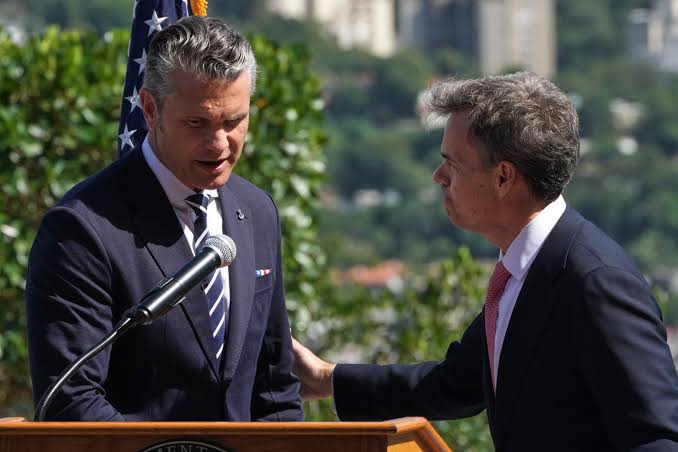
U.S. Defense Secretary Pete Hegseth flew into Caracas on Wednesday, November 18, and announced that the United States and Venezuela had signed an agreement to re-establish military ties. It was his first visit to the country since American special forces captured President Nicolás Maduro in a January raid, and the latest in a string of trips by senior Trump administration officials to a capital that, less than a year ago, Washington treated as a hostile regime.
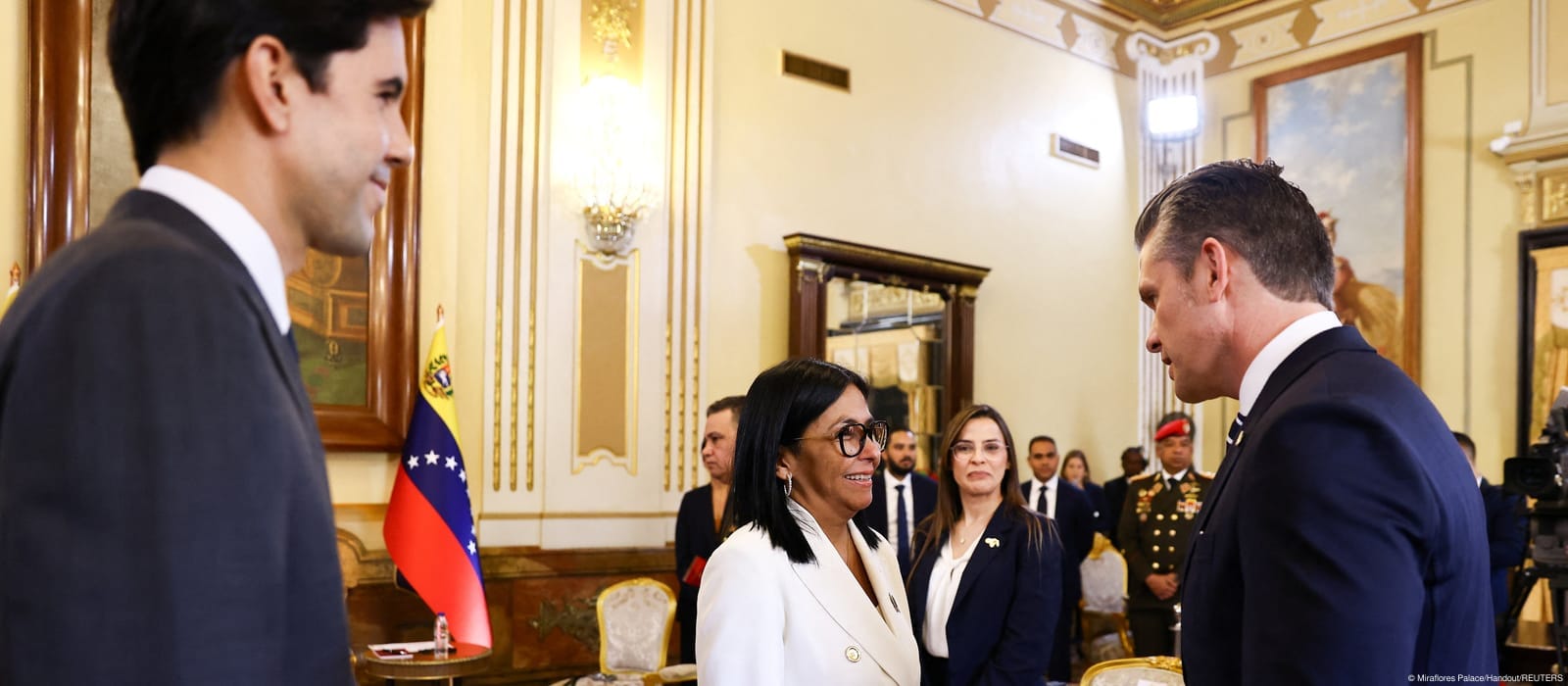
The trip was not announced in advance. Air & Space Forces Magazine, which confirmed it through flight tracking and sources, reported that Hegseth flew from Miami aboard an Air Force C-32 after visiting U.S. Southern Command, brought no travelling press, and was scheduled to continue to Colombia and other countries in the region. In Caracas he met the country's interim leadership, headed by acting President Delcy Rodríguez, and spoke to diplomats and military officers from both countries at the U.S. embassy.
Details of the accord are sparse. The Associated Press reported that it covers joint training and intelligence sharing; the Pentagon released no text and offered no further specifics. Hegseth described the partnership in broad strokes as "training together, partnering together, sharing intelligence, more defense equipment and capabilities together," and said it would allow America "to cooperate with the Venezuelan government and Venezuelan military." He added that Venezuela would work with the United States to recover territory from drug-trafficking networks, which the administration labels "narco-terrorists."
Rodríguez, standing alongside him, said she hoped cooperation could be raised "to its highest possible level" to confront "common threats," and that the accord would help her armed forces gain training and "new military technologies." None of the reports reviewed for this article identified which Venezuelan military commanders, if any, signed the document.

Background: From Absolute Resolve to Partnership
The agreement caps a remarkable reversal. On January 3, in what the Pentagon called Operation Absolute Resolve, U.S. forces seized Maduro and his wife, Cilia Flores, and flew them to New York, where they face drug-trafficking charges in federal court. Rodríguez, Maduro's vice president and a longtime ally, assumed the presidency on an interim basis and has since steered Venezuela into an unlikely working relationship with Washington, freeing batches of political prisoners after U.S.-backed talks and opening the oil sector to American-linked investors.
Hegseth used his speech to celebrate the raid. According to PBS NewsHour's account of the AP report, he called it the most sophisticated military operation in Latin American history, said it lasted just 48 minutes, and claimed it had solved a 27-year problem for the hemisphere within hours, a reference to the quarter-century of chavista rule that began in 1999. He also turned Maduro's own slogan back on him, saying the result was peace without war.
Accounts of one of his central lines differ slightly. Air & Space Forces Magazine quoted Hegseth as saying Venezuela "has gone from our most aggressive regional threat to a compliant security partner." The AP's version, carried by PBS and ABC affiliates, described him as saying the country had become a "cooperative" security partner. The distinction matters for how the relationship is perceived in Latin America, where the notion of a "compliant" partner evokes a long history of U.S. dominance; until a transcript is released, the exact wording should be treated as uncertain.
The military pact rests on an economic foundation laid in August, when Trump announced a sweeping oil arrangement negotiated by Rubio and Hegseth. According to the Jerusalem Post, the deal gave North American Blue Energy Partners (NABEP), now Venezuela's second-largest oil operator, long-term access to 17 oilfields holding roughly a fifth of the country's reserves, while the U.S. government secured a 35 percent stake in NABEP's parent company, a guaranteed share of output and a right of first refusal on the rest. NABEP's owner, businessman Alejandro Betancourt, was seen at both the presidential palace and the U.S. embassy on Wednesday and attended Hegseth's speech. He said he had discussed oil cooperation with the defense secretary and that NABEP aims to produce more than 250,000 barrels per day by year-end, up from about 224,000 in mid-October.
Hormuz and the Hemisphere
Hegseth tied the visit directly to the war with Iran. With the Strait of Hormuz largely shut and global fuel prices elevated, he argued that the Venezuelan oil arrangement "makes the Strait of Hormuz a non-factor for the Western Hemisphere." Rodríguez echoed the economic framing, saying the energy deal supports development in both countries and benefits both peoples.
Industry realities temper that claim. Venezuela sits on the world's largest proven crude reserves, but its oil infrastructure has been badly neglected after years of mismanagement and sanctions, and Air & Space Forces Magazine noted that restoring production will take years. Output of a quarter of a million barrels a day from NABEP's fields is significant for Venezuela but modest against the volumes normally moving through Hormuz.
The visit also fits the administration's broader strategic shift. The Pentagon's National Defense Strategy places Western Hemisphere security at the top of its priorities, and the military's footprint in the region has grown sharply. Since September 2025, U.S. forces have struck boats in the Caribbean and eastern Pacific that officials say were smuggling drugs; at least 240 people have been killed, according to the AP, while officials have released little public evidence to support their claims. Hegseth is the latest in a line of senior visitors to Caracas this year, following Energy Secretary Chris Wright, Interior Secretary Doug Burgum, Joint Chiefs Chairman Gen. Dan Caine in June, and Southern Command chief Gen. Francis Donovan, with discussions focused on oil, critical minerals and security. In Colombia, the next stop, the defense minister said Hegseth would hand over a Lockheed Martin C-130 aircraft and discuss U.S. support against drug-trafficking groups.
The Democratic Deficit
What the agreement does not address is Venezuela's political future. Rodríguez's court-approved interim term expired in July, but she continues to serve as head of state, and no date has been set for a new presidential election. At the United Nations in September she promised that "there will be elections," without naming a date. Opposition leader María Corina Machado returned to the country in October after roughly ten months in exile and several failed attempts that her supporters blamed on the government; Secretary of State Marco Rubio credited U.S.-backed reconciliation talks for her return, talks in which her movement has not been a central participant.
The AP reported that many Venezuelans are relieved Maduro is gone but believe Washington's decision to prioritise the oil industry over democratic reforms was a mistake. A formal military partnership with an unelected interim government sharpens that criticism: it binds U.S. training and intelligence to security forces that, until January, were the backbone of Maduro's rule, and it gives Rodríguez a powerful external patron at a time when the opposition is pressing for an election by July 2027. Democrats in Congress have previously criticised the oil arrangement as opaque and as propping up an unelected government, and the new defense accord is likely to draw similar scrutiny when Democrats take control of both chambers in January.
There is also a geopolitical dimension. Under Chávez and Maduro, Venezuela built its armed forces largely around Russian equipment and cultivated close security ties with Moscow and Havana. A U.S. partnership that promises "more defense equipment and capabilities" points toward a gradual reorientation of the Venezuelan military away from those patrons, although none of the reports on Wednesday's signing addressed what happens to existing arrangements with Russia, China or Cuba.
Reactions and Open Questions
Public reaction on the day was limited, in part because so little of the agreement has been disclosed. NABEP did not immediately respond to requests for comment, according to the Jerusalem Post, and the Pentagon declined to elaborate on the accord's terms. The absence of detail leaves basic questions unanswered: whether U.S. personnel will be stationed in Venezuela, whether intelligence sharing extends to domestic political surveillance, which units will receive training, and whether any human-rights conditions are attached.
Hegseth himself arrives in Caracas with his own political vulnerabilities at home. Earlier this month the House voted 211-204 to refer articles of impeachment against him, over the Iran war and the boat strikes, to the Judiciary Committee, effectively shelving them for this Congress. A new Democratic majority could revisit both his conduct and the legal basis for the Caribbean strikes.
What's Next
In the coming weeks, the first indications of how the partnership works in practice will likely come from joint counter-narcotics operations or training deployments, and from whether the Pentagon publishes the agreement's text. In New York, Maduro's legal fight continues: his lawyers have argued that he is immune from prosecution as a head of state, a claim legal experts give long odds given Washington's refusal to recognise him since 2019, and his trial has been set for June 2027.
For Venezuela, the larger question is whether deepening military and economic integration with the United States will be paired with a credible path to elections. The administration's bet is that stability, oil and security cooperation come first and democracy can follow. Critics, including many in the Venezuelan opposition, fear the reverse: that each new deal entrenches an interim government with little incentive to submit itself to voters. Hegseth's visit signals that, for now, Washington is comfortable with the former approach, and that the post-Maduro relationship is becoming a strategic alliance as much as an oil partnership.
Published By | News Editor