Written By | Fashion and Design Desk
Australia's best-known suiting brand has opened its first store outside its home market, a two-floor flagship on London's most storied menswear street.
FASHION | MENSWEAR
LONDON
For more than three hundred years, Jermyn Street has been where British gentlemen came for their shirts, shoes and sense of propriety. This month it has a new neighbour with an unmistakably Australian accent. M.J. Bale, the Sydney menswear label founded by Matt Jensen in 2009, has opened its first store outside Australia, a flagship at 48-50 Jermyn Street in St James's.
It is a significant step for a brand that has built more than 80 stores at home but, until now, had no physical presence anywhere else. And it is a deliberate one. In an interview with FashionUnited published this week, Jensen made clear he sees London not as a beachhead for rapid expansion but as a statement of values.
"To open on Jermyn Street is a significant milestone for M.J. Bale - and one we don't take lightly," Jensen said when the move was first announced. "This street has upheld the highest standards in menswear for over three centuries."
A club with the doors thrown open
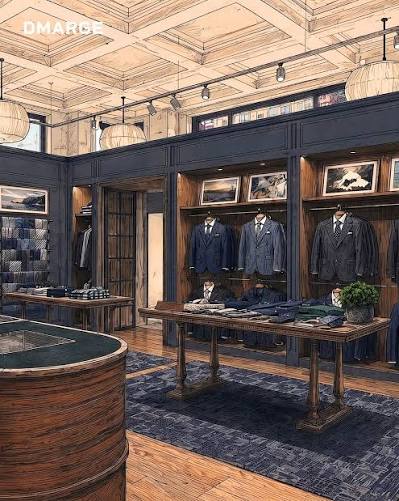
The store occupies a prominent corner of the newly developed 30 Duke Street St James's building, spanning 2,636 square feet across two floors with six-metre ceilings. It was designed by Sydney-based Mandy Edge of Edge Design Studio, and the materials read like a tour of the British Isles: reclaimed Cheshire timber underfoot, limestone from the Dorset coast, handcrafted hardware from North Devon and awnings made in Greenwich. In a detail that will delight tailoring obsessives, the curtains are cut from the same cloth as the suits.
Jensen told FashionUnited the team wanted "warmth, character and a sense of permanence, rather than a conventional retail fit-out." His ambition is for the space to feel like a club with the doors thrown open: somewhere a customer might happily spend an hour, whether or not he buys anything.
On Jermyn Street, that is not a small promise. The neighbours are heritage shirtmakers and bootmakers with centuries of history. Jensen, who worked in London's financial markets in the 1990s, called the choice of city a very personal one, and said that for menswear, Jermyn Street ranks above anywhere else after Savile Row.
Wool as a founding story
What M.J. Bale brings to St James's is a provenance story it believes few rivals can match. Jensen grew up in a wool-growing family in New South Wales. "I grew up on a sheep farm, so Merino wool and the families that produce it were part of my world long before I entered menswear," he told FashionUnited.
That background shapes the supply chain. According to Ragtrader, the brand's wool is traceable to 29 named farms across Australia and New Zealand, and a closed-loop store-to-farm rebate has returned more than $600,000 to farm conservation programmes. Its Kingston tailoring, made in Japan from single-source Tasmanian wool, is produced in partnership with farmer Simon Cameron, with a share of every Kingston sale going back to his farm for conservation work.
The brand has also explored how a seaweed supplement could reduce the methane produced by sheep, a nod to one of the wool industry's thorniest environmental questions. And its reach extends well beyond Australia: lambswool spun at Loch Leven and knitted in Hawick, Made in Italy jackets, shirts, knitwear and denim, and a ski range developed with JAAM Italia using wool from Lake Hāwea Station in New Zealand's Southern Alps.
"We come here with a provenance story that is distinctly Australian," Jensen said, pointing to the company's commitment to natural fibres, regenerative farming and craft. The brand describes its philosophy as making "garments of integrity." In his words to FashionUnited: "We believe quality, provenance, and commercial success should not be competing ideas."
Dressing for a British winter
The London store carries the full range: tailoring, knitwear, outerwear and casualwear, with hero pieces including the Kingston suits, flannel suiting, Scottish-made sweaters and Merino-based performance pieces. Jensen said the merchandising has been adapted for the UK customer and the country's ever-changing climate, which, in late November, is no small consideration. Ski jackets feature an outer shell of pure Merino grown on a B Corp-certified farm in New Zealand. Pricing for the London store has not been detailed in the coverage reviewed for this article.
What this means for you
For British shoppers, M.J. Bale's arrival adds a new name to a street dominated by long-established houses, and a slightly different proposition: modern, wearable tailoring with an unusually transparent story about where the fibre came from. For Australians living in London, it is a familiar label within walking distance of Piccadilly.
More broadly, the opening is a sign of where premium menswear is heading. Traceability, regenerative farming and natural fibres are no longer niche talking points; they are becoming the price of entry for brands that want to command full-price loyalty. If you are investing in a winter suit or coat this season, it is worth asking any retailer the questions M.J. Bale is now answering on its shop floor: where the wool comes from, who grew it, and what happens to the land.
Not growth at any cost
Will Jermyn Street be the first of many? Jensen is open to it, but in no hurry. "I certainly see potential beyond London, including opportunities across the UK and, in time, Europe," he said, adding: "we won't rush that." First, he told FashionUnited, the brand must get the right product, people and partners in place. He framed the flagship as the beginning of a new chapter rather than a declaration of growth at any cost.
In a fashion economy that often rewards speed, that patience may be M.J. Bale's sharpest selling point. On a street that has measured itself in centuries, a brand that thinks in seasons of wool rather than quarters of sales may fit in rather well.