Written By | Health News Agencies
Health watchdog's verdict lands as cases top 5,400, infants die in three states and doctors warn the nation has "failed our populace"
WASHINGTON, D.C.
It took a quarter of a century to win, and barely two years to lose. The United States has reportedly been stripped of the measles-elimination status it has proudly held since 2000, a stunning public health reversal that confirms what doctors on the front lines have feared for months: measles is no longer a disease that visits America from overseas. It now lives here.
The bombshell determination, first reported on Friday, November 13, by The Wall Street Journal and separately by KFF Health News, citing people with direct knowledge of the deliberations, came out of a closed-door review by an independent verification commission of the Pan American Health Organization (PAHO). The panel met in Washington, D.C., from November 10 to 13. PAHO had planned to make the decision public on Tuesday, November 17.
The verdict means that a single chain of measles transmission has kept spreading, unbroken, inside the country for at least 12 months. That is the official line that separates a country where measles has been "eliminated" from one where it is "endemic," and America has now crossed it.
"It's really a slap in our face to say that we have failed our populace," Dr. Paul Offit, the vaccine expert at Children's Hospital of Philadelphia, said ahead of the decision. The virus, he warned, "has gained a foothold" in the United States.
The Numbers Are Staggering
To understand how fast things have unraveled, look at the figures. As of November 12, the Centers for Disease Control and Prevention had logged 5,412 confirmed measles cases in 2026. That is more than double the 2,289 cases recorded in all of 2025, which was itself the worst year in decades. Cases have been reported by 47 jurisdictions, and 2026 is now the worst year for measles in the U.S. since 1991.
This is not a scattering of isolated infections. According to the CDC, 96 percent of this year's cases, 5,216 of them, have been tied to outbreaks. The country has seen 43 brand-new outbreaks this year alone, on top of 48 last year. Since January 2025, the nation has counted nearly 7,500 cases.
And the virus has been deadly. Since early 2025, state and federal officials have reported 11 measles deaths. Three came in the 2025 Texas and New Mexico outbreak, one adult and two school-aged children, which were the first U.S. measles deaths since 2015. In 2026, the toll has fallen hardest on the smallest and most vulnerable.
Babies Paying the Price
In August, Pennsylvania announced its first measles deaths in 35 years: two unvaccinated infants. Four more Pennsylvanians died in the weeks that followed, bringing that state's toll to six.
On November 2, New York reported its first measles death in three decades, an unvaccinated seven-month-old in rural northern New York.
Then, on November 5, Wisconsin health officials announced that an infant in the southwestern part of the state had died, the state's first measles death in 36 years. The coroner listed the immediate cause of death simply as measles.
Babies under 12 months are too young for their first routine dose of the measles, mumps and rubella (MMR) vaccine. They rely entirely on the people around them being immune. When enough people are not, the youngest children are the first to be caught in the crossfire.
"Infants too young to be vaccinated and people with weakened immune systems are paying for gaps in community immunity," New York City emergency physician Dr. Stephanie Widmer told Fox News, calling the loss of elimination status a "public health setback."
How America Lost Its Shield
The trail of this disaster leads back to West Texas. On January 20, 2025, an outbreak erupted in a largely under-vaccinated community in West Texas. It swelled to 762 cases and 99 hospitalizations before officials declared it over about seven months later, at an estimated cost of roughly $12.6 million, according to an unpublished study cited by KFF Health News. But by then, the virus had already slipped out into other parts of Texas and the wider country.
In June 2025, an outbreak began on the Utah and Arizona border. It never really stopped. Scientists sequencing measles genomes, each about 16,000 genetic "letters" long, have been tracing the virus as it moves. A ProPublica analysis of more than 1,800 whole-genome sequences followed mutations from the earliest Texas cases through Utah and into at least four other states. The Utah strain differs from the original Texas virus by just 12 letters out of nearly 16,000.
In other words, the same viral family tree kept growing branch after branch across state lines for well over a year.
Noel Brewer, who chairs an independent U.S. measles advisory panel, said the Arizona-Utah outbreak, which began in June 2025 and is still going, likely meets the 12-month criterion on its own.
The review was originally expected in April 2026 but was pushed back to November. Writing in a CIDRAP opinion piece, public health scientist Jess Steier argued the delay changed nothing about the facts: "a year of nearly identical sequences across multiple states says it did not," she wrote, referring to the idea that transmission was ever interrupted.
Not Alone, But Not Comforting
America is not the only country in the region to lose its badge. Canada lost its measles-elimination status in November 2025. Canada, Spain and the United Kingdom have all recently lost their status following World Health Organization reviews. Mexico and Bolivia were also on PAHO's watch list this year because of prolonged outbreaks.
The U.S. has withdrawn from the WHO but remains a member of PAHO, which reviewed reports from all 35 member states in the Americas. PAHO Director Jarbas Barbosa is responsible for the final decision.
Losing elimination status triggers no formal penalty, no sanctions and no travel bans. But public health experts say its symbolic weight is enormous.
Demetre Daskalakis, the former director of the CDC's immunization center who resigned in protest in August 2025, put it bluntly: measles is "the great indicator of where the cracks are in our foundation."
The Vaccine Gap Behind the Crisis
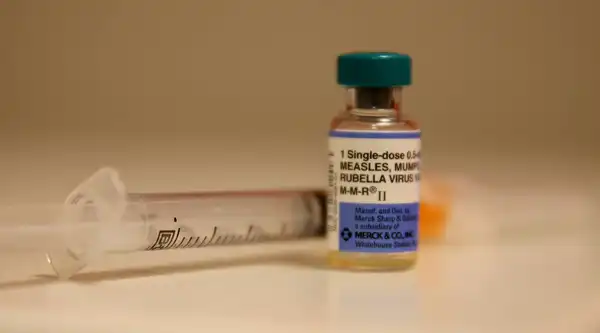
The vaccine has not stopped working. Doctors want to make that crystal clear. Two doses of MMR are about 97 percent effective at preventing measles. During the 2025 outbreaks, only about 4 percent of confirmed cases were in people who had received two doses.
The problem is that fewer children are getting those doses. Kindergarten MMR coverage has slid from 95.2 percent in the 2019-2020 school year to 92.4 percent in 2025-2026, below the 95 percent threshold experts say is needed to stop outbreaks. That leaves roughly 280,000 kindergartners at risk.
Measles is among the most contagious diseases known. The CDC says it will infect up to nine in ten unprotected people who are close to an infected person, and the virus can linger in the air for up to two hours after a sick person has left the room. Even a small dip in coverage gives it room to run.
"It's shocking that people aren't getting vaccinated," said Dr. Aaron Glatt of Mount Sinai South Nassau, warning that the country is "going in the very wrong direction" on MMR coverage.
A Political Firestorm
The decision lands in the middle of a fierce fight over vaccine policy under Health Secretary Robert F. Kennedy Jr.
Many public health experts say changes to childhood immunization policy under Kennedy have fueled vaccine hesitancy and contributed to the highest U.S. infection rate in more than three decades. Kennedy fired the experts on the CDC's vaccine advisory committee in 2025 and has repeatedly questioned vaccine safety. KFF Health News investigations have reported that the administration slowed CDC communication with Texas officials and delayed federal emergency funds during the 2025 outbreak.
Federal officials push back. The Department of Health and Human Services says national vaccination rates were falling before Kennedy took office, and HHS spokesperson Emily Hilliard has attributed vaccination gaps to COVID-era disruptions. HHS says the CDC has committed about $100 million in extra funding and deployed experts to help states, and that its leaders continue to recommend MMR vaccination.
CDC Director Dr. Erica Schwartz said the agency is working closely with states, focusing on communities where immunization rates have been low for decades. If the status is lost, she said, "we're going to be doing the same exact thing that we've been doing today," adding that "the number one way to prevent measles is the MMR" vaccine.
Expert Perspective
The American Academy of Family Physicians said the loss signals continuous spread and that too many people remain unprotected. The group called for restoring confidence in vaccine safety and efficacy, and for an organized, sustained response: more support for state and local health departments, faster surveillance and communication, clearer information for families, and easier access to vaccines.
Fox News senior medical analyst Dr. Marc Siegel said the change reflects measles spreading at home, not just being imported by travelers, and urged authorities to send "vaccine trucks and clinics" into the areas where vaccine refusal is most concentrated.
There is one sliver of hope. "The status is reclaimable," Steier wrote. Countries can win elimination back by stopping endemic transmission for at least 12 months, backed by strong surveillance. It has been done before. It will take high vaccination rates, fast outbreak response and public trust to do it again.
What This Means for You
For most families, the practical message is simple: check your records. The CDC recommends two doses of MMR for children, the first at 12 to 15 months and the second at 4 to 6 years. Most adults who lack evidence of immunity need at least one dose, and certain higher-risk adults, such as healthcare workers, international travelers and college students, may need two. If you were born before 1957, you are generally presumed to be immune, but ask your doctor if you are unsure.
If you are planning travel, especially with a baby, talk to your pediatrician. Infants aged 6 to 11 months can receive an early dose before international travel, and doctors may consider it during local outbreaks.
Know the warning signs: high fever, cough, runny nose and red, watery eyes, followed a few days later by a rash that starts on the face and spreads down the body. If you suspect measles, call your doctor or emergency department before you arrive, so staff can keep you from exposing others in the waiting room.
And remember who is most at risk: babies, pregnant women and people with weakened immune systems. Measles can cause pneumonia, brain swelling, permanent neurological damage and death.
The Bottom Line
For 26 years, measles was a disease most American parents only read about in history books. That era appears to be over.
The official announcement from PAHO is expected on Tuesday. But the numbers already tell the story: more than 5,400 cases this year, 11 deaths since early 2025, and babies in Pennsylvania, New York and Wisconsin who did not live to see their first birthdays.
The vaccine that defeated measles once is still sitting on pharmacy shelves, still 97 percent effective. Whether America wins its badge back now depends on whether enough people roll up their sleeves.