Written By | Sports News Agencies
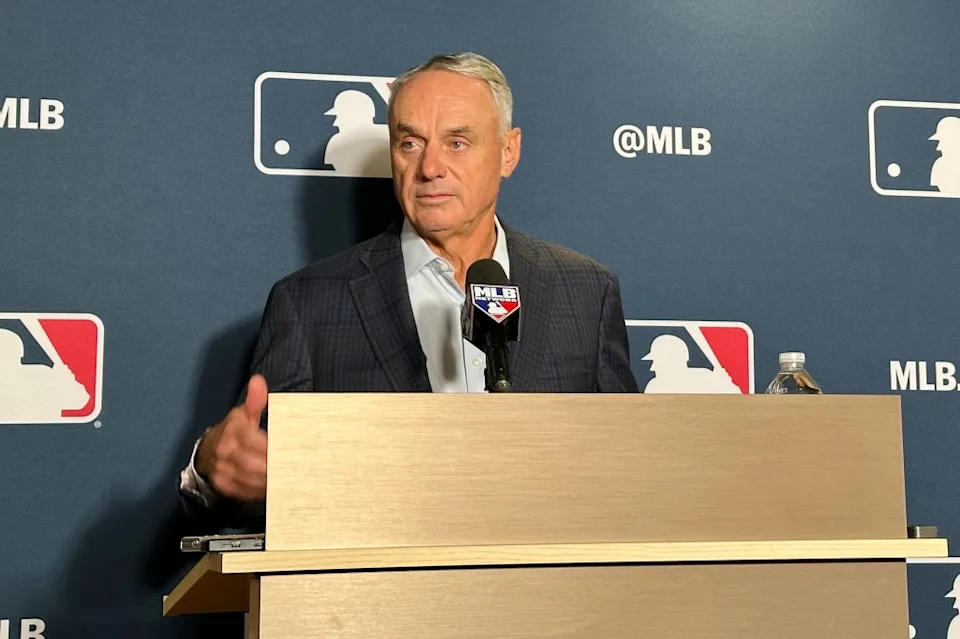
With the collective bargaining agreement set to expire on December 1, MLB's commissioner left the owners' meetings with what amounts to an ultimatum, and the union fired straight back
SPORTS
NEW YORK
Baseball had a remarkable October. Milwaukee won its first World Series, small markets got their moment, and the sport's on-field reforms kept winning fans over. Then, on Wednesday afternoon at Major League Baseball's Manhattan headquarters, Commissioner Rob Manfred reminded everyone that the hardest contest of the year is still to come, and that it will be fought in conference rooms instead of ballparks.
Closing the owners' quarterly meetings on November 18, Manfred made the league's position as plain as he ever has. "I can't imagine the owners ratifying a deal that does not include a cap and floor," he told reporters, according to the Boston Globe. Asked how firmly the clubs held that view, he answered in two words: "It's serious."
An ultimatum, thirteen days out
The timing is what makes the remarks matter. The current five-year collective bargaining agreement, reached in March 2022 after a 99-day lockout, expires on December 1. Once it lapses, management is widely expected to lock players out, freezing free-agent signings and trades in the middle of what is normally the sport's busiest shopping season. The Globe described a lockout in less than two weeks as something that "looks like a lock," although Manfred said owners have not yet formally authorized one and that he hoped talks would continue until the last moment.
Manfred called the players' proposals to date untenable, arguing that they "actually exacerbate our competitive problems." He described the union's refusal to engage on a cap and floor as a refusal to bargain, urged the players to "move to the middle," and said the league's "overriding objective" was a deal that preserves an uninterrupted 162-game schedule. He also said the league would keep up its public information campaign and would bargain "whenever and wherever," Thanksgiving included.
He leaned on public opinion as well. "We are not prepared to tell 70 percent of our fans that they're wrong," he said, referring to the league's polling on a cap. Over the summer, Manfred cited a November 2025 Morning Consult survey of 2,202 people in which 59 percent of all respondents and 79 percent of avid fans backed a cap to some degree, CBS Sports reported.
The union's response: "Lack of seriousness"
The Major League Baseball Players Association answered within hours. Interim executive director Bruce Meyer said in a statement that the league's stance reflected a "lack of seriousness," and accused owners of seeking to "make more money in profits and franchise values by artificially suppressing player salaries."
The two sides do not even agree on the basic arithmetic. The league wants a 50-50 split of revenue between owners and players, roughly the model used in the NFL, NBA and NHL. Meyer has estimated that players currently receive 55 to 56 percent of revenue; Manfred puts the figure below 50 percent. MLB executive Morgan Sword walked owners through a 46-page economics presentation this week, and the league released a five-minute promotional video for its proposals the week before.
The proposal itself is a historic departure. MLB's opening offer last spring was its first salary cap proposal since 1994: a spending limit of $245.3 million for 2027, measured on luxury-tax payrolls, and a payroll floor of $171.2 million that would force some low-spending clubs to spend more, the Associated Press reported. Players, for their part, have asked for expanded free agency and salary arbitration, a near-doubling of the major league minimum salary and more revenue sharing, and have vowed to fight a cap "as long as it takes."
Why the owners say the luxury tax failed
Manfred's argument rests on the claim that the competitive balance tax, in place since 2003, simply hasn't worked. "Sometimes you got to admit you failed," he said in June. The numbers he points to are striking: total tax payments rose from $78.5 million in 2022 to $222.8 million in 2023, $311.3 million in 2024 and $402.6 million in 2025. A record nine clubs paid the tax in both 2024 and 2025, and the Los Angeles Dodgers were hit with a $169.4 million bill on their own. The Dodgers opened 2026 with a payroll of $415.2 million, and in July Manfred noted that the gap between baseball's highest and lowest payrolls had reached $441 million.
Critics, including the union, counter that the sport is thriving. Attendance this summer was on pace for its best total since 2017, revenue is still rising, and new national broadcast deals arrive in 2028. Meyer has called the league's effort to persuade fans the product is broken "perverse," and has said that if owners want to argue hardship, they should open their books.
The ghost of 1994
Every conversation about a cap in baseball eventually comes back to 1994, the last time owners pushed for one. That fight produced a strike of roughly seven and a half months and the cancellation of the World Series. Manfred was a junior lawyer on the owners' bargaining team then. Asked in June whether he feared a repeat, he said, "Of course I do," while declining to speculate about stoppages. Baseball has had nine work stoppages since 1972, but it has not lost regular-season games to labor strife since 1995. There is a legacy question too. Manfred has said he will step down when his term ends in January 2029. The pitch clock and the automated ball-strike challenge system have been popular successes, and losing part or all of the 2027 season would overshadow them, as CBS Sports has noted.
What this means for you
For fans, the immediate impact is the hot stove. If a lockout begins on December 2, the free-agent market and the trade market would stop overnight, so expect a flurry of signings and deals in the final days of November as teams and agents race the clock. Season-ticket holders should read their renewal terms closely for refund and credit language. And if talks drag past February, spring training schedules, and eventually Opening Day, are the next dominoes.
The bottom line
Labor standoffs often look hopeless two weeks out, and they often end with a deal hammered out under deadline pressure. But this one is different in kind: the owners say a cap and floor are non-negotiable, and the players say they will never accept one. Something has to give. Wednesday's message from Park Avenue was that it won't be the owners, at least not yet. Baseball's best season in years may be about to give way to its longest winter.